Raoura vs HoneyBook (2026): a solo freelancer comparison
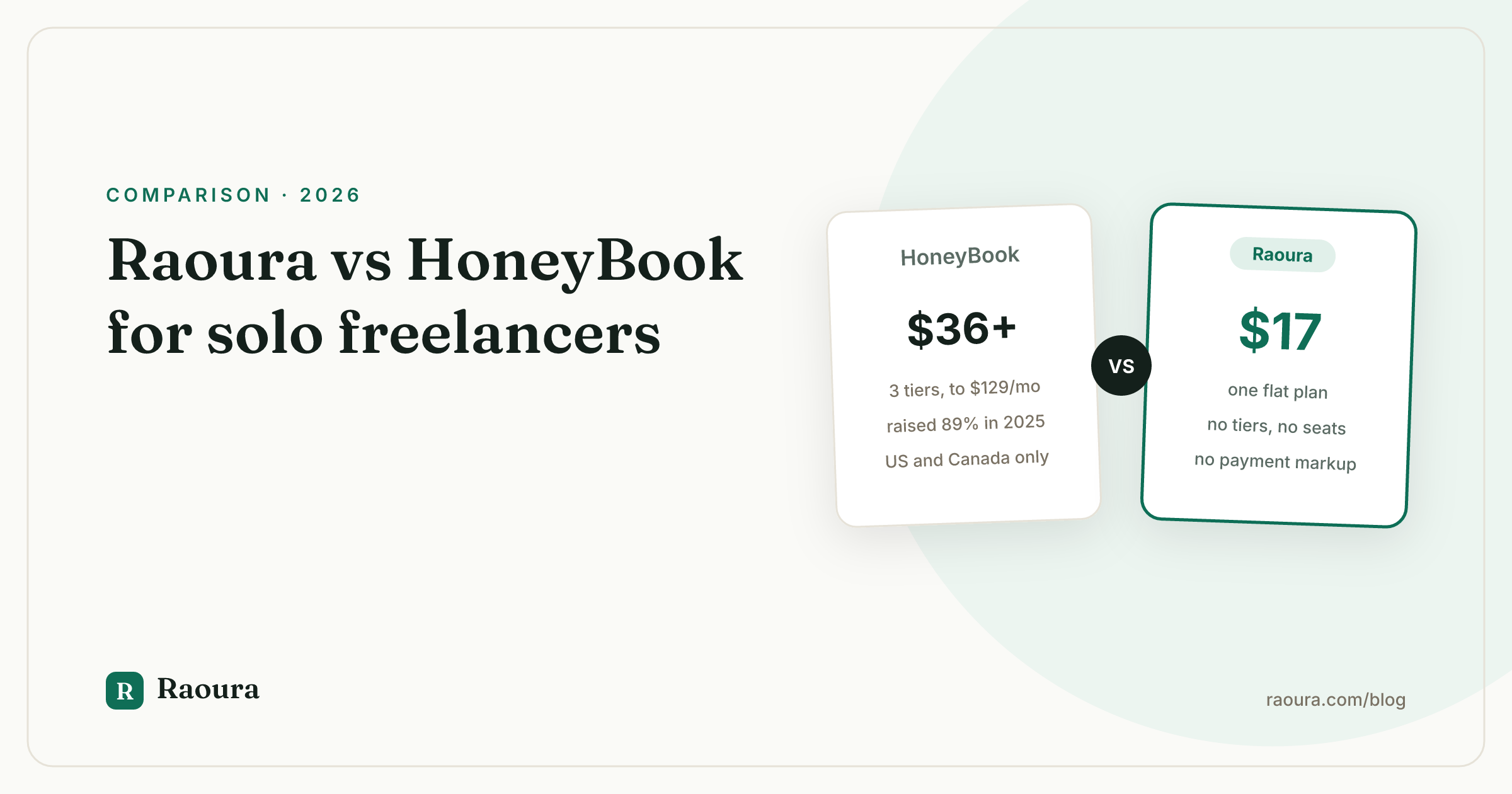
TL;DR: Raoura costs $17 per month on one flat plan, with no markup on payment processing. HoneyBook starts at $36 per month after its February 2025 price increase and charges 2.9% plus 25 cents on card payments. If you are a solo freelancer who needs proposals, contracts, invoicing, projects, and a client portal, Raoura covers all of it for less than half the price. If you need built-in scheduling, a template marketplace, and a big community, HoneyBook is the more built-out platform.
If you freelance solo, you have probably had the HoneyBook conversation with yourself at least once. It is the best-known client management platform in the creative space, and it earned that position. But in February 2025, HoneyBook raised prices by as much as 89.5%, and a lot of solo freelancers started doing math they had not done in years.
Raoura is one of the tools people land on when they do that math. We built it, so read this with that in mind. We are going to be specific, cite sources for every pricing claim, and tell you plainly where HoneyBook beats us. Raoura is new, so we will not wave around review scores or customer counts we do not have. What we can do is compare what each tool actually does and what it actually costs.
Side-by-side comparison#
| Raoura | HoneyBook | |
|---|---|---|
| Pricing | $17/mo, one flat plan | $36/mo Starter, $59/mo Essentials, $129/mo Premium (annual billing is lower), as of mid-2026 |
| Free trial | 14 days, no credit card required | 7 days |
| Fees on payments | No markup. Stripe's processing fee passed through at cost | 2.9% + 25c per card transaction, 1.5% ACH, as of mid-2026 |
| Proposals | Templates plus AI drafting | Yes, plus a template marketplace |
| Contracts | E-signature included | E-signature included |
| Invoicing | Line items, tax, discounts, multi-currency, deposits, partial payments, payment plans, automatic overdue reminders | Yes, with payment plans and reminders |
| Client portal | Branded, magic-link login, no client passwords | Yes, client portal included |
| Projects | Projects with client-approvable milestones | Project and pipeline management |
| Team seats | No. Solo only, on purpose | Yes, on higher tiers |
| Scheduling | No | Yes, built-in scheduler |
| Availability | Anywhere Stripe works, multi-currency invoicing | US and Canada only |
| Learning curve | Designed to be set up in an afternoon | Moderate. Powerful, but there is a lot of surface area |
Pricing sources: Taskip's HoneyBook pricing breakdown and AgencyHandy's HoneyBook pricing review, both current as of mid-2026.
Price, and whether you can trust it to stay put#
Let us start with the numbers, because they are the reason most people are reading this.
Raoura costs $17 per month on one flat plan. There are no tiers, no feature gates, and no markup on payments. Every feature Raoura has, every customer gets.
HoneyBook, as of mid-2026, has three tiers: Starter at $36 per month, Essentials at $59, and Premium at $129, with discounts for annual billing, per Taskip and HoneyBook's own pricing page. Those numbers arrived in February 2025, when Starter jumped from $19 to $36, an increase of roughly 89.5%, with Essentials up 69% and Premium up 63%, per AgencyHandy.
That price hike matters beyond the dollar amount. When a platform nearly doubles its entry price in one move, it tells you something about how it thinks about existing customers. HoneyBook has been repositioning itself as an AI-first business platform, and the new pricing reflects a company chasing a bigger, more upmarket product. That may be great for HoneyBook. It is less obviously great for a solo freelancer who signed up for a $19 tool.
Raoura's pricing model is deliberately boring: one plan, one price, everything included. We think a tool for solo freelancers should cost like a tool for solo freelancers.
The gap over a year: Raoura is $204. HoneyBook Starter is $432 at the monthly rate, as of mid-2026. That difference is a decent camera lens, a conference ticket, or two months of your phone bill.
Day-one setup#
HoneyBook gives you a lot to configure: pipelines, automations, scheduling, brand files, templates. That flexibility is genuinely useful once it is set up, but the first week can feel like a part-time job. The template marketplace helps, and the community has produced years of setup guides, which tells you both that help exists and that people need it.
Raoura is built around the opposite bet: a solo freelancer should be sending their first proposal the same afternoon they sign up. You connect your website and Raoura pulls your brand (logo, colors) so your proposals and portal match your site without design work. Proposal templates and AI drafting get you from blank page to reviewable draft quickly. Raoura includes AI credits for this: 10 per month on the trial and 30 per month on the paid plan, with top-up packs at 25 credits for $5 or 100 for $15.
There is no pipeline builder to configure, because there is no pipeline. That is a real limitation if you run heavy lead-gen, and a relief if you just want to stop managing your business out of email threads.
Getting paid#
This is where the pricing difference compounds quietly.
HoneyBook processes payments itself and charges 2.9% plus 25 cents per card transaction and 1.5% for ACH bank transfers, as of mid-2026, per Taskip. To be fair, those card rates are in line with industry norms, and HoneyBook's payments experience is polished. But the fees are HoneyBook's rates, set by HoneyBook, on top of a subscription that already went up 89.5% once.
Raoura does not take a cut of your payments. You connect your own Stripe account, Stripe's processing fee is passed through at cost, and Raoura adds nothing on top. Your payment costs are between you and Stripe, and they do not change because our pricing team had a meeting.
On invoicing features, Raoura covers the full solo workflow: line items, tax, discounts, multi-currency, deposits and partial payments, payment plans, and automatic overdue reminders. The multi-currency support matters more than it sounds: HoneyBook is only available to businesses in the US and Canada, as of mid-2026, per AgencyHandy. If your clients are in London or Sydney, or you are, that ends the comparison on its own.
The client experience#
Your clients do not care what software you use. They care whether working with you feels organized.
Both tools give clients a portal. HoneyBook's client experience is mature and well tested across millions of projects. Raoura's portal is branded to you (matched from your website), and clients sign in with a magic link, no password to create or forget. For proposals and contracts, clients review and e-sign in the same place. For projects, Raoura has client-approvable milestones, so "is this approved?" becomes a button click with a record, not an email you have to dig up later.
One honest note: HoneyBook's scheduler means clients can book calls with you inside the same system. Raoura does not do scheduling, so you will keep your Calendly or whatever you use today. We think that is fine, because those tools are excellent and often free, but it is one more tab, and you should know that going in.
Where HoneyBook is genuinely better#
We would rather you hear this from us than discover it after switching.
- Scheduling is built in. Session booking, availability, reminders. Raoura has none of this.
- The template marketplace is real leverage. Years of contributed templates for photographers, planners, and designers. Raoura ships its own templates plus AI drafting, but there is no marketplace.
- Lead pipelines. If you run inquiries through a structured pipeline with automations, HoneyBook does that well. Raoura deliberately does not have a lead pipeline.
- Team features. If you have an assistant or a second shooter, HoneyBook's higher tiers handle that. Raoura has no team seats at all.
- Community and ecosystem. Facebook groups, educators, setup consultants. When you get stuck, someone has been stuck there before you.
- Payments ecosystem. Instant deposits and financial tools that Raoura does not offer.
If several items on that list are things you use weekly, HoneyBook is worth its price for you, and you should stay.
Who should pick which#
Pick HoneyBook if:
- You book clients into scheduled sessions and want the scheduler in the same tool
- You run a structured lead pipeline with automations on inquiries
- You have (or plan to have) team members
- You want a big template marketplace and an active community
- You are US or Canada based and price is not your deciding factor
Pick Raoura if:
- You are one person and expect to stay that way
- Your workflow is proposals, contracts, invoices, projects, and a client portal, and you want exactly that with nothing to configure around
- You want one flat price ($17/mo) instead of tiers, and no markup on payments
- You invoice in multiple currencies or work outside the US and Canada
- You are tired of paying for pipelines, scheduling, and team features you never open
Run your client work in one place
Send a proposal, get it signed, invoice, and get paid, with a branded portal your clients will actually use. One flat plan at $17/month, and we never take a cut of your payments.
Try Raoura free for 14 daysNo credit card required. Set up in minutes.
Keep reading
Late Fees for Freelancers: What Is Legal and What Actually Works
The standard freelance late fee is 1.5% per month, but almost everything else you have read about late fees is either vague or wrong. Here is what state law actually allows (with the statutes and court cases linked), the exact clause wording that holds up, the invoice data on whether late fees work, and the three states where the law now does the collecting for you.
How to Get Clients to Pay Invoices on Time: Scripts, Deposits, and a System That Works
Roughly 85% of freelancers get paid late at least sometimes, and most of us just eat it. Here is the prevention system, the exact escalation emails to copy, and what to do when a client goes fully silent.
Leaving Upwork: A 90-Day Plan to Go Direct
Rage-quitting Upwork costs you money. Leaving it in stages does not. Here is a dated 90-day plan: audit which clients you can legally take with you, build a direct pipeline while the platform still pays your bills, and replace escrow with contracts and deposits.