Late Fees for Freelancers: What Is Legal and What Actually Works
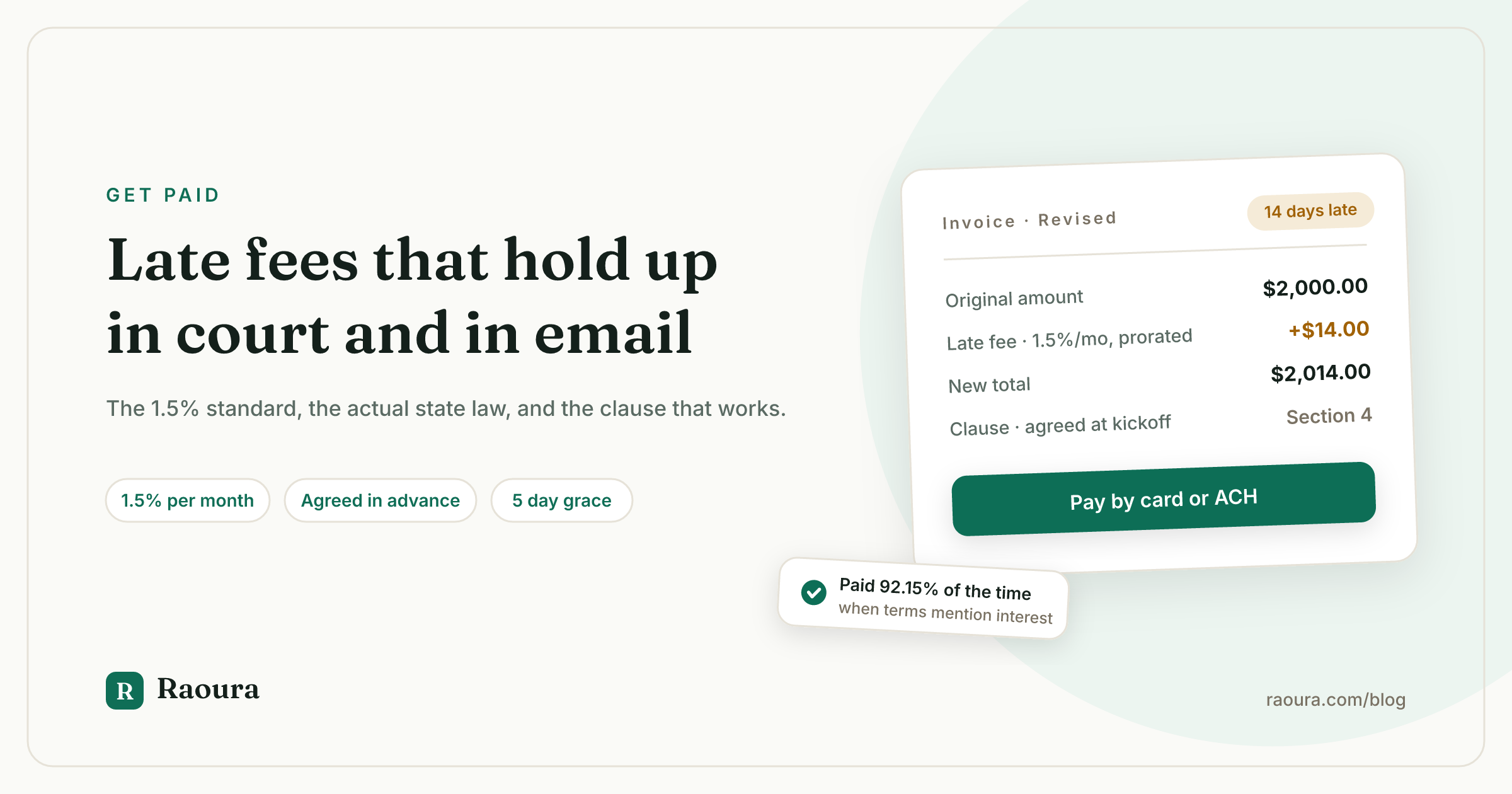
A late fee is the most misunderstood sentence in a freelance contract. Most advice about it is confidently vague: charge "1 to 2%," check "your state's usury laws," and hope. Meanwhile the actual questions go unanswered. Is the fee even enforceable? Is there really a state cap? Does charging one make clients pay faster, or just make them annoyed?
The stakes are not hypothetical. Intuit QuickBooks' January 2025 survey of 2,487 small businesses found 56% are owed money on unpaid invoices, averaging $17,500 each, and 47% have invoices more than 30 days overdue. Bonsai's analysis of invoices from 100,000+ freelancers found 29% are paid at least a day late. Late payment is the normal condition of freelancing, and the late fee is the one deterrent you control entirely.
This guide gives you the numbers, the actual law with primary sources (statutes and court decisions, not another uncited state table), the data on whether fees work, and the exact wording to use. Everything was checked in July 2026.
How much should a freelance late fee be?#
The standard freelance late fee is 1.5% of the invoice amount per month, which works out to 18% per year. That figure shows up consistently across the invoicing platforms that see real data: FreshBooks calls 1.5% per month the common approach among freelancers and service businesses, QuickBooks puts the typical range at 1 to 2% of the past-due amount per month, and Keeper lands on the same 1.5% norm.
You have three ways to structure it:
| Structure | Example | Annualized cost to the client | Best for |
|---|---|---|---|
| Percentage per month | 1.5% per month: $30 per month on a $2,000 invoice | 18% per year | The default for most freelance work |
| Flat fee | $25 added once the invoice is 7 days overdue | Not applicable | Small invoices where a percentage is pocket change |
| Flat fee, then percentage | $25 at 7 days overdue, then 1.5% per month from day 30 | Varies | Larger projects with slow-paying clients |
The flat-then-percentage hybrid exists because percentages fail at small scale. On a $400 invoice, 1.5% is $6 a month, which deters nobody. A $25 flat fee is felt. On a $12,000 invoice the positions reverse: QuickBooks' own worked example shows 1% monthly adding $120 per month, which is real money, while a flat $25 would be a rounding error.
Here is the arithmetic nobody runs, and it changes how you should think about the whole topic. Bonsai's invoice data shows over 75% of late invoices are paid within 14 days of the due date. On a $2,000 invoice with a 1.5% monthly fee prorated daily, 14 days of lateness earns you about $14. That is our own math on Bonsai's figures, and the conclusion is blunt: a late fee will never be meaningful income. Its entire value is as a deterrent sentence, and as you will see in the data section, the sentence happens to work.
Whatever structure you pick, make the interest simple, not compounding. Charge the percentage on the original invoice amount each month, not on the invoice plus accumulated fees. Compounding is harder to defend in court, harder to explain to a client, and the extra dollars are trivial anyway.
Is a late fee even legal? Yes, if you clear three bars#
A freelance late fee is legal in every US state as long as it was agreed in writing before the work started, and courts have upheld rates of 1.5% per month. The widespread advice to "check your state's usury cap" is mostly a red herring, and the pages repeating it never cite a statute. Here is what the law actually says.
Bar one: the fee must be agreed in advance. This is the rule that actually voids late fees in practice. New York's Department of Financial Services put it plainly in a 2000 interpretation letter: a late charge is liquidated damages, and "it cannot be enforced absent an express or implied agreement providing for its existence." The client must know about the fee before incurring the obligation. You cannot invent a fee when an invoice goes overdue, and you cannot add one to a contract retroactively. It goes in the contract and on every invoice, or it does not exist.
Bar two: the fee must be compensation, not punishment. Contract law enforces liquidated damages (a reasonable pre-estimate of what the delay costs you) and voids penalties. A proportionate percentage passes easily. A fee that dwarfs the invoice does not: $100 stacked onto a $150 invoice looks like punishment to a judge, while $250 in accumulated fees on a $5,000 invoice looks like compensation. If your fee would make a stranger wince, it is too high.
Bar three: stay inside the real outer bounds, which are higher than you think. This is where the usury myth dies. Usury laws cap interest on loans. Two of the biggest freelance states have ruled that a late fee on an unpaid invoice is not a loan:
- The California Supreme Court held in Southwest Concrete Products v. Gosh Construction (1990) that "interest payments on overdue commercial accounts are not subject to the usury law." The contract in that case charged exactly 1.5% per month, and it was upheld. Your standard rate is court-tested in California.
- New York's DFS says the same in the letter above: the state's 16% civil usury limit "only applies in cases in which there is intent to lend money, not to a late charge." The letter does warn that a rate above 25% per year could run into New York's criminal usury statute, so treat 2% per month as the practical ceiling there.
So the honest summary is: no meaningful state cap stops you from charging 1.5% per month, the pre-agreement requirement is what actually trips freelancers up, and reasonableness is the test a court applies if a client ever fights the fee.
State rules worth knowing (with actual citations)#
Of the five biggest freelance states we checked statute by statute, only Texas gives you late payment interest without a clause: 6% per year starting on day 30. Everywhere else, no clause means no fee. The state-by-state late fee tables that rank for this query contradict each other and cite nothing, so here is a table you can trace to a primary source in every row.
| State | What the law actually says | Practical takeaway |
|---|---|---|
| New York | Late fees are liquidated damages, not loans; the 16% usury cap does not apply, but rates above 25% per year risk the criminal usury statute (NY DFS interpretation letter) | 1.5 to 2% per month is safe; do not exceed 2% |
| California | Usury law does not apply to overdue commercial accounts; 1.5% per month upheld by the state Supreme Court (Southwest Concrete v. Gosh, 1990) | 1.5% per month is court-tested |
| Texas | With no agreed rate, you may charge 6% per year starting on the 30th day after the amount is due (Tex. Fin. Code 302.002) | A statutory fallback exists, but your own clause beats it |
| Florida | Contracts for interest on loans above 18% per year are usurious (Fla. Stat. 687.02); whether that reaches invoice late fees is unsettled | Keep to 1.5% per month and the question never comes up |
| Washington | Businesses cannot plead usury at all in commercial transactions (RCW 19.52.080) | Reasonableness is the only test |
For contrast, the UK settled this question by statute: business clients there owe 8% plus the Bank of England base rate on late B2B invoices automatically, which is 11.75% per year at the current 3.75% base rate. The US has no federal equivalent, which is exactly why your contract clause has to do the work.
The three states where the law now collects for you#
If your client is in New York, Illinois, or California, late payment now triggers double damages under state law, which is worth far more than any late fee. These freelance payment laws are recent, and none of the pages ranking for late fee queries mention them:
- New York: the Freelance Isn't Free Act went statewide on August 28, 2024. Contracts of $800+ must be written; payment is due by the contract date or within 30 days of finishing the work; a freelancer who sues for nonpayment and wins is entitled to double damages plus attorney fees, and can also file a free complaint with the state Attorney General.
- Illinois: the Freelance Worker Protection Act covers contracts of $500+ since July 1, 2024, requires payment within 30 days of completing the work, and provides double the underpayment plus attorney fees in a civil action.
- California: SB 988 applies to contracts of $250+ from January 1, 2025, sets the same 30-day default payment deadline, and allows damages up to twice the unpaid amount plus attorney fees.
This changes the role of your late fee in those states. The fee is the polite deterrent on the invoice. The statute is the hammer you mention when the deterrent fails. A one-line email noting that the invoice is now covered by the Freelance Isn't Free Act, and that the statute provides double damages and attorney fees, concentrates minds in a way 1.5% never will.
Do late fees actually work? The data says yes, with one honest caveat#
Invoices whose payment terms mention interest get paid 92.15% of the time, versus 78.62% for invoices overall, a 13.5 point lift. That is from FreshBooks' analysis of more than one million invoices sent through its platform over a year, and it is the only large-scale published evidence on this question. "Interest" was the single most effective word the study found in invoice terms.
Note what that finding is and is not. It measures whether the invoice ever gets paid, not how fast. No published dataset shows late fees shortening days-to-pay, and any page telling you fees reliably speed up payment is guessing. The speed levers in the same FreshBooks study are different ones: invoices on 7-day terms were paid within a week 58% of the time versus 40% for 30-day terms, and vague "due upon receipt" wording underperformed concrete dates. We cover that side of the system in payment terms that get you paid in days, not months.
The practical reading of the data, combined with the sandwich-money arithmetic from earlier: the late fee's power is almost entirely in its presence, not its collection. The sentence signals that you run a real business and that ignoring the invoice has a defined consequence. You get that 13.5 point effect the day you add the sentence, whether or not you ever charge a dollar of it.
The exact wording and the workflow around it#
A working late fee needs one clause in the contract, one line on the invoice, and a 5 day grace period before you apply it. None of the top-ranking pages hand you language with the legal bars from above built in, so here is a version to adapt.
In the contract:
Invoices are due within 7 days of the invoice date. Balances unpaid more than 5 days after the due date accrue a late fee of 1.5% of the invoice amount per month (18% per year), simple and non-compounding, prorated daily until paid. This fee is liquidated damages for the cost of delayed payment, not a penalty, and [Client] agrees it is a reasonable estimate of that cost.
On every invoice:
Payment due within 7 days, by [date]. Balances more than 5 days past due accrue a late fee of 1.5% per month, per our agreement dated [date].
Then run it like a system, not a mood:
- Say it out loud at kickoff. One sentence when you send the contract ("standard late fee clause in section 4, it never applies to anyone who pays on time") means it is never a surprise. Surprise is what makes clients fight fees.
- Give the grace period you promised. A fee applied on day one of lateness reads as a trap. Five days is the common convention, and most states do not legally require any grace period, so this is goodwill you get credit for.
- Apply it with a revised invoice, not a threat. When the grace period lapses, send an updated invoice with the fee as its own line item and one neutral sentence: "This invoice now includes the late fee provided in our agreement." The reminder emails around it are covered in our guide to getting clients to pay on time.
- Waive it once, strategically, in writing. For a good client who is late one time, "I have waived the late fee this once" converts the fee into relationship credit while confirming it exists and will apply next time. A fee you waive deliberately is leverage; a fee you never mention is fiction.
- Never apply a fee you never disclosed. If your current contracts have no clause, you cannot start charging existing clients mid-project. Add the clause to new contracts and to renewals (Texas freelancers have the 6% statutory fallback from the table above, everyone else has nothing).
The reason most freelancers never collect a late fee, though, is not law or wording. It is that applying one requires noticing the invoice is overdue, recalculating the total, editing the invoice, and being the bad guy, four small tasks that all compete with billable work. This is a place where software earns its keep: Raoura tracks due dates, applies your agreed late fee automatically after the grace period, and reissues the invoice with the fee as a line item, so the policy enforces itself while you stay the reasonable human in the email thread. Disclosure: Raoura is our product.
A late fee is also the last line of defense, not the first. A deposit means less of your money is ever at risk (we cover how much deposit to charge separately), short payment terms move the whole timeline earlier, and the fee handles the residue. The full contract context is in what should be in a freelance contract.
When the fee is not enough#
If an invoice passes 30 days overdue, stop relying on the fee and start escalating: reminders, a pause on work, a statutory complaint where available, then small claims court, which handles disputes from $2,500 up to $25,000 depending on the state. Those limits come from Nolo's 50-state small claims survey; California allows individuals up to $10,000 and Texas up to $20,000, which covers most freelance invoices without a lawyer. In New York, Illinois, and California, the freelance payment laws above give you a cheaper step first: a statutory claim with double damages and attorney fees, which usually makes the demand letter self-enforcing.
The full escalation sequence deserves its own article and gets one soon. For the statistics that put your situation in context (how late is normal, how much freelancers are typically owed, how often invoices are never paid at all), see our freelance late payment statistics hub.
Run your client work in one place
Send a proposal, get it signed, invoice, and get paid, with a branded portal your clients will actually use. One flat plan at $17/month, and we never take a cut of your payments.
Try Raoura free for 14 daysNo credit card required. Set up in minutes.
Keep reading
How to Get Clients to Pay Invoices on Time: Scripts, Deposits, and a System That Works
Roughly 85% of freelancers get paid late at least sometimes, and most of us just eat it. Here is the prevention system, the exact escalation emails to copy, and what to do when a client goes fully silent.
The Unpaid Invoice Escalation Ladder: What to Do When a Client Won't Pay
A client who won't pay is not one problem, it is five decisions in a row: when to remind, when to stop work, when to send a demand letter, when to invoke the new double-damages freelance laws, and when to sue or walk away. Here is the full ladder with the real cost, timing, and recovery odds of every rung, verified against primary sources in July 2026.
The Real Cost of Upwork in 2026: A Full-Year Breakdown of the 0-15% Fee, Connects, and Everything Else
Upwork's fee page says 0-15% and stops. We built the full-year math for a solo freelancer: the variable service fee, Connects and boosting, the Plus subscription, withdrawal fees, the 10-day payment lag, and the $8,424 exit toll. On a $60,000 year, the gap between Upwork and running your own clients is four to seven thousand dollars.