Dubsado 3.0 Problems: What Broke, What Got Fixed, and When to Leave
If you logged into Dubsado one morning in late 2025 and found a completely different product, you were part of the biggest platform transition in the company's history. Dubsado 3.0 rolled out to existing users in waves between November 17 and 21, 2025, a ground-up rebuild that replaced Workflows with a visual builder called Flows, added a new inbox, and redesigned nearly every screen you knew.
Eight months later, here is the strange part: as of July 12, 2026, Dubsado's own login page still describes 3.0 as "the beta" and "an optional opt-in at the moment", while the version most long-time users built their businesses on is now labeled "legacy 2.0". You are being asked to run your client work on a beta, or to stay on a platform that no longer receives feature releases.
Search results for "Dubsado 3.0 problems" do not resolve this. The most-cited review froze in February 2026. The freshest ranking page is a competitor pitch with a scrambled review table.
So we did the tedious thing: we reconciled the documented launch complaints against every entry Dubsado published to its public changelog from March 26 through June 26, 2026, plus Dubsado's own 2026 statements. This article covers what broke, what got fixed, what is still missing, where the 2.0 sunset actually stands, and a straight framework for deciding whether to embrace 3.0, wait on 2.0, or take the disruption as your exit.
What Dubsado 3.0 actually changed#
Dubsado 3.0, rolled out from November 17, 2025, rebuilt the entire interface: a new Home dashboard, a Messages inbox, a drag-and-drop Flows automation builder, board-style project views, and app-wide time tracking, with all new trials starting on 3.0 only.
The core mechanics did not change as much as the screens did. Certified Dubsado Specialist Colie James, whose 3.0 review is the most thorough independent account of the launch, described the Flows builder as a visual reskin of the old workflow engine: "No new triggers. No new actions. Same functionality." Your data, templates, forms, and canned emails transferred automatically, and Dubsado let existing users run 2.0 and 3.0 side by side through separate login URLs, which is still true today (2.0 at hello.dubsado.com, 3.0 at app.dubsado.com).
Pricing moved at the same time. New subscribers since December 1, 2025 pay $35 per month for Starter and $55 per month for Premier, or $335 and $525 per year on annual billing, with a 21-day full-access trial and no credit card required. Subscribers from before that date keep their old rates, and 3.0 is included at no extra cost. If the price change is your bigger concern, our Dubsado alternatives comparison covers that math in detail.
The five features missing at launch, and where they stand now#
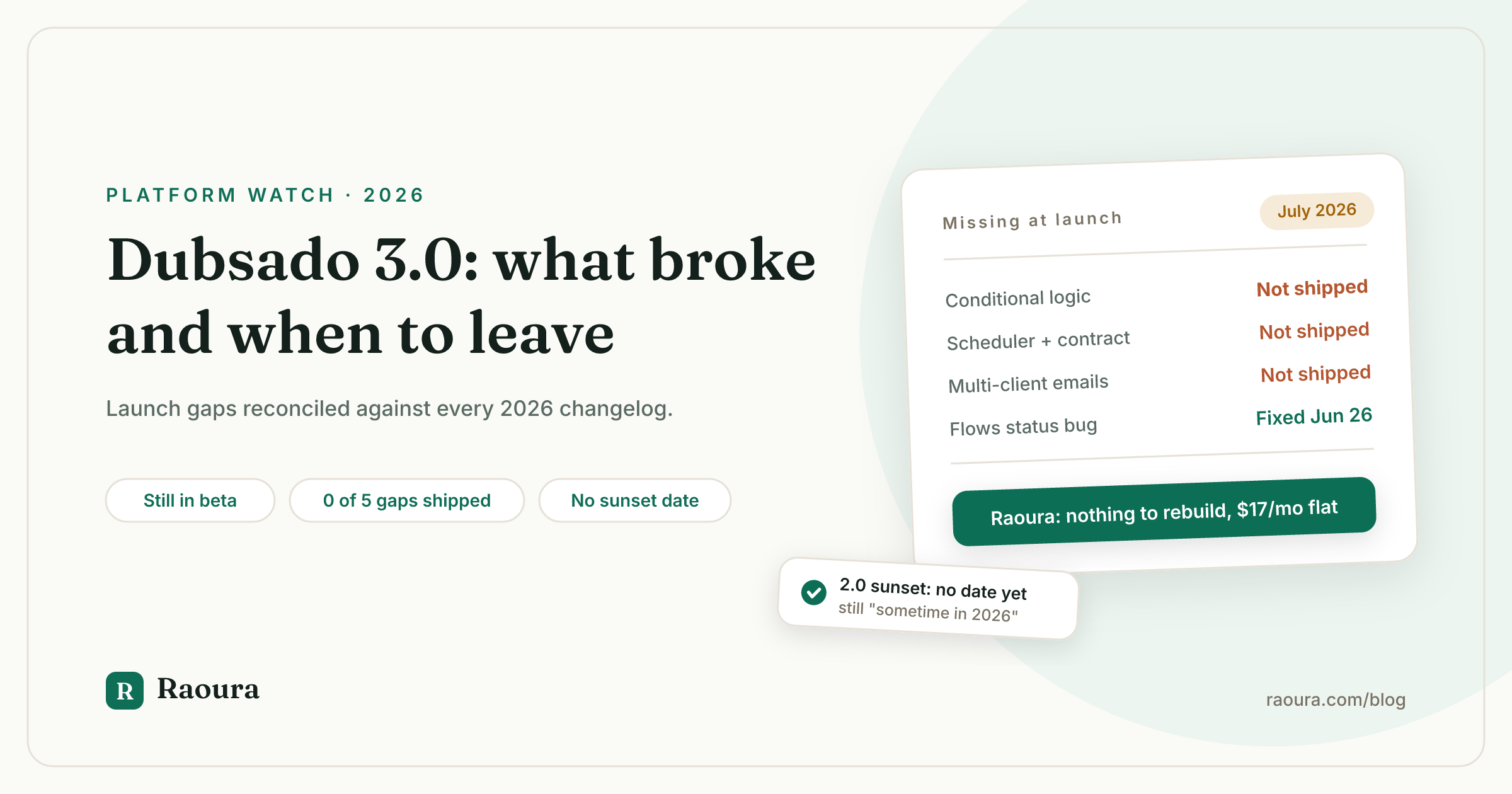
As of July 2026, none of the five feature gaps documented at the November 2025 launch appear in any of Dubsado's published 2026 release notes.
Colie James documented five specific things 3.0 could not do at launch, several of which were long-standing 2.0 requests the rebuild was expected to address. Dubsado announced on Threads, as cited in her review, that conditional logic, SMS messaging, multi-client projects, and global brand settings were in progress. We checked each gap against every release Dubsado published to its public changelog between March 26 and June 26, 2026. Here is the reconciliation:
| Missing at launch (Nov 2025) | Status in July 2026 | What shipped instead |
|---|---|---|
| True conditional logic in Flows | Not shipped | Flow bug fixes and active-hours validation (Jun 26) |
| Booking a scheduler and contract in one step | Not shipped | Prevent Rescheduling toggle (Apr 14) |
| Appointment dates syncing to project dates | Not shipped | Rebuilt external calendar sync (May 8) |
| Emailing two clients on one project via Flows | Not shipped | Bulk email to up to 100 recipients, capped at 25 per minute and 400 per day (Mar 26) |
| Separate team calendars and emails | Not shipped | 2.0-to-3.0 team data visibility bridge (Jun 26) |
That table is the original observation of this article, and it is the one thing no ranking page tells you: the rebuild changed how Dubsado looks faster than it changed what Dubsado can do. The features that did ship in 2026 are real (more on those below), but if one of these five gaps is the reason you were waiting on 3.0, it had not closed as of this writing. Verify against updates.dubsado.com before you commit either way.
The bugs Dubsado itself confirmed#
Dubsado's own 2026 changelogs confirm and fix multiple Flows bugs, including installment payments displaying as "undefined" (April 15) and untriggered flow actions incorrectly showing as completed (June 26).
You do not need angry forum posts to establish that 3.0 shipped rough; Dubsado's release notes do it in the company's own words. A sample from the public changelog:
- April 15, 2026: fix for installment payments in Flows "displaying as 'undefined'", plus a PayPal toggle fix.
- May 8, 2026: a 48-item changelog, including a rebuilt external calendar sync and a fix for a workflow "expired" error.
- June 26, 2026: fix for the Flow action status bar, where "untriggered flow actions were incorrectly showing up as completed."
Read that last one again if you run your client onboarding through Flows: for some period before June 26, the interface could tell you an automation step had run when it had not. For a solo business, that is the difference between a client getting their contract and you finding out three weeks later that nobody did.
To Dubsado's credit, it now operates an in-app Known Issues tracker (published April 23, 2026) with statuses for todo, in progress, coming soon, and resolved. None of the pages ranking for this search mention it, and it is the single most useful thing to check before you move your business to 3.0: it is Dubsado's own live list of what is currently broken.
The softer complaints have mostly aged out. The buried revenue tracker that dominated launch-week discussion was fixed quickly, per Colie James's update. The board-style project view still draws criticism: specialist Ema Katiraee, whose 3.0 feature log was still being updated in July 2026, notes it "takes up more space and requires quite a bit of scrolling."
Is Dubsado 2.0 going away? The sunset question#
As of July 12, 2026, Dubsado has announced no specific sunset date for 2.0, saying only that it will retire "sometime in 2026" with advance notice, while 2.0 receives no new feature releases.
This is the question underneath every other question, because the safest launch-week advice ("just stay on 2.0 until 3.0 stabilizes") has a clock on it. Here is everything Dubsado has said publicly, in order:
- The 3.0 announcement page: "We'll be sunsetting 2.0 sometime in 2026, but you'll get plenty of advance notice before that happens." It also confirms 2.0 "will not receive further feature releases."
- Dubsado's llm-info page, last updated May 2026: "Dubsado 2.0 will be sunset sometime in 2026 with advance notice provided to all users," and all future feature development is "built exclusively in 3.0."
- The login page, as of July 12, 2026: 3.0 is still "an optional opt-in at the moment."
So the official position is a 2026 sunset, and more than half of 2026 is gone without a date. Katiraee hedges her own estimate to "sometime in 2026 or 2027," but that is a specialist's read, not an announcement.
The practical takeaway: staying on 2.0 is still possible and still supported day to day, but it is a lease that can be terminated with "advance notice" of unspecified length, on a platform that stopped improving in November 2025.
Treat any workflow you rebuild in 2.0 as work you will do twice.
Standalone fact worth keeping: Dubsado 3.0 was still labeled a beta and an optional opt-in on Dubsado's own login page eight months after rollout, as of July 12, 2026.
What 3.0 got right (because the ledger has two sides)#
Between March and June 2026, Dubsado shipped at least six substantial 3.0-only features, including a redesigned invoice builder, AI form creation, and a call-recording Notetaker.
If you read only complaint threads you would miss that 2026 has been Dubsado's most productive feature run in years, all of it exclusive to 3.0, per the changelog:
- Project Suggestions plus expanded bulk actions and bulk email (March 26)
- A Prevent Rescheduling toggle for schedulers (April 14)
- Template tags and archiving (April 23)
- A redesigned invoice builder, permanent for all 3.0 users after June 16 (May 27)
- AI Easy Form Creation, available only on 3.0 (June 2)
- A Notetaker that records and transcribes client calls, on all plans (June 11), plus a public checkout page rolling out through the new Dubsado Labs program (June 4)
This is the honest tension of the whole situation. Dubsado, which claims 120,000+ users and 30,000 paying customers, is visibly investing in 3.0. The product is getting better month over month.
It is also, simultaneously, a self-described beta with a live known-issues tracker and a five-item list of launch gaps that had not closed by July. Both things are true, and which one matters more depends entirely on how much of your business runs through the parts still marked "in progress."
Switch, stay, or leave: a decision framework#
There are only three moves available to a Dubsado user in mid-2026, and the right one depends on whether your automations are load-bearing.
Switch to 3.0 now if your Dubsado use is forms, invoices, contracts, and scheduling, with little or no Flows automation. The launch bugs that mattered most lived in Flows. Everything else is where the 2026 improvements landed, you will have to move eventually, and learning the new interface on your own schedule beats learning it during a forced migration. Check the Known Issues tracker first, and spot-check any Flow you do keep against its actual behavior, not its status bar.
Stay on 2.0 for now if you run deep, working automations and none of the shipped 3.0 features solve a problem you have. Specialist Emma Wilkens's launch-week advice, wait until things feel stable, was reasonable then and the login page's "beta" label says it has not fully expired. But set a calendar reminder to re-check the sunset status quarterly. You are not choosing "keep my setup forever"; you are choosing "defer the rebuild," and the deferral window is officially supposed to close this year.
Take the exit if the honest audit says you never finished your Dubsado setup anyway, or the thought of rebuilding your workflows in Flows fills you with dread rather than interest. A platform transition is the cheapest possible moment to leave: your data exports the same either way, and the rebuild effort you are being asked to spend on Flows could set up an entire simpler tool instead. We wrote a weekend migration guide covering exactly what Dubsado lets you export and what must be copied out by hand, and if you were only ever using a fraction of Dubsado, the setup-cost math explains why that fraction was so expensive to configure.
This third path is where our bias lives, so here is the disclosure up front: Raoura is our product. We built it for exactly the person who reads a changelog reconciliation like this one and realizes they do not want to be a platform migration project manager. Raoura is client and project management for solo freelancers at $17 per month flat: proposals, contracts, invoices, projects, and a client portal, with no versions to choose between and nothing to rebuild.
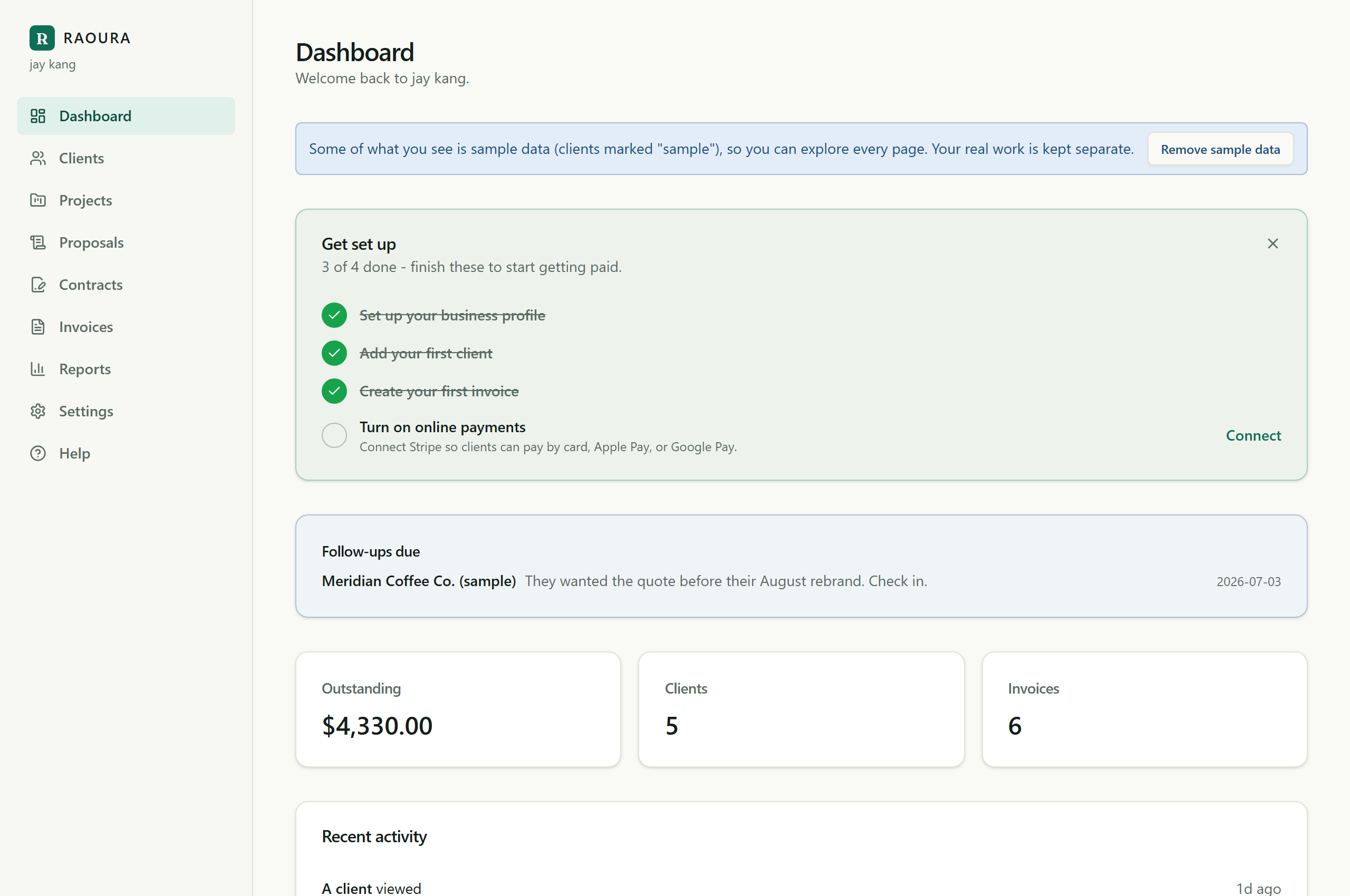
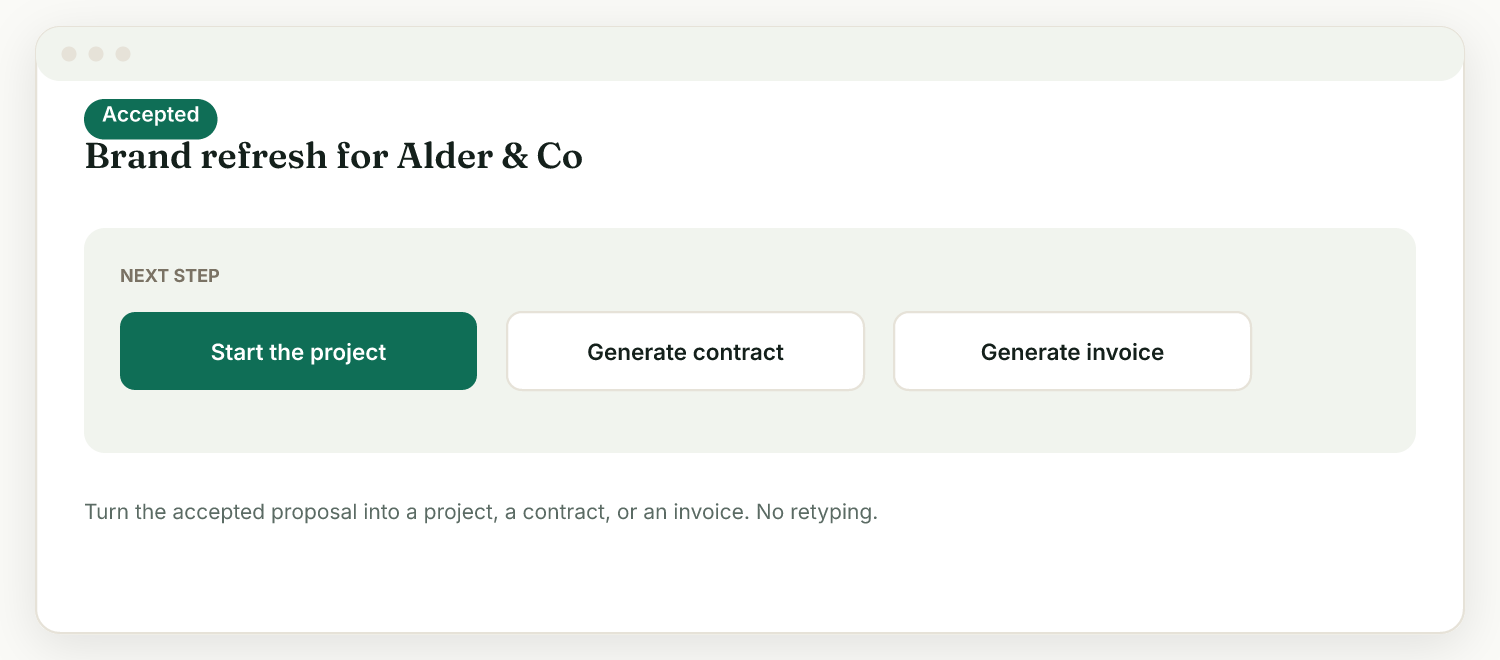
The philosophical difference matters more than the price. Dubsado's power comes from automation you construct; when the automation layer wobbles, as the 2026 changelogs show it did, the wobble is in your critical path. Raoura's flow is built in rather than built by you: an accepted proposal offers to generate the contract and the invoice with the details already carried over.
If you want the full feature-by-feature comparison, that lives in Raoura vs Dubsado.
Frequently asked questions
Is Dubsado 3.0 still in beta?
By Dubsado's own labeling, yes. As of July 12, 2026, the login page calls 3.0 "the beta" and "an optional opt-in at the moment" for existing users, eight months after the November 2025 rollout. New trials and new subscribers get 3.0 only.
Can I still use Dubsado 2.0?
Yes. Existing users can run 2.0 and 3.0 side by side with data transferring automatically: 2.0 at hello.dubsado.com and 3.0 at app.dubsado.com. But 2.0 receives no new features and Dubsado says it will be sunset "sometime in 2026" with advance notice.
When exactly will Dubsado 2.0 shut down?
No specific date has been announced as of July 12, 2026. Dubsado's published statements say only "sometime in 2026" with "plenty of advance notice." Check dubsado.com/three-point-o and the changelog for updates.
Did Dubsado 3.0 add conditional logic to Flows?
Not as of July 2026. Conditional logic was missing at launch and announced as in progress, but it does not appear in any 2026 release note through June 26. The Flows builder launched with the same triggers and actions as 2.0 workflows in a new visual interface.
What bugs did Dubsado 3.0 have?
The ones Dubsado itself confirmed and fixed in 2026 changelogs include installment payments displaying as "undefined" in Flows, a workflow "expired" error, calendar sync problems that led to a full rebuild of external calendar sync, and untriggered flow actions incorrectly showing as completed. Current issues are listed on Dubsado's Known Issues tracker.
Does Dubsado 3.0 cost more?
The rebuild itself is included for existing subscribers at their old rates. New subscribers since December 1, 2025 pay the higher prices that took effect alongside the launch: $35 per month Starter, $55 per month Premier, or $335 and $525 per year.
The short version#
Dubsado 3.0 shipped in November 2025 as a visual rebuild with the same automation engine, spent 2026 fixing confirmed Flows bugs while shipping six genuinely useful features, and still had not closed its five documented launch gaps or named a 2.0 sunset date by July 2026, all while its own login page called it a beta. If your automations are load-bearing, stay on 2.0 with a quarterly check on the sunset. If they are not, switch calmly and check the known-issues list first. And if this whole saga reads like more platform management than a business of one signed up for, that is a fair conclusion: Raoura runs the solo client workflow for $17 flat per month with nothing to rebuild, ever. Disclosure: Raoura is our product.
Try Raoura free for 14 days at raoura.com. Bring one real client and see how far you get before dinner.
All prices, dates, changelog entries, and feature statuses verified July 2026 against the linked primary sources.
Run your client work in one place
Send a proposal, get it signed, invoice, and get paid, with a branded portal your clients will actually use. One flat plan at $17/month, and we never take a cut of your payments.
Try Raoura free for 14 daysNo credit card required. Set up in minutes.
Keep reading
7 17hats Alternatives for Solos Who Don't Need $60/mo Software (2026)
17hats now costs around $60 per month on a single all-inclusive plan, which is a lot for one freelancer. Here are 7 alternatives from $0 to $36 per month, with honest tradeoffs for each.
Card vs ACH vs Wire for Big Freelance Payments
On a normal invoice, the payment rail barely matters. On a five-figure deposit or project payoff, it is the difference between a $5 fee and a $290 one, and the guides that cover this either skip wire transfers entirely or repeat a Form 8300 myth that is not true. Every fee and rule below is verified from Stripe, Nacha, the IRS, and current bank fee schedules.
Demand Letter for an Unpaid Invoice: Free Template (No Email Gate)
The full demand letter template is on this page, no signup, no trial. Plus the one paragraph that legally doubles what your client owes you in New York, Illinois, and California, the exact certified mail math, and an honest answer to whether demand letters actually work. Verified against primary sources in July 2026.