Demand Letter for an Unpaid Invoice: Free Template (No Email Gate)
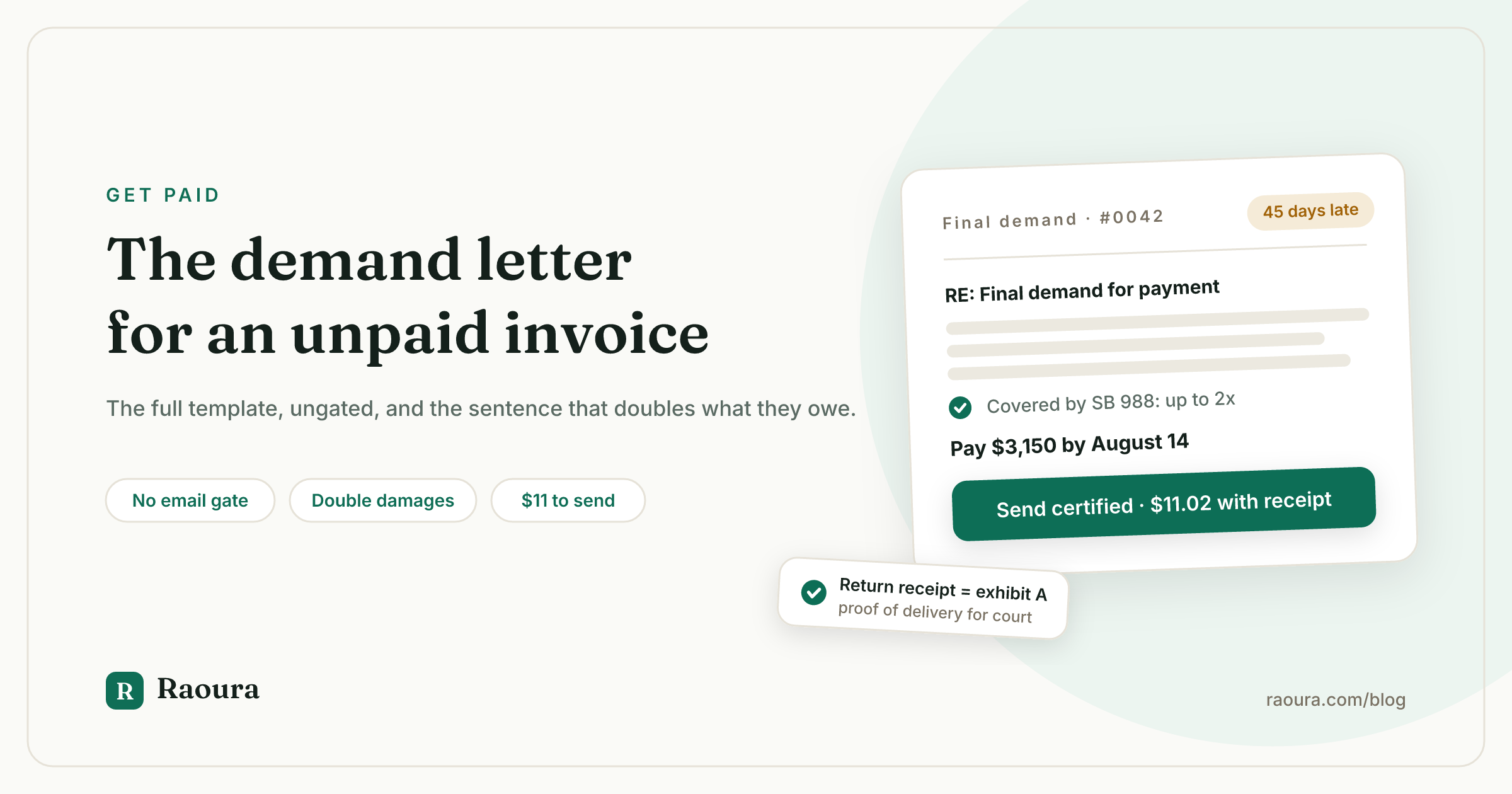
Here is what we found when we checked every page ranking for this query in July 2026: of the five top results, only one lets you download a demand letter template without handing over your email or starting a $49 per month trial. Not one of the five mentions the state freelance payment laws passed in 2024 and 2025 that can double what your client owes you. And every single one is written for a company with an accounts receivable department, not for a person who did the work themselves and is now owed the money personally.
So this page does three things differently:
- The full template is right here in the article, copy and paste it, no gate.
- It includes the statutory paragraph that changes your client's math entirely if they are in New York, Illinois, or California.
- It is written for the situation you are actually in: invoice 30 or more days overdue, reminders ignored, relationship probably over, and you deciding whether the next step is court or letting it go.
If you are not at the demand letter stage yet, start with the unpaid invoice escalation ladder. A demand letter is rung three of five. Sending it too early burns a client relationship a reminder would have saved. You are in demand letter territory when the invoice is roughly 30 days overdue and at least two or three payment reminders have gone unanswered.
What a demand letter is and when to send one#
A demand letter is a final written notice, sent when an invoice is around 30 to 60 days overdue, that gives the client a firm deadline, usually 10 business days, to pay before you pursue legal remedies. It is the line between collection and enforcement. Everything before it says "please pay". The demand letter says "pay by this date or here is exactly what happens next".
Three facts about it that the template sites tend to blur:
- A demand letter is not itself legally binding, and no law dictates its format. Its power is practical: it proves you made a formal demand, it starts a documented clock, and it makes the consequence concrete.
- In some situations it is legally required before you can sue. California's small claims process expects you to have demanded payment before filing, and the court's own self-help site walks you through writing one.
- It works partly because of what it signals. A client who ignores emails understands that a person who sends a dated, certified, deadline-bearing letter is a person who will actually file.
You are far from alone in needing one. Intuit QuickBooks' 2025 survey of 2,487 small businesses found 56% are owed money on unpaid invoices, averaging $17,500 each, and Bonsai's dataset of invoices from 100,000+ freelancers shows that while about 90% of late invoices get paid within a month, the ones that survive past that point are exactly the ones that need a letter like this.
The template#
A demand letter that works contains five elements and fits on one page: the facts, the total owed, the deadline, the specific consequence, and an easy way to pay. Copy the version below, replace the brackets, delete the optional lines that do not apply, and keep your edits boring. Anger reads as weakness in a document like this; precision reads as strength.
[Your name / business name]
[Your address]
[Date]
[Client name]
[Client business name]
[Client address]
RE: Final demand for payment, Invoice #[number], $[total amount] past due
Dear [name],
On [contract date], you engaged me to [one line describing the work, e.g. "design and deliver a brand identity package"] under [our signed agreement / our email agreement of that date]. I completed and delivered that work on [delivery date], and you accepted delivery [describe acceptance, e.g. "by email on June 3" or "by publishing the deliverables on your website"].
Invoice #[number] for $[amount], issued on [issue date], was due on [due date]. Despite reminders sent on [dates], it remains unpaid [number] days past due. [Optional, if agreed in writing beforehand: "Under the late fee clause in our agreement, interest of [rate]% per month has accrued since [date], bringing the total now due to $[total]."]
I require payment of $[total] no later than [date, 10 business days out].
[Optional statutory paragraph, see the next section, for clients in NY, IL, or CA.]
If payment is not received by that date, I will pursue the remedies available to me, including filing a claim in [county] small claims court [or: "filing a complaint under the [statute name]"], where I will also seek all recoverable costs and interest. I would prefer to resolve this without involving the court.
You can pay immediately by [payment link / method]. If there is a genuine problem on your end, contact me before [deadline date] in writing to propose a payment plan with specific dates.
Sincerely,
[Name]
Enclosures: Invoice #[number], [contract / email agreement], delivery confirmation
Two usage notes.
- Name a real consequence you are actually willing to execute, in the specific venue: "I will file in Travis County small claims court" lands differently than "I will explore legal options", which lands like nothing at all.
- The last paragraph matters more than it looks. Giving the client a payment link and a written-plan escape hatch makes surrender the easiest available move, and surrender is the outcome you want.
The full range of what happens after this letter, including small claims mechanics and statutory claims, is covered in the escalation ladder.
The paragraph that doubles the debt in three states#
If your client is in New York (contracts of $800+), Illinois ($500+), or California ($250+), state freelance payment laws entitle you to up to double the unpaid amount plus attorney fees, and your demand letter should say so in one sentence. These laws took effect between mid 2024 and January 2025, and, as noted above, no page ranking for this query mentions any of them.
| State | Law | Covers contracts of | If you win | Complaint route |
|---|---|---|---|---|
| New York | Freelance Isn't Free Act, statewide since Aug 28, 2024 | $800+ (alone or aggregated over 120 days) | Double damages plus attorney fees | Free complaint via the NY Attorney General, or civil court |
| Illinois | Freelance Worker Protection Act, contracts after Jul 1, 2024 | $500+ (within a 120-day period) | Double the underpayment plus attorney fees | Illinois Department of Labor complaint (2-year window), or civil court |
| California | SB 988, Freelance Worker Protection Act, effective Jan 1, 2025 | $250+ (alone or aggregated over 120 days) | Up to twice the unpaid amount plus attorney fees | Civil action only, no agency route |
The sentence to insert where the template marks it:
This invoice is covered by the [statute name]. If I am forced to pursue this claim, the statute provides for double damages plus attorney's fees, in addition to the amount owed.
Read that from the client's side. Stalling you was free until this paragraph. Now every week of delay is a bet that could cost double, plus your lawyer's bill.
The mechanism has teeth in practice: New York City's older local version of the law recovered over $1.3 million for 1,191 freelancers in 2018 to 2019 through its complaint office. Details, thresholds, and the two state agency complaint routes are in our freelance payment laws by state guide.
Note the coverage tests: what matters is generally where the hiring party operates, the law's definition of covered work (California's covers "professional services" like writing, design, and marketing), and the dollar thresholds, which can aggregate multiple small invoices over 120 days.
How to send it: email plus certified mail, about $11#
Send the demand letter twice on the same day: by email, and by USPS Certified Mail with Return Receipt, which costs $11.02 at the counter ($0.82 postage + $5.55 certified fee + $4.65 physical return receipt) at the rates effective July 12, 2026. Choosing the electronic return receipt instead brings it to $9.28. Current fees are tracked against USPS Notice 123 here.
Why both channels. Email arrives instantly and most clients pay from the email. But email's weakness is deniability, and demand letters exist to create proof: LawDepot's guidance is blunt that email or text delivery may not satisfy the legal requirements for proof of delivery.
The certified mail receipt and the signed (or electronically confirmed) return receipt are what you hand a small claims judge to show the client knew, on a specific date, exactly what they owed and what was coming.
Eleven dollars is the cheapest piece of litigation insurance you will ever buy.
| Delivery method | Cost | Proof it creates |
|---|---|---|
| $0 | Send record; client can claim it went to spam | |
| Certified Mail + electronic return receipt | $9.28 | USPS tracking plus delivery confirmation PDF |
| Certified Mail + physical green card | $11.02 | Signed card returned to you, the classic court exhibit |
| Attorney sends it for you | Typically a few hundred dollars | Everything above, plus a law firm letterhead |
On that last row: Nolo's practical view is that an attorney letter carries more weight and costs substantially less than hiring the attorney for a lawsuit, and one letter does not obligate you to retain them further. Nolo publishes no price; attorney marketplaces typically quote a few hundred dollars to around $1,000.
The math is scale-dependent: on a $6,000 invoice a $400 attorney letter pencils out easily, on a $600 invoice it never does. In the three statutory states, send your own letter citing the law first; the statute is scarier than the letterhead.
One more delivery detail the template sites skip: address it to the person with authority to pay, not just your day-to-day contact. If your client is a company, that may be an owner or finance lead. If you invoice a company with a real AP department, your dispute may be with a process rather than a person, which changes tactics more than tone.
Does a demand letter actually work? The honest numbers#
There is no credible published statistic on what percentage of demand letters get paid, and any page quoting one is guessing; what is documented is that the overwhelming majority of civil cases settle before trial. We looked for a primary source behind the "one third of demand letters produce payment" claim that circulates, and behind several similar figures.
None exists.
What the data does show is the shape of the game: almost nothing that gets filed actually gets tried, which means the period between your demand letter and a court date is where nearly all disputes resolve.
Practically, a demand letter sorts clients into three groups:
- Clients who always intended to pay eventually treat the deadline as real and pay.
- Clients with a genuine cash problem surface and negotiate, which is a win: a written payment plan with dates beats silence.
- Clients who never intended to pay stay silent, which is also information, because it tells you the invoice will cost a court filing to recover, and you can now make that decision with a clean conscience and a documented file.
The one outcome a proper demand letter eliminates is ambiguity.
What raises the odds it lands in group one or two: a clean paper trail attached (contract, delivery proof, invoice, reminder dates), a consequence with a named venue, a deadline inside two weeks, and evidence that you enforce your own terms. That last one is built months earlier, by payment terms with teeth and a late fee clause agreed upfront. A client who watched you apply a late fee on day 15 does not doubt you will file on day 45.
After the deadline: the three paths#
When the deadline passes, you have three options: file (small claims up to $2,500 to $25,000 depending on state, for a $15 to $100 fee), hand it to a collection agency (which keeps 20% to 50% of recovery), or write it off deliberately. The decision math for each rung, including the state small claims table and the reasons a cash-basis freelancer usually cannot deduct a written-off invoice, is in the escalation ladder guide.
Whatever you choose, do it on the date you named. The letter said 10 business days; on day 11, file the claim or send the one-line write-off note.
You also have more time than panic suggests: the statute of limitations on written contracts runs 3 to 10 years depending on the state, so the deadline pressure is about evidence freshness and the client's solvency, not the law.
If the client responds with a dispute about the work itself rather than silence, that is a different problem with a different playbook: solve it on the merits, in writing, before restarting the payment clock.
If the silence started before the invoice was even overdue, the dynamics are different again, and the client ghosted after delivery playbook covers that recovery sequence.
The evidence stack is built before the dispute#
All four things the demand letter cites (the reminder dates, the due date, the accrued late fee, and the delivery record) should already exist as a timestamped trail by the time you write it. Assembling that trail after the fact, from a year of email threads, is the single most demoralizing part of chasing a debt. Keeping it as a byproduct of normal invoicing is a systems choice.
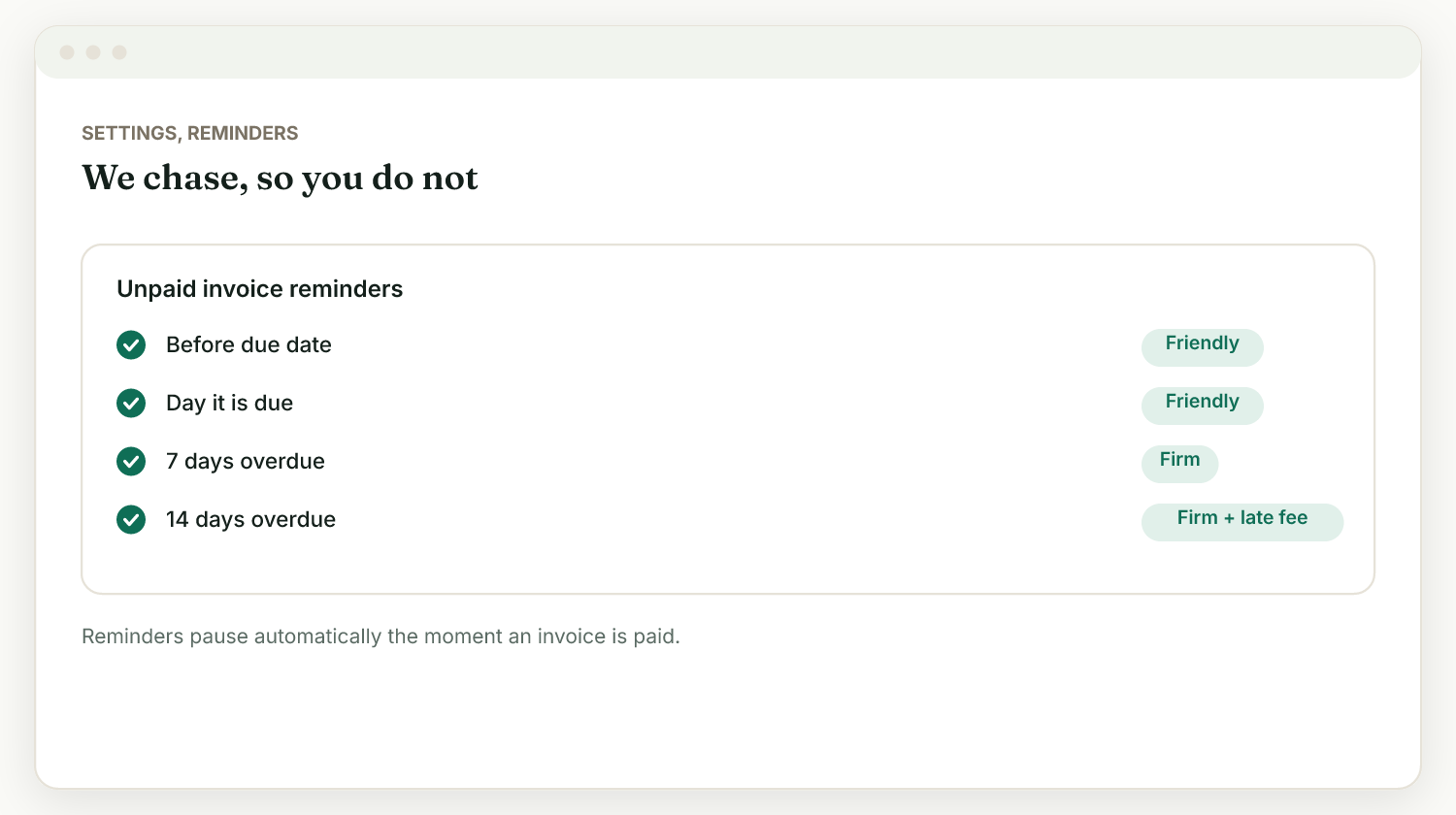
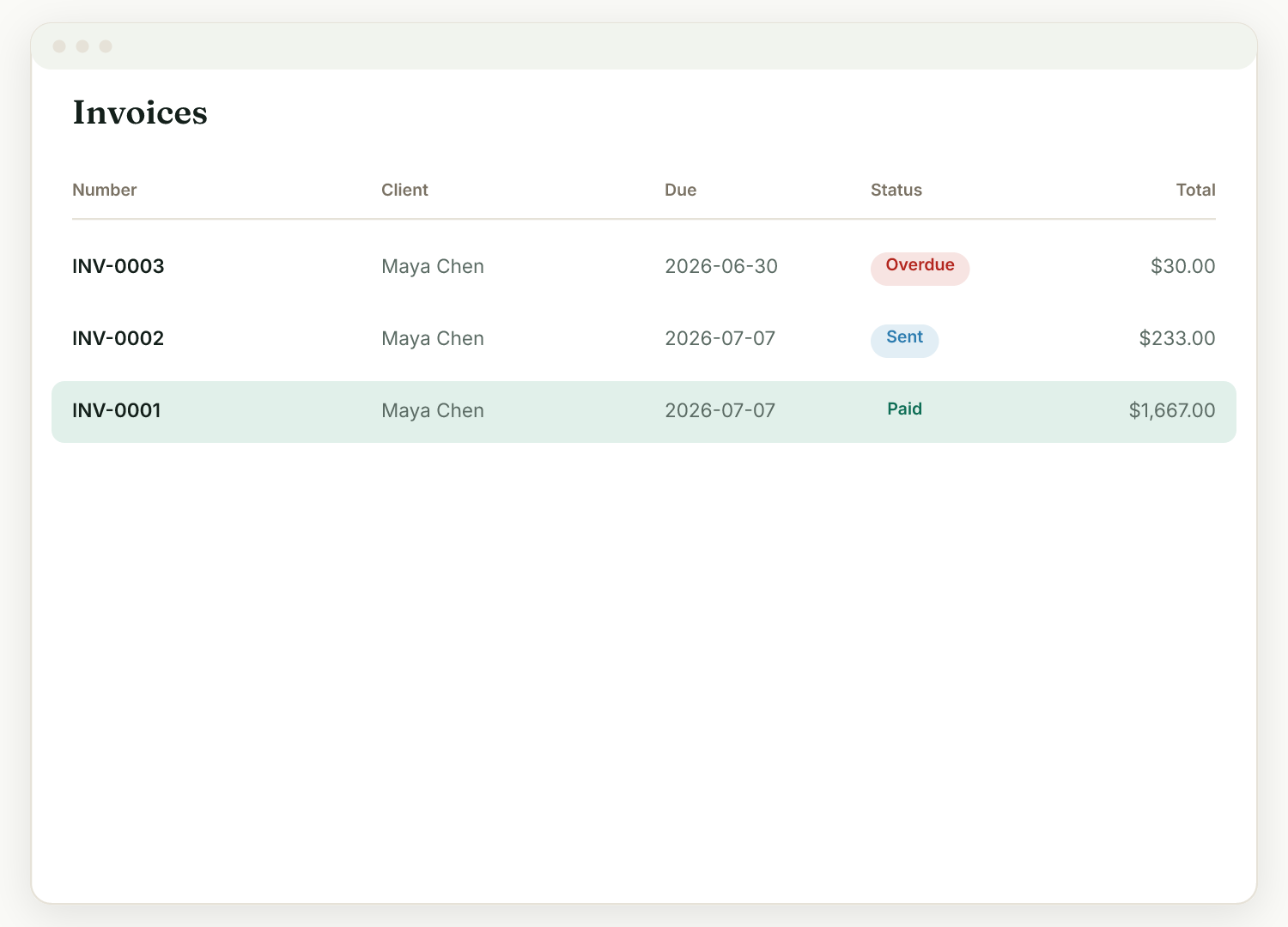
This is the part Raoura automates. Every invoice carries its issue date, due date, and status in one place, reminders go out on your schedule and are logged with dates you can cite in the letter ("Despite reminders sent on June 12, June 19, and June 26..."), and your agreed late fee applies itself after the grace period so the "total now due" line is already computed. Disclosure: Raoura is our product, and the template above works identically if your records live in a spreadsheet.
For the wider picture of how often invoices go this far and how much freelancers typically recover, see the freelance late payment statistics hub.
Frequently asked questions
Is a demand letter legally required before suing?
Sometimes. California expects you to have demanded payment before filing in small claims, and some contracts require written notice and a cure period before either party can sue. Even where it is not required, judges expect to see one, and skipping it makes you look unreasonable in the one room where that matters.
Can I just email it?
Email alone is usually a valid demand, but it is weak proof. The certified mail receipt exists to remove the "never got it" defense. Send both. If your contract has a notice clause specifying how formal notices must be delivered, follow it exactly.
How many days should I give?
Ten business days is the convention and fits most situations. Shorter than seven looks like theater; longer than fourteen tells the client the deadline is soft. Whatever you pick, act on it the day after it passes.
What if we never signed a contract?
Send the letter anyway. Emails, texts, invoices, and the delivered work establish an agreement in every state. Reference the email thread where the client approved the work in place of the contract date. Note that the three state statutes are harder to invoke without a written contract, though New York and Illinois penalize clients for refusing to provide one you requested. What a contract should have contained is in our contract guide, for next time.
Should the letter come from a lawyer?
On large invoices, or with a client who has ignored everything else, a few hundred dollars for an attorney letter is often the last cheap move before filing. On small invoices, or in New York, Illinois, or California where you can cite double damages yourself, send your own first.
My client is in another state. Does the letter change?
The letter barely changes, but the consequence line should name a venue that is realistic, which usually means the client's state for small claims. The statutory paragraph depends on where the hiring party is based, not where you are. Cross-state jurisdiction has its own tradeoffs and is on our topic map as a dedicated guide.
The client replied offering half. Take it?
A written offer is progress, not an insult. Whether to accept depends on collection odds and your hourly value: half today with a signed release often beats double someday in theory. If you counter with a payment plan, put dates and an acceleration clause (miss one payment, full balance due) in writing.
What tone should it take if I might work with them again?
By the time a demand letter is warranted, the relationship is almost always over, and pretending otherwise weakens the letter. If you genuinely believe this is salvageable, you are probably at the reminder stage, not the demand stage; see the reminder cadence guide before sending this.
Every rate, statute, and figure in this article was verified against primary sources in July 2026: USPS Notice 123 rates effective July 12, 2026 via certified mail rate trackers, the New York State DOL and Senate bill text for the Freelance Isn't Free Act, the Illinois Department of Labor and 820 ILCS 193, the California Legislature's text of SB 988, the California courts' small claims self-help pages, Nolo's collection guidance and statute of limitations chart, and invoice datasets from Intuit QuickBooks and Bonsai. We also checked the five top-ranking pages for this query: one ungated template (eForms), one email-gated (LegalTemplates), one behind a $49/month trial (LawDepot), and zero mentions of the NY, IL, or CA freelance payment laws across all five.
Run your client work in one place
Send a proposal, get it signed, invoice, and get paid, with a branded portal your clients will actually use. One flat plan at $17/month, and we never take a cut of your payments.
Try Raoura free for 14 daysNo credit card required. Set up in minutes.
Keep reading
7 17hats Alternatives for Solos Who Don't Need $60/mo Software (2026)
17hats now costs around $60 per month on a single all-inclusive plan, which is a lot for one freelancer. Here are 7 alternatives from $0 to $36 per month, with honest tradeoffs for each.
Card vs ACH vs Wire for Big Freelance Payments
On a normal invoice, the payment rail barely matters. On a five-figure deposit or project payoff, it is the difference between a $5 fee and a $290 one, and the guides that cover this either skip wire transfers entirely or repeat a Form 8300 myth that is not true. Every fee and rule below is verified from Stripe, Nacha, the IRS, and current bank fee schedules.
Fiverr Workspace Is Gone: The Full Story, Your Missing Data, and 8 Alternatives
Fiverr Workspace (formerly AND.CO) was permanently deleted on March 1, 2026, and Fiverr never even left a note: the old URL now dumps you on the gig marketplace. Here is the full shutdown timeline, how to rebuild the records you lost, and 8 replacements with verified July 2026 pricing.