Card vs ACH vs Wire for Big Freelance Payments
Search "ACH vs card freelance" and you get a handful of generic small-business payments guides, none written for the moment that actually costs you money: a client is ready to send $8,000, $15,000, or $40,000, and you have to tell them how. Most of these pages never mention wire transfers at all. The ones that do wave at "$15 to $50" without saying which side pays it, and at least one repeats a common myth that a wire over $10,000 triggers an IRS Form 8300 filing, which is not true.
This article runs the numbers on all three rails, at the sizes where the difference actually shows up in your bank account, using rates read directly from Stripe, Nacha, and current bank fee schedules.
The short answer#
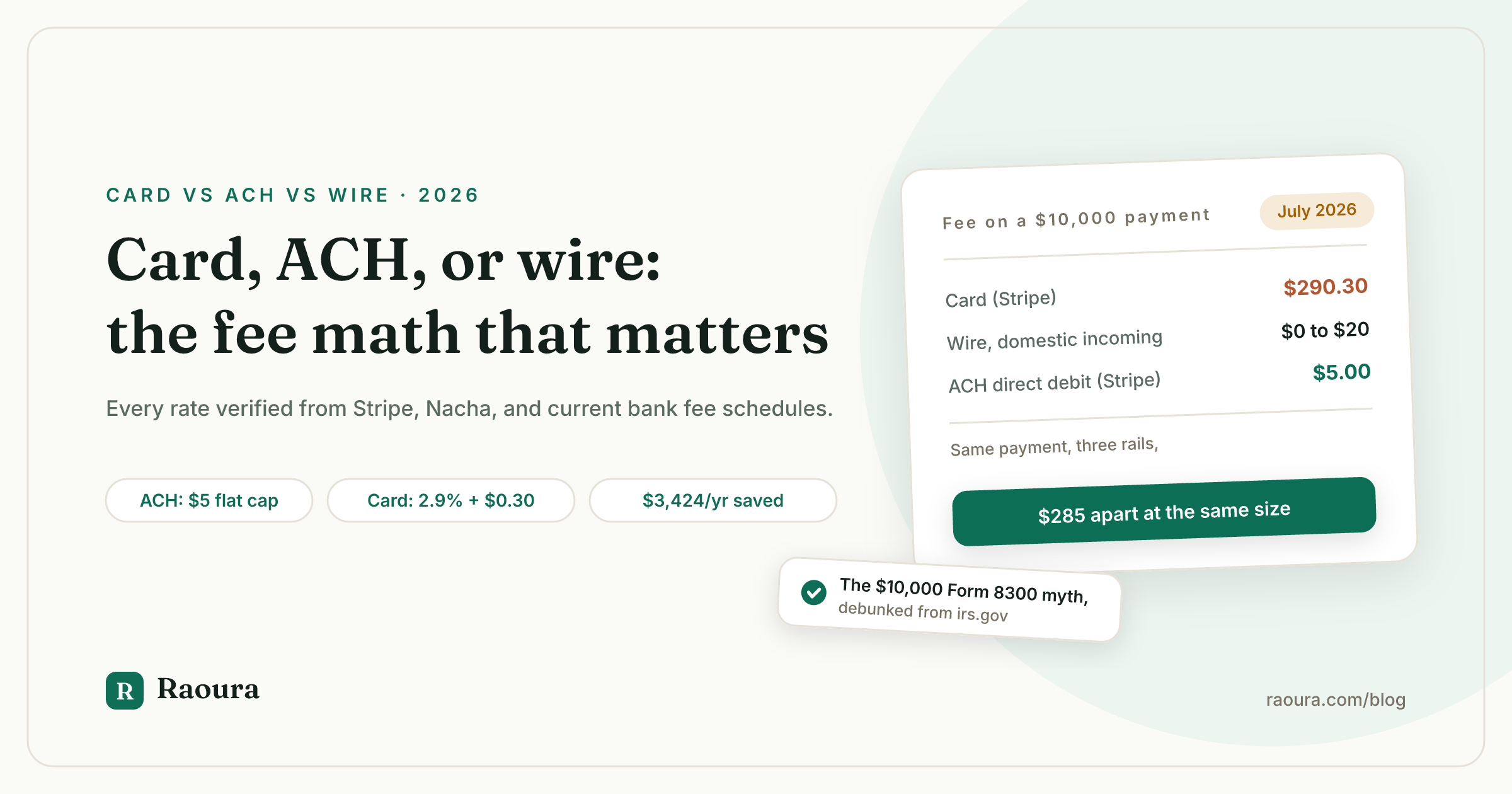
On a $10,000 payment, card processing costs $290.30, ACH costs a flat $5.00, and a bank wire costs whatever your bank charges to receive one, typically $0 to $25 regardless of the amount.
The rail that looks the same on a $200 invoice is wildly different on a $20,000 one. Card fees scale with the payment, so they get worse as the number gets bigger. ACH and wire fees are flat (or capped), so they barely move at all. For anything past a couple thousand dollars, that difference in shape, not just in headline rate, is the whole story.
Every fee, verified July 2026#
Card processing runs 2.9% plus $0.30 through Stripe, ACH direct debit runs 0.8% capped at $5.00 per transaction, and a bank wire is a flat fee your own bank sets, unrelated to your processor.
All figures below were read from Stripe's pricing page and Bankrate's July 2026 wire transfer fee roundup (published January 21, 2026 and current as of this check) on July 18, 2026.
| Rail | Fee | Scales with amount? | Who charges it |
|---|---|---|---|
| Card (Stripe) | 2.9% + $0.30 | Yes, no cap | Your payment processor |
| ACH direct debit (Stripe) | 0.8%, capped at $5.00 | Capped above $625 | Your payment processor |
| Wire, domestic incoming | $0 to $20 (bank-dependent) | No, flat | Your own bank |
| Wire, international incoming | $0 to $25 (bank-dependent) | No, flat | Your own bank |
Incoming wire fees vary by bank more than most freelancers expect. Wells Fargo and Citi commonly waive incoming wire fees on standard accounts, Chase, Bank of America, and PNC charge $0 to $15 depending on account tier, and US Bank charges a flat $20 domestic and $25 international. A handful of banks built for online-first customers, including Fidelity Cash Management and Marcus by Goldman Sachs, charge $0 on incoming wires entirely.
The number that matters is the incoming fee, since that is the one your bank deducts from what lands in your account. Outgoing wire fees ($25 to $50 at most major banks) are the client's problem, not yours, assuming they pay from their own account.
What a $10,000 payment actually costs on each rail#
Across a $2,000 to $50,000 range, card fees climb from $58.30 to $1,450.30, ACH stays flat at $5.00 the entire way, and a typical wire stays flat at whatever your bank's incoming fee is.
| Payment amount | Card fee (2.9% + $0.30) | ACH fee (0.8%, $5 cap) | Wire fee (flat, bank-set) |
|---|---|---|---|
| $2,000 | $58.30 | $5.00 | $0 to $20 |
| $5,000 | $145.30 | $5.00 | $0 to $20 |
| $10,000 | $290.30 | $5.00 | $0 to $20 |
| $25,000 | $725.30 | $5.00 | $0 to $20 |
| $50,000 | $1,450.30 | $5.00 | $0 to $20 |
ACH hits its $5 cap at $625 (0.8% of $625 is exactly $5.00), so every payment above that runs through Stripe's ACH rail at a flat $5, whether the invoice is $700 or $70,000.
Stretch that over a year and the gap becomes real money. A freelancer collecting twelve project payoffs of $10,000 apiece pays $3,483.60 in card fees across the year, versus $60.00 on ACH, a $3,423.60 difference for choosing one button over another on the invoice. Even against a $15 wire fee (a common rate at Chase or Bank of America), twelve wires would run $180 for the year, still six times more than ACH and with none of the automatic reconciliation a processor gives you.
The same $290.30-versus-$5.00 gap shows up at deposit time too. Our deposit percentage guide ran this exact math on a $10,000 deposit; this article is really that same fee table, scaled up to full project payoffs and a third rail.
ACH has a hard cap on the fee, but not a clear cap on the amount#
Stripe does not publish a specific dollar limit on ACH direct debits; it sets per-account limits based on history and risk, and the underlying banking network allows Same Day ACH transactions up to $1,000,000 as of a Nacha rule that took effect March 18, 2022.
This is the part every comparison page glosses over. Nacha's own rule page confirms the $1 million per-entry ceiling for Same Day ACH, up from $100,000 before 2022, so the payments network itself has no problem clearing a six-figure ACH transaction.
Stripe is the narrower constraint. Its support documentation on bank debit limits confirms that transaction size and weekly volume limits exist and scale with your account's history, but does not publish the actual dollar figures anywhere on that page. New accounts see tighter limits than established ones.
The practical move: if you are about to invoice a client for $15,000 or more and want to offer ACH, check your Stripe dashboard for your current limit before the invoice goes out, and contact Stripe support ahead of time if you need it raised. Finding out about a limit after the client has already tried to pay is a bad way to collect a large invoice.
Wire transfers do not run through your invoicing tool#
A wire transfer moves directly from the client's bank to your bank, outside Stripe, PayPal, or any invoicing platform, which means there is no "pay by wire" button for the client to click.
This trips people up because Stripe's invoicing product does have a feature called "bank transfer," but Stripe's own documentation confirms it works by generating a unique virtual bank account number for the client to send money to, which Stripe then reconciles as an ACH or local bank-rail payment, not a true Fedwire or SWIFT wire.
A real wire happens the old way: you give the client your bank's routing number, account number, and (for international wires) SWIFT/BIC code, either on the invoice itself or in a separate note, and their bank sends the money directly to yours. Your invoicing tool can track that the invoice was marked paid by wire, but it never touches the transfer itself.
That also means wire fraud protection is entirely on you. Wire instructions sent by plain email are a known target for business email compromise scams, where a scammer intercepts or spoofs the email and swaps in their own account number. Always confirm wire details by phone with a number you already have on file, never one from the email itself, before a client sends five figures.
Speed: same-day wire, multi-day ACH, instant card#
A domestic wire typically arrives the same business day, standard ACH clears in 1 to 4 business days, and a card payment settles to your processor instantly but still takes about 2 business days to reach your bank account.
International wires take longer, typically 1 to 5 business days depending on how many correspondent banks the payment routes through and which currencies are involved.
It helps to separate two different clocks that get conflated constantly. Bank-to-bank ACH clearing (how fast the money actually moves between banks) is a Nacha-governed process. Processor-to-you payout timing (how fast Stripe or another processor releases your balance to your bank account) is a separate, processor-specific schedule. Stripe's ACH documentation lists standard settlement to your Stripe balance at 4 business days, with 2-day "faster settlement" available on some accounts, and that is before your normal payout schedule to your bank kicks in on top.
For a payment you need in hand by a specific date, a same-day domestic wire is still the fastest rail that exists, full stop. It is also the one where you eat the highest fee if your bank charges for incoming wires.
Risk: the dispute window is wildly asymmetric#
A consumer client can dispute an ACH debit for up to 60 days under Nacha's rules, a business client can generally only dispute one for about 2 business days on Stripe, and a completed wire has no equivalent return mechanism at all.
This is the single biggest risk difference between the three rails, and none of the pages ranking for this topic mention it.
Nacha's own explainer on the subject, "Which 60 Days? Understanding the Different Periods," clarifies that there are actually three separate 60-day windows across Nacha's rules and Regulation E, and they govern different things: the right to return an unauthorized debit, liability limits, and investigation timelines. The practical upshot for a freelancer collecting ACH from an individual's personal bank account is that an unauthorized-debit claim can technically surface up to 60 days after the transaction settled.
Business accounts work differently. Stripe's documentation on ACH disputes states a debit from a business bank account can generally only be disputed within about 2 business days, a dramatically shorter window than the consumer rule. That is a real, if underused, argument for billing companies and LLCs by ACH with more confidence than you would bill an individual client the same way.
Wire transfers sit at the opposite end entirely. Once a wire settles, it is effectively final. There is no Nacha-style return window and no card-style chargeback process; unwinding a wire generally requires both banks to cooperate voluntarily, which is why wire fraud is taken so seriously and why confirming instructions out of band matters as much as it does.
The $10,000 wire myth: Form 8300 does not apply#
A wire transfer over $10,000 does not trigger an IRS Form 8300 filing, because the IRS's own definition of reportable "cash" specifically excludes wire transfers.
Several pages that cover large freelance payments repeat a version of "wires over $10,000 get reported to the IRS," and it is not accurate. The IRS's Form 8300 reference guide defines reportable cash as US or foreign currency plus certain cash-equivalent instruments (cashier's checks, bank drafts, traveler's checks, and money orders with a face value of $10,000 or less). A wire transfer is explicitly not included in that definition.
The IRS's own example makes this concrete: a buyer who pays $4,000 in currency and wires the remaining $15,000 from their bank account only triggers a Form 8300 filing for the $4,000 cash portion, not the wire. A freelancer who receives a $30,000 project payoff entirely by wire has no Form 8300 exposure from the wire itself.
None of this changes your tax obligations. The income is taxable and reportable on your own return regardless of which rail delivered it; Form 8300 is a separate anti-money-laundering filing that a business receiving actual cash has to make, and most freelancers taking card, ACH, or wire payments will never encounter it.
Choose card if, choose ACH if, choose wire if#
Card wins on speed to click "pay" and universal familiarity, ACH wins on cost for anything past a few hundred dollars, and wire wins on same-day certainty when timing matters more than either fee.
| Situation | Best rail |
|---|---|
| Client wants to pay in 30 seconds from their phone | Card |
| Payment is over $1,000 and the client can set up a bank debit | ACH |
| You need funds to land the same business day, no exceptions | Wire |
| Recurring retainer or milestone payments | ACH (set once, low fee every time) |
| One-time six-figure project payoff | Wire, or ACH if your Stripe limit supports it |
| International client | Wire (for certainty) or ACH-equivalent local rails where available; see our international invoicing fee guide |
| Client is an individual, not a company | Weigh ACH's longer consumer dispute window before defaulting to it |
In practice, most freelancers should default to ACH for anything over a few hundred dollars, keep card available for clients who will not use anything else, and reserve wire for the specific case where same-day certainty is worth a flat bank fee. That is close to the same conclusion we reached comparing Stripe and PayPal for smaller invoices, just with the gap widened by another zero.
How Raoura handles this#
Disclosure: Raoura is our product. Raoura is client and project management for solo freelancers at $17 per month flat, and invoices run on your own Stripe account through Stripe Connect, so you get exactly Stripe's published rates above, card at 2.9% plus $0.30 and ACH at 0.8% capped at $5, with no markup added on top.
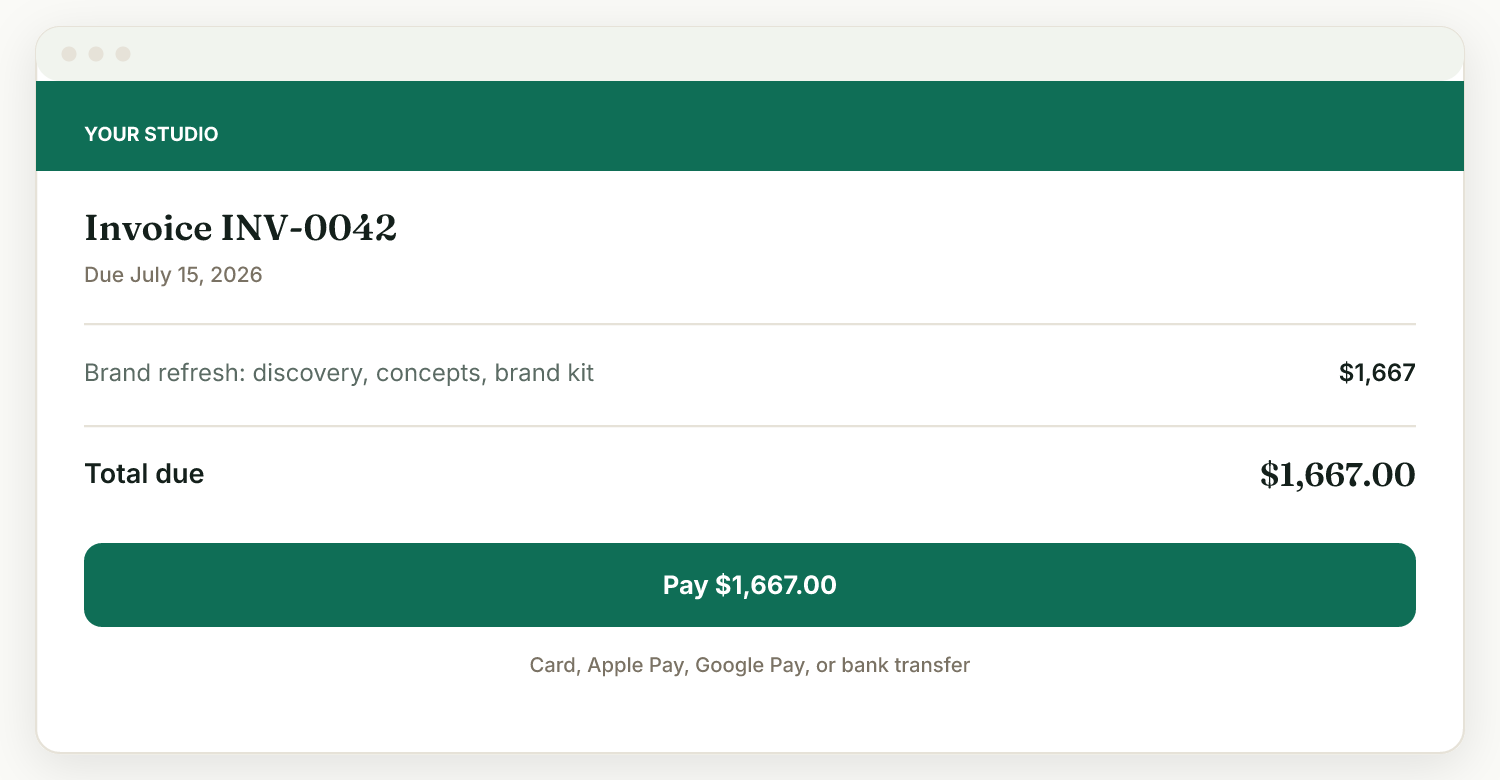
When you build an invoice, you choose which payment methods to offer, so you can put ACH in front of a client for a large payment instead of leaving card as the only option.
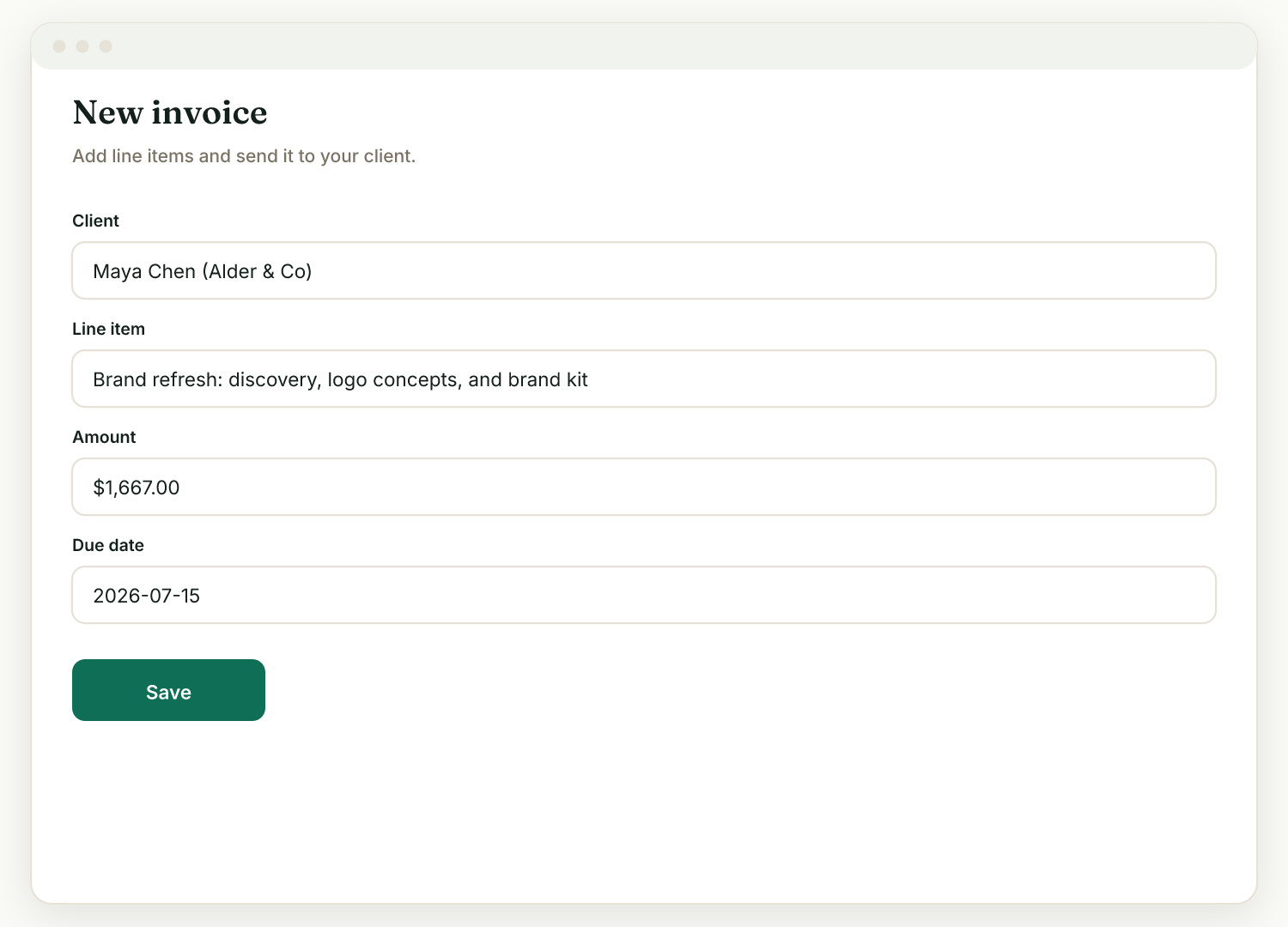
For a wire, Raoura will not process the transfer itself, since no invoicing tool does, but you can note wire instructions on the invoice and mark it paid manually once the funds land, keeping the payment tied to the right client, project, and contract either way.
Frequently asked questions
Is ACH safe for a large one-time payment?
Yes, with one caveat worth knowing. A consumer client can technically dispute an unauthorized ACH debit for up to 60 days under Nacha's rules, while a business client's dispute window is much shorter, around 2 business days on Stripe. Both are lower-risk than accepting a check, and neither carries card-style chargeback rates.
Does Stripe let me accept a $50,000 ACH payment?
Possibly, but Stripe does not publish a fixed dollar limit; it sets account-specific limits based on your history that you can view in your dashboard. The underlying Nacha network allows Same Day ACH transactions up to $1,000,000 per entry, so the ceiling is more about your Stripe account's standing than the payment rails themselves. Contact Stripe support ahead of a large invoice if you are unsure of your current limit.
Can a client pay me by wire through Stripe or PayPal?
Not directly. A wire transfer moves bank-to-bank using routing and account numbers (or SWIFT/BIC for international), completely outside any invoicing processor. Stripe's "bank transfer" invoicing feature looks similar but actually routes through ACH-style virtual account numbers, not a true wire.
Do I have to report a wire transfer over $10,000 to the IRS?
No, not through Form 8300. The IRS's definition of reportable cash specifically excludes wire transfers; Form 8300 applies to actual currency and certain cash-equivalent instruments like cashier's checks. The income itself is still taxable and belongs on your return regardless of the rail.
What is the cheapest way to collect a $20,000 payment?
ACH, almost always. At Stripe's 0.8% rate capped at $5, a $20,000 ACH payment costs $5.00 flat, against $580.30 on a card and $0 to $25 on a wire depending on your bank's incoming fee. Wire only wins on cost at banks that charge nothing for incoming wires and only matters more than ACH's fee when you need same-day certainty.
How do I protect myself from wire fraud when sending payment instructions?
Never send account numbers over email as the only channel. Confirm the destination account by phone using a number you already had on file before the transfer, not one supplied in the same email thread, and be suspicious of any last-minute change to previously confirmed wire details. This is the single most common way freelancers and their clients lose large payments to fraud.
Every fee and rule in this article was verified from primary sources on July 18, 2026: Stripe's pricing and ACH documentation, Nacha's Same Day ACH rule pages, the IRS Form 8300 reference guide, and Bankrate's January 2026 wire transfer fee roundup, cross-checked against individual bank fee schedules. Processor and bank pricing changes without notice; the linked sources outrank this article the moment they disagree. Verified July 2026.
Run your client work in one place
Send a proposal, get it signed, invoice, and get paid, with a branded portal your clients will actually use. One flat plan at $17/month, and we never take a cut of your payments.
Try Raoura free for 14 daysNo credit card required. Set up in minutes.
Keep reading
7 17hats Alternatives for Solos Who Don't Need $60/mo Software (2026)
17hats now costs around $60 per month on a single all-inclusive plan, which is a lot for one freelancer. Here are 7 alternatives from $0 to $36 per month, with honest tradeoffs for each.
Demand Letter for an Unpaid Invoice: Free Template (No Email Gate)
The full demand letter template is on this page, no signup, no trial. Plus the one paragraph that legally doubles what your client owes you in New York, Illinois, and California, the exact certified mail math, and an honest answer to whether demand letters actually work. Verified against primary sources in July 2026.
Fiverr Workspace Is Gone: The Full Story, Your Missing Data, and 8 Alternatives
Fiverr Workspace (formerly AND.CO) was permanently deleted on March 1, 2026, and Fiverr never even left a note: the old URL now dumps you on the gig marketplace. Here is the full shutdown timeline, how to rebuild the records you lost, and 8 replacements with verified July 2026 pricing.