Fiverr Workspace Is Gone: The Full Story, Your Missing Data, and 8 Alternatives
Type workspace.fiverr.com into your browser today and you land on Fiverr's gig marketplace homepage. No goodbye page, no explanation, no link to your data. We checked on July 5, 2026: the URL 301-redirects straight to fiverr.com, the app subdomain returns an empty page, and the help article that once explained the shutdown appears to have been removed from Fiverr's support center. A product that tens of thousands of freelancers ran their businesses on for a decade now ends in a silent redirect.
If you are here because your invoices, contracts, and time logs lived in Fiverr Workspace, this article covers three things: exactly what happened and when, how to rebuild the records you can no longer download, and which tools are worth moving to, with pricing we verified against every vendor's own site this month.
One disclosure before anything else: this is the Raoura blog. Raoura is our product, it appears in the alternatives section below, and we flag it again there. Everything before that section stands on its own.
What happened to Fiverr Workspace?#
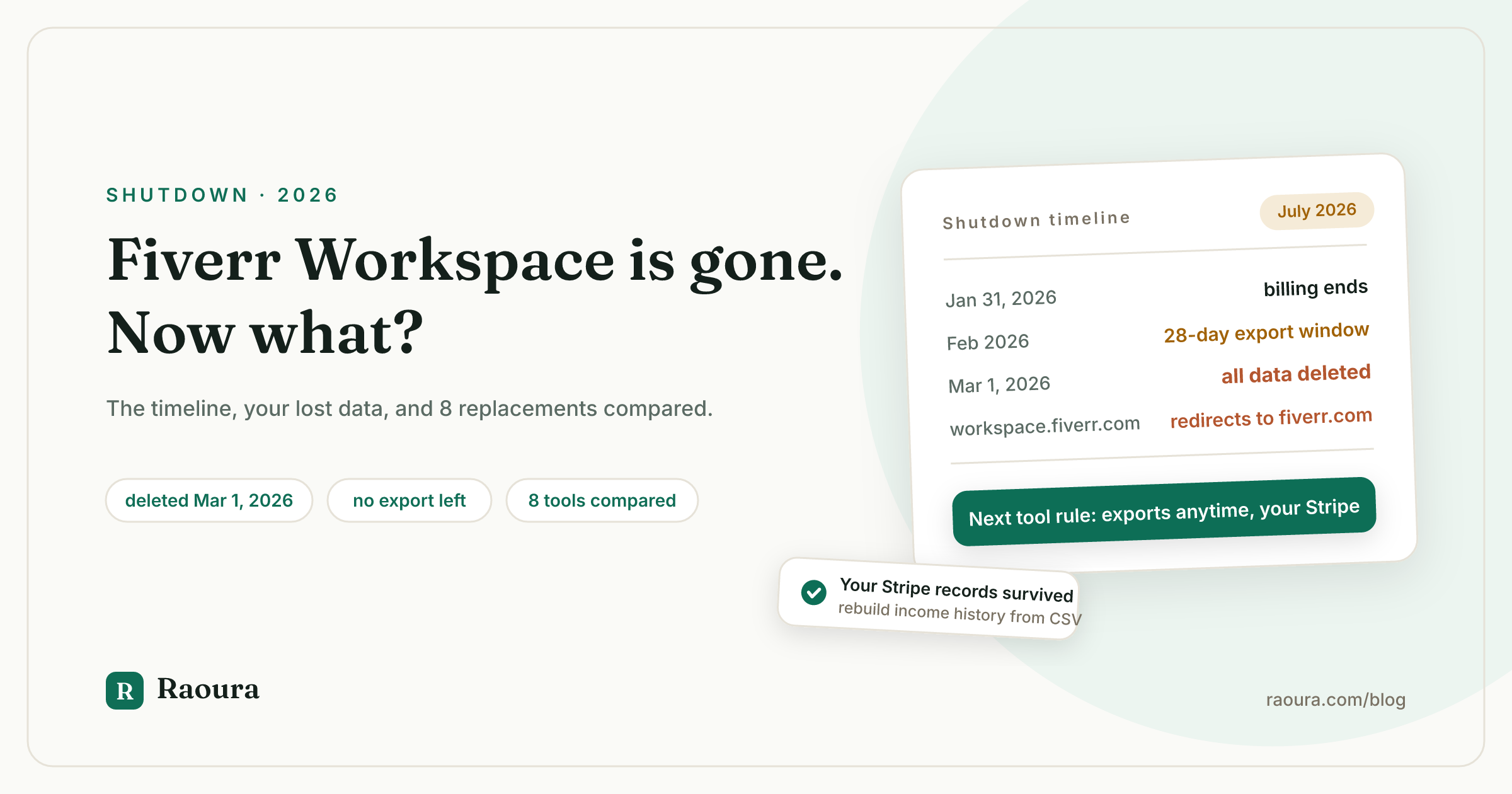
Fiverr shut down Fiverr Workspace (formerly AND.CO) on March 1, 2026, permanently deleting all accounts and data; billing ended January 31, 2026, and February was a 28-day free-access window for exports.
Fiverr never published a press release about the shutdown, and its own help article about the discontinuation is no longer findable in the support center. The most complete public record of the wind-down timeline is third-party coverage published while the notices were still live, notably Plutio's migration guide from January 2026.
That guide documented the dates Fiverr gave users: final billing on January 31, 2026, with annual subscribers automatically refunded for unused months, free access through February for downloading data, and on March 1, 2026, in the guide's words, "all access terminated... Data becomes permanently inaccessible. No recovery possible."
Here is the full arc of the product:
| Date | Event |
|---|---|
| 2015 | AND.CO founded in New York by Leif Abraham and Martin Strutz, per TechCrunch |
| January 24, 2018 | Fiverr acquires AND.CO for an undisclosed sum and makes the product free |
| November 8, 2021 | AND.CO is rebranded as Fiverr Workspace, per Fiverr's announcement |
| Late 2025 | Shutdown notices reach users; third-party coverage begins in November 2025 |
| January 31, 2026 | Final billing date; monthly plans auto-cancel, annual plans refunded pro rata |
| February 1 to 28, 2026 | Free access for data export only |
| March 1, 2026 | All accounts and data permanently deleted |
Two sentences worth keeping for the record. Fiverr Workspace, formerly AND.CO, was permanently shut down on March 1, 2026, and all user data was deleted. As of July 2026, workspace.fiverr.com redirects to Fiverr's marketplace homepage with no notice that the product ever existed.
The bitter footnote is what was said at the start. When Fiverr acquired AND.CO in 2018, TechCrunch reported that CEO Micha Kaufman was making the software free and promising "a roadmap for the next few years... and a full commitment to continue investing in it." The product got eight more years, a rebrand, and then a deletion date.
The decline was visible years before the deletion#
The acquisition-to-shutdown arc ran 8 years, and the warning signs showed up in order: the free plan shrank to 1 client, feature investment stopped, the brand was absorbed, and then the company's attention moved to something else entirely.
By the end, Fiverr Workspace's pricing had settled at a free plan capped at a single client and an Unlimited plan at $24 per month, or $216 per year on annual billing, per the pricing Fiverr supplied to G2. Reviewers on G2's alternatives page cited poor support, payment delays, and "lack of feature investment since acquisition" as the recurring complaints. Meanwhile Fiverr's headlines went elsewhere: in February 2025 the company launched Fiverr Go, its AI platform, which is where the investment now visibly lives.
If this pattern feels familiar, it should. In the last 18 months alone:
- HoneyBook raised prices on February 4, 2025, taking its Starter plan from $19 to $36 per month (we track that story in our HoneyBook price increase guide).
- Bonsai was acquired by Zoom in a deal announced November 5, 2025, with integration into Zoom Workplace planned (our read on what that means is in Bonsai Alternatives Now That Bonsai Belongs to Zoom).
- Fiverr deleted Workspace outright.
Three different owners, three different outcomes, one lesson: when a freelance tool stops being its owner's main business, your business becomes someone's line item.
If you missed the export window: rebuilding your records#
Your Workspace data is unrecoverable, but most of what taxes and bookkeeping actually require can be rebuilt from 4 sources you still control: your payment processor, your email, your bank statements, and your clients.
Nothing brings the data back. What you can do is reconstruct the records that matter, in roughly this order of usefulness:
- Your payment processor. If clients paid your Workspace invoices through Stripe or PayPal, the authoritative record of every payment (date, amount, payer, fees) still sits in your Stripe or PayPal dashboard, exportable as CSV. Processors keep this history independently of any tool that sat on top of them. For income records, this is better than the invoices themselves.
- Your email. Workspace emailed invoices and contracts to your clients, and copies of most of those messages are still in your sent folder or theirs. Search your mailbox for the sender and subject lines you used, and save the PDFs it attached.
- Your bank and card statements. For the expense-tracking side of Workspace, your bank already holds the transaction history. It lacks your category labels, but a spreadsheet afternoon rebuilds a usable expense record for any open tax year.
- Your clients. Their accounts-payable records, inboxes, and signed-contract folders contain the other half of your paperwork. A short email ("switching systems, could you send me copies of our signed agreement and the invoices from 2025") is normal and nobody will blink.
Two honest caveats:
- Time logs are the one category that is mostly gone. If you billed hourly and need to substantiate hours, your calendar, git history, or file timestamps are the fallback.
- Your tax obligations did not shut down with the product. You are still expected to keep records supporting the income and expenses on your returns, so rebuild the open years now, not when a letter arrives.
Reconstructing from processor and bank records is standard, accepted practice; it is just tedious, which is why the next section starts with export requirements.
What to demand from the next tool#
Before you pay for a replacement, verify 3 things in the trial: a self-serve export that produces CSV and PDF files, payments that run through your own Stripe or PayPal account, and a pricing page that has not been rewritten upward in the last 2 years.
The export test takes five minutes: put in one fake client, one invoice, one contract, then find the export button and look at what comes out. If the answer involves emailing support, you have learned something important while it costs you nothing. Then make the export a habit, not an emergency: a quarterly download of clients, invoices, and contracts into a folder you own turns any future shutdown from a crisis into an inconvenience.
The payment-rails test matters even more, because it decides who holds your money the day something goes wrong. When payments run through your own Stripe or PayPal account, a shutdown, an acquisition, or an account freeze at the tool level cannot touch funds in flight, and your entire payment history survives no matter what happens to the software. When the tool processes payments itself, you are trusting its owner twice. We wrote the full argument in Why Your Client Tool Should Never Touch Your Money, and the Workspace deletion is now Exhibit A: everyone whose payments ran through their own processor still has those records today.
8 Fiverr Workspace alternatives, prices verified July 2026#
Workspace Unlimited cost $216 per year, and the 8 replacements below run from $0 (Wave's free plan) to $600 per year (17hats), with a median entry-tier cost of about $215 per year on annual billing, within two dollars of what Workspace charged.
That median is our own calculation across the table below, and it says something useful: replacing Workspace does not have to cost more than Workspace did. Prices were checked against each vendor's own pricing page during the first week of July 2026.
| Tool | Monthly billing | Annual billing (per year) | Free plan | Best for |
|---|---|---|---|---|
| Raoura | $17 flat, one plan | $204 | No (trial) | Solos who want proposals, contracts, invoices, and a client portal without tiers |
| Moxie | $12 to $40 | $120 (Starter), $240 (Pro) | No (14-day trial) | The closest feature-for-feature Workspace replacement |
| Bonsai | $15 to $59 per user | from $108 (Basic) | No (trial) | Freelancers heading toward agency scale, if the Zoom era sits fine with you |
| Indy | $25 (Pro) | $225 | Yes (3 clients, limited sends) | Budget all-in-one with a usable free tier |
| Wave | $0 (Starter), $19 (Pro) | $0 or $190 | Yes, genuinely free | Invoicing plus real accounting, no proposals or contracts |
| FreshBooks | $23 (Lite, 5 clients) | about $248 with the 10% annual discount | No (30-day trial) | Freelancers who need proper books more than client management |
| HoneyBook | $36 to $129 | from $348 (Starter) | No | Creatives and event pros who live on booking flows |
| 17hats | $60, one plan | $600 | Yes (4 invoices per quarter) | Systematized service businesses that will use the automations |
Notes that do not fit in a table:
Raoura is our product, so read this paragraph knowing that. One flat plan at $17 per month covers clients, projects, proposals, contracts with e-signature, invoicing, and a white-label client portal. Payments go through your own Stripe account, we never hold your money and never add a percentage, and your data exports without a support ticket, which after this article is the whole sales pitch. (Disclosure: Raoura is our product.)
Moxie is the most direct heir to what AND.CO was: freelancer-only, warm product voice, and Starter at $10 per month on annual billing is the cheapest full suite in the table. It went through its own identity change (it launched as Hectic, and the mobile apps still carry that name) and a leadership change, so apply the same acquisition-watch habits you just learned.
Bonsai is polished and deep, but it has moved to per-user pricing aimed at teams, it adds its own fees on some payment methods, and it is now four months into Zoom ownership. If the AND.CO story made you allergic to "acquired, promises continuity," weigh that here.
Wave deserves a special mention for anyone whose Workspace usage was really just invoicing and expense tracking: the free plan does both, with real double-entry accounting underneath. You give up proposals, contracts, time tracking, and a portal.
Who is not on the list: Dubsado, because its 21-day trial is shorter than the setup time the tool realistically needs (our full teardown is in Dubsado Alternatives That Do Not Need a $2,000 Setup Specialist), and Harlow, a likable small suite whose pricing page metadata shows it last modified in June 2023; after this article, treat visible product silence as a cost. 17hats makes the table because its pricing is one honest number, but the add-ons ($5 per month each for bank connections and time tracking) belong in your math, and we compare it to lighter options in 17hats Alternatives.
If you came to Workspace through Fiverr itself and the real question is whether to keep marketplace work at all, that is a different decision with different math, and we wrote it up in Leaving Upwork: A 90-Day Plan to Go Direct, which applies almost clause for clause to Fiverr sellers.
Frequently asked questions
Why did Fiverr shut down Fiverr Workspace?
Fiverr never published an official reason. The observable facts: user reviews complained of stalled investment for years, the company launched its AI platform Fiverr Go in February 2025, and the Workspace help documentation was removed after the March 2026 deletion. The product simply stopped being part of Fiverr's story.
Can I still recover my Fiverr Workspace data?
No. All data was permanently deleted on March 1, 2026, and Fiverr's wind-down notices stated there is no recovery option. You can rebuild most financial records from your payment processor, email, bank statements, and clients, as described above.
What was Fiverr Workspace?
A freelance back-office suite (proposals, contracts, invoicing, time tracking, expense tracking) founded as AND.CO in 2015, acquired by Fiverr in January 2018, rebranded Fiverr Workspace in November 2021, and shut down March 1, 2026. Its final pricing was a free plan limited to 1 client and a $24 per month Unlimited plan ($216 per year on annual billing).
Did Fiverr refund annual Workspace subscriptions?
Per the wind-down terms documented in January 2026, annual subscribers were automatically refunded for months remaining after the January 31, 2026 final billing date. If your refund never arrived, your card statement and Fiverr support are the escalation path.
What did Fiverr replace Workspace with?
Nothing. There is no successor tool and no migration partner; workspace.fiverr.com now redirects to the Fiverr marketplace homepage. Invoicing for Fiverr gig work happens inside the marketplace itself.
What is the cheapest Fiverr Workspace replacement?
Wave is free if you only need invoicing and expense tracking. Among full suites, Moxie's Starter plan is $120 per year on annual billing, Indy's free plan covers 3 clients, and Raoura is $17 per month flat (disclosure: Raoura is our product).
Shutdown timeline, product history, and all pricing verified July 2026 against vendor pricing pages, Fiverr's 2021 announcement, TechCrunch's 2018 acquisition coverage, and third-party wind-down documentation published while Fiverr's notices were live. The $215 median annual cost is our calculation across the eight entry-tier annual prices in the table. Fiverr's own shutdown help article was no longer available to cite as of July 5, 2026.
Run your client work in one place
Send a proposal, get it signed, invoice, and get paid, with a branded portal your clients will actually use. One flat plan at $17/month, and we never take a cut of your payments.
Try Raoura free for 14 daysNo credit card required. Set up in minutes.
Keep reading
Small Claims Court for a Freelance Invoice: Worth It?
Suing a client in small claims court costs $15 to $305 in filing fees, caps out between $2,500 and $25,000 depending on your state, and ends with a judgment the court will not collect for you. Here is the honest math on when filing beats walking away, verified against primary sources in July 2026.
Project Cancelled Mid-Stream: What You Are Owed
A client cancelling a half-finished project is not a dead loss, it is an accounting question. What you can collect depends on four contract clauses, one legal doctrine that works even without a contract, and three state laws that put double damages behind your final invoice. Here is the full math: what you are owed in every scenario, a worked example on a $6,000 project, and the exact collection ladder from final invoice to small claims.
How to Get Freelance Clients Without Upwork
Every page ranking for this query says the same five vague things. Here is the operational version: five channels with costs, timelines, and benchmarks, the conversion layer that turns conversations into signed work, and a 30-day starting sequence with real numbers.