Scope of Work Template for Freelancers (Copy-Paste, No Signup)
Search for a scope of work template and you get a strange bargain: hand over your email address, or sign up for someone's project management app, and in exchange you receive a Word file written for a construction company. We fetched the five top-ranking template pages while researching this article. Three gate the template behind a signup, one has no downloadable template at all, and exactly zero put a complete, freelancer-specific scope of work on the page where you can read it.
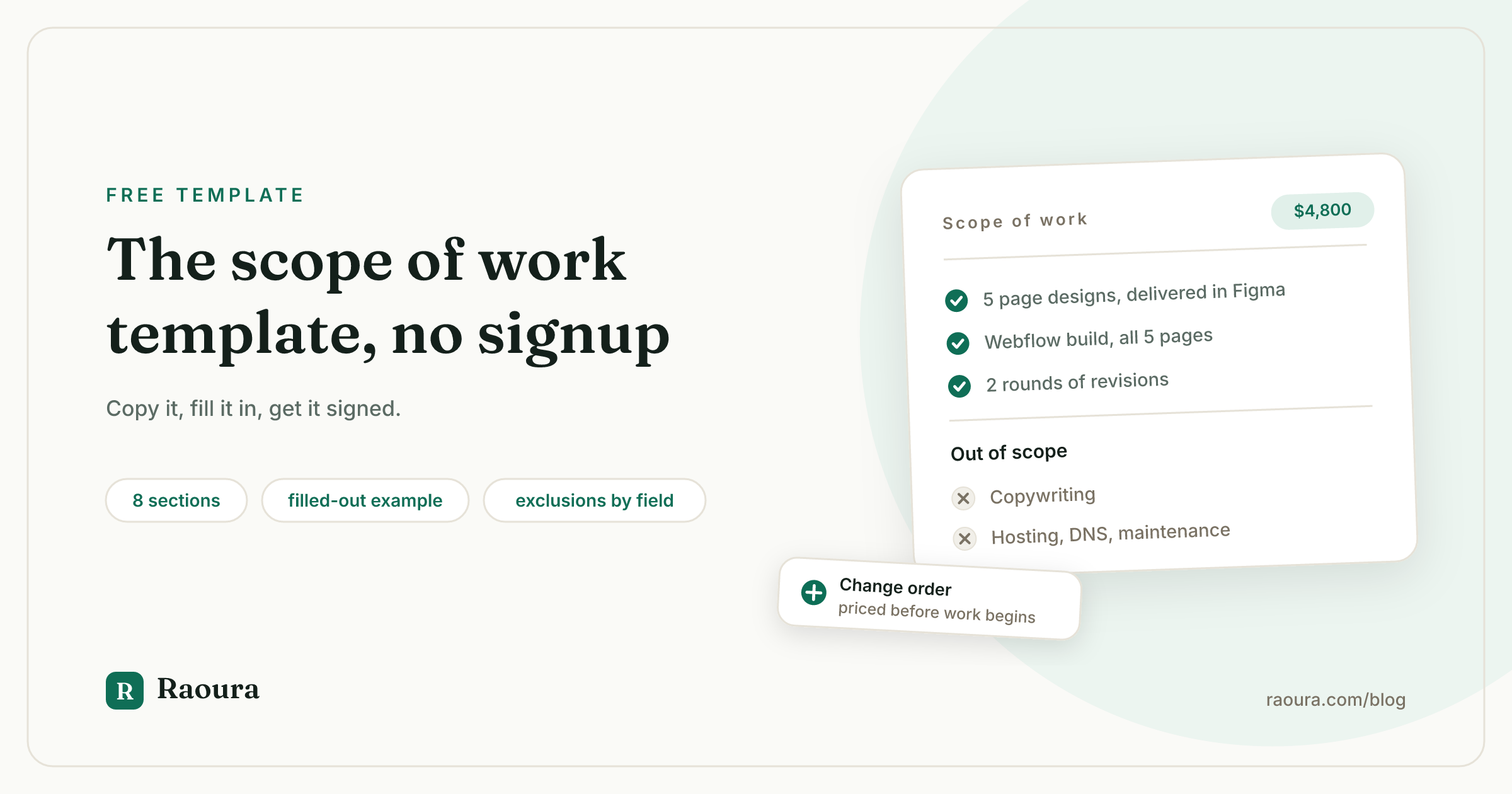
This page is the opposite of that bargain. The full template is below, copy-pasteable, no signup, followed by a filled-out example from a real project structure, exclusion language you can steal by field, and the change order sentence that keeps the scope from quietly doubling. If you want the deeper theory of the document this scope lives inside, that is in how to write a statement of work that prevents disputes. This article is the part you paste.
What a scope of work actually is#
A scope of work is the section of your project paperwork that lists what is included and what is excluded, and on a typical solo project it fits in under 400 words. It is not the whole agreement. The proposal sells the project, the contract sets the legal terms, the statement of work wraps everything in dates, money, and acceptance rules, and the scope of work is the beating heart inside it: the list both of you point at when someone says "I thought that was included."
That last sentence is the whole job. 52% of projects experienced scope creep or uncontrolled changes in the preceding 12 months, per PMI's Pulse of the Profession survey of 5,000+ project practitioners, up from 43% five years earlier. Those are trained project managers with procurement departments behind them. A solo freelancer's only defense is the document, so the document has to be good.
One quotable rule: a scope of work is finished when a stranger could read it and tell you, item by item, whether the project is done.
The template: 8 sections, ready to paste#
The template below has 8 sections and takes about 20 minutes to fill in for a typical project. Paste it into a Google Doc or Word file, replace the bracketed text, delete what does not apply, and attach it to your contract or statement of work. Nothing here requires a lawyer; it requires specificity.
SCOPE OF WORK
Project: [project name]
Client: [client name and company]
Freelancer: [your name and business name]
Date: [date]
Attached to: [contract or statement of work reference, if separate]

1. PROJECT SUMMARY
[Two or three sentences: what the project is and what business outcome
it serves. Example: "Redesign of the client's five-page marketing
website to increase demo signups."]

2. DELIVERABLES (WHAT IS INCLUDED)
[List every deliverable as a countable noun with format and quantity.]
- [Deliverable 1, e.g. "5 page designs (Home, About, Services,
  Pricing, Contact) delivered as Figma files"]
- [Deliverable 2]
- [Deliverable 3]

3. OUT OF SCOPE (WHAT IS NOT INCLUDED)
The following are not included and can be added by written change
order:
- [Exclusion 1, e.g. "copywriting for any page"]
- [Exclusion 2, e.g. "hosting setup, domain, or DNS changes"]
- [Exclusion 3, e.g. "post-launch maintenance or content updates"]

4. CLIENT RESPONSIBILITIES AND ASSUMPTIONS
- Client provides [materials, e.g. "all copy, logo files, and brand
  guidelines"] by [date].
- Feedback arrives consolidated, in writing, from [one named contact].
- Timeline dates shift day for day with any delay in client materials
  or feedback.

5. TIMELINE AND MILESTONES
- [Milestone 1]: [date]
- [Milestone 2]: [date]
- [Final delivery]: [date]

6. REVISIONS
The price includes [2] rounds of revisions per deliverable. A round is
one set of consolidated, written revision requests submitted together.
Additional rounds, and revisions that change the scope, are billed at
[$X/hour] or by change order.

7. PRICE AND PAYMENT SCHEDULE
Total: [$X]. [Deposit %] due before work begins; the remainder is
invoiced per the milestones above. Invoices are due within [7] days.

8. CHANGES AND ACCEPTANCE
Any work not listed in section 2 requires a written change order,
priced and approved before the work begins. Client will review each
deliverable within [7] business days of delivery; deliverables
receiving no written response within that period are deemed accepted.

Agreed:
Client signature: ______________  Date: ______
Freelancer signature: ______________  Date: ______
Two of those sections do most of the dispute prevention, and they are the two most templates skip: section 3 (out of scope) and the deemed acceptance sentence in section 8. If you keep nothing else, keep those. The deemed acceptance mechanic and why clients already accept it every day on Upwork is covered in the statement of work guide.
A filled-out example: $4,800 website project#
Here is the same 8-section template filled in for a $4,800 five-page website project, because a blank template hides exactly the decisions that matter. None of the five top-ranking pages shows a completed freelance example; this is what done looks like.
SCOPE OF WORK
Project: Marketing website redesign
Client: Meridian Bookkeeping LLC (contact: Dana Reyes)
Freelancer: Alex Chen, Chen Design Studio
Date: July 9, 2026
Attached to: Services Agreement dated July 9, 2026

1. PROJECT SUMMARY
Redesign of Meridian's five-page marketing website in Webflow to
modernize the brand and increase consultation bookings. The project
covers design and build of the pages listed below. It is not a
rebrand, an app, or an SEO engagement.

2. DELIVERABLES (WHAT IS INCLUDED)
- 5 responsive page designs: Home, Services, Pricing, About, Contact
- Webflow build of all 5 pages on the client's Webflow account
- 1 reusable blog post template (design and build)
- Contact form connected to the client's email
- 1 handoff call (up to 60 minutes) with a recorded walkthrough

3. OUT OF SCOPE (WHAT IS NOT INCLUDED)
The following are not included and can be added by written change
order:
- Copywriting (client provides final copy for all pages)
- Logo design or brand identity changes
- Stock photo licensing fees
- Blog content migration beyond 3 sample posts
- Hosting, domain, DNS setup, or Webflow subscription fees
- SEO work beyond basic page titles and meta descriptions
- Post-launch maintenance, updates, or training beyond the handoff call

4. CLIENT RESPONSIBILITIES AND ASSUMPTIONS
- Client provides final copy, logo files, and photography by July 20.
- Feedback arrives consolidated, in writing, from Dana only.
- Timeline dates shift day for day with any delay in client materials
  or feedback. If materials are more than 14 days late, Freelancer may
  invoice for work completed and reschedule the remainder.

5. TIMELINE AND MILESTONES
- Kickoff and deposit: July 13
- Homepage design approved: July 27
- All 5 page designs approved: August 10
- Webflow build complete, site live: August 24

6. REVISIONS
The price includes 2 rounds of revisions per deliverable. A round is
one set of consolidated, written revision requests submitted together.
Additional rounds are billed at $95/hour or by change order.

7. PRICE AND PAYMENT SCHEDULE
Total: $4,800.
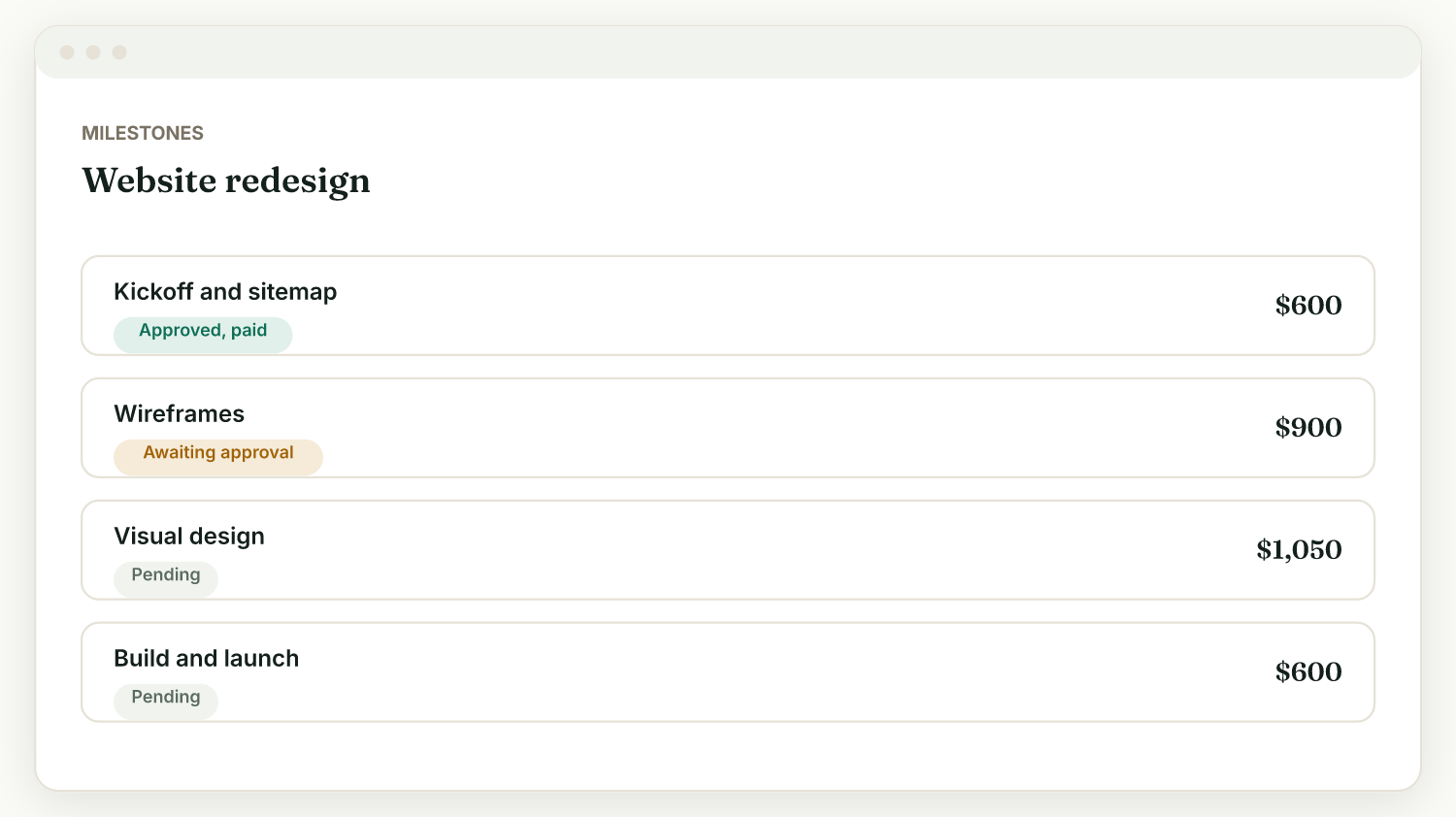
- $1,920 (40%) due at kickoff, before work begins
- $1,440 (30%) due at approval of all 5 page designs
- $1,440 (30%) due at launch
Invoices are due within 7 days.

8. CHANGES AND ACCEPTANCE
Any work not listed in section 2 requires a written change order,
priced and approved before the work begins. Client will review each
deliverable within 7 business days of delivery; deliverables receiving
no written response within that period are deemed accepted, and the
associated invoice becomes due.
Notice what the example does that blank templates cannot teach. The summary says what the project is not. Every deliverable passes the pointing test (you could point at "5 responsive page designs" when they exist). The exclusions name the exact items website clients most often assume are included. And the payment schedule means Alex is never owed more than one phase of work, which is the entire argument of milestone billing. The deposit math is worth copying too: 40% up front is squarely inside the normal range for a project this size.
The exclusions library: steal these by field#
The out-of-scope section prevents more disputes per word than any other section, because scope creep starts where assumptions differ, and every field has predictable assumptions. Copy your field's list, cut what you actually do include, and you have written the most valuable 60 words of your paperwork.
Design and branding: source files and working files (decide, then say so), additional concepts beyond the number quoted, brand collateral not listed (business cards, social templates), printing and print management, stock imagery and font licensing fees, files reworked for mediums not listed.
Writing and content: additional revision rounds after the included ones, interviews beyond the number quoted, image sourcing and licensing, uploading and formatting in the client's CMS, headline or meta variations beyond those listed, performance guarantees of any kind.
Web development: content entry beyond sample pages, hosting, domain, DNS, and SSL setup, plugin or platform license fees, browser support for legacy versions, post-launch bug fixes beyond a named warranty window, speed or SEO work not listed, training beyond the handoff call.
Virtual assistance and marketing: channels not named in the deliverables, ad spend (always the client's card, never yours), community moderation outside stated hours, reporting beyond the named cadence, tools and subscription costs, weekend or same-day turnaround.
If a client pushes back on an exclusion, good: you have surfaced a mismatched assumption while it costs nothing. The scripts for the harder version of that conversation, after the project has started, are in scope creep scripts.
What the top-ranking templates actually give you#
Of the 5 top-ranking scope of work template pages in July 2026, 3 gate the template behind a signup, only 1 offers an ungated download, and 0 show a completed freelance example. We fetched and reviewed each one; this is what you find at the end of each click.
| Page | Ungated? | Formats | Written for | Filled-out example? |
|---|---|---|---|---|
| Bonsai template gallery | No, requires signup | In-app only | Freelancers and agencies | No |
| Smartsheet | Yes | Word, Excel, PDF, Google Docs | Corporate PM and construction | Sample text on 1 of 12 |
| Indy blog | Template not on page | Unclear, in-app | Freelancers | No |
| 10x Management | Yes, but no download | On-page outline only | Companies hiring freelancers | Partially |
| ClickUp | No, requires signup | ClickUp doc only | Anyone | No |
Smartsheet deserves its ranking as the only truly ungated option, but its templates are written for people managing commercial construction and enterprise projects, with stakeholder matrices and cost codes a solo freelancer will never use, and nothing about revisions, deposits, or what happens when the client goes silent. The 10x Management outline is substantive but written from the hiring company's side of the table. The freelancer-side scope, where payment is tied to acceptance and exclusions do the heavy lifting, was not on the SERP. Now it is.
How much scope paperwork does the project deserve?#
Match the paperwork to the project: under $1,000, a half-page scope inside the proposal or email is enough; above $5,000, use all 8 sections attached to a signed agreement. Specificity protects you; length does not.
| Project size | Scope format | Sections to keep |
|---|---|---|
| Under $1,000 | Bulleted scope inside the proposal or a recap email with a written yes | 2, 3, 6, 7 |
| $1,000 to $5,000 | One-page scope of work, signed, merged with your base terms | All 8, kept tight |
| Over $5,000 | Full scope inside a signed statement of work referencing your contract | All 8, plus acceptance criteria per deliverable |
Two notes on that table. First, even the smallest tier needs the out-of-scope list; that is the section whose absence you feel at any price. Second, in New York, Illinois, and California, written agreements stop being optional above thresholds of $800, $500, and $250 respectively under the new freelance payment laws, so the middle and top tiers may be legal requirements depending on where you and your client sit. The details are in freelance payment laws by state.
A scope of work is not legally binding on its own, by the way. It becomes binding when it is signed as part of, or attached to, a contract with the essential terms. If you do not have a base contract yet, start with the annotated freelance contract template and attach this scope to it.
The one sentence that handles every change#
One sentence handles every mid-project change: any work not listed in the deliverables requires a written change order, priced and approved before the work begins. That sentence is already in section 8 of the template, and it converts "can you just quickly add..." from an awkward favor negotiation into a neutral process both sides agreed to on day one.
The change order itself is a five-line document: what is changing, what it costs, how it moves the timeline, and two signatures. The full walkthrough, including the email that introduces a change order without souring the relationship, is in the change order guide. The pattern to internalize: the scope defines the baseline, the change order amends it in writing, and nothing amends it verbally. PMI's data puts 9.9% of every project dollar wasted on poor project performance; for a freelancer, unpriced scope changes are exactly where that waste comes from, except the wasted dollars are yours.
Write it once, use it three times#
A good scope should be written once and reused 3 times: as the proposal's scope section, as the signed agreement's core, and as the checklist you invoice against. The reason freelancers skip scope documents is friction, not ignorance, so the fix is making the same 400 words do all three jobs.
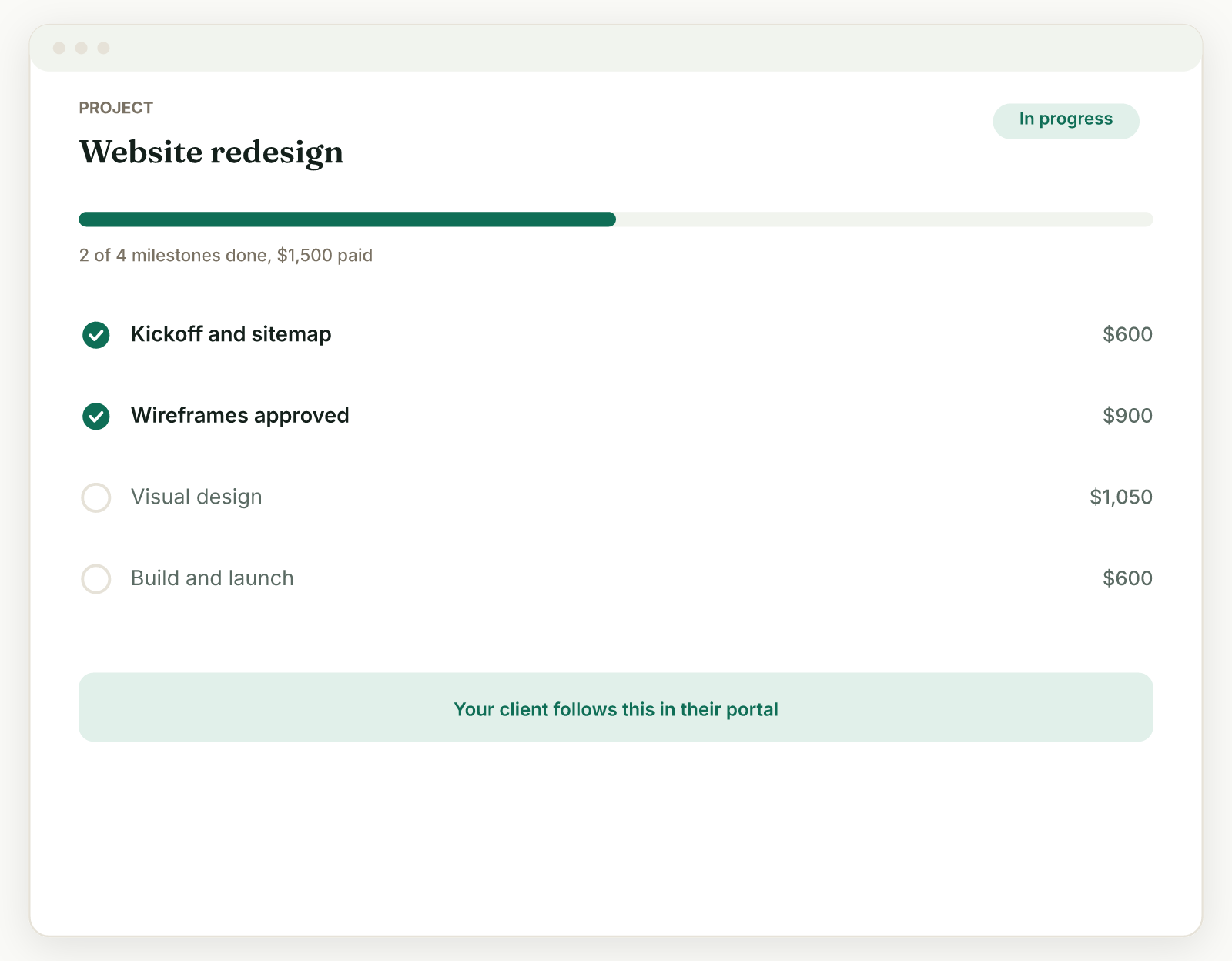
Write the deliverables and exclusions carefully at proposal time, and the conversion to a signed scope is a paste. Tie the milestones to invoices, and your payment schedule writes itself. That is the workflow Raoura is built around: the proposal's scope becomes the signed agreement, milestones carry into invoices automatically, and client approvals happen in the portal with a visible timestamp, so the deemed acceptance window in section 8 is enforceable instead of arguable (Disclosure: Raoura is our product). The template above works identically in a Google Doc with an e-signature app; the software removes the friction, not the need for the document.
Verified July 2026. Scope creep (52%, up from 43%) and project waste (9.9% per dollar) figures are from PMI's Pulse of the Profession 2018 survey of 5,000+ project practitioners, confirmed against the primary PDF this month. State law thresholds confirmed against the NY DOL, Illinois DOL, and California Legislative Information pages. The top-five template page audit (3 of 5 gated, 1 ungated download, 0 completed freelance examples) is our own review of the ranking pages for "scope of work template freelance", July 2026.
Frequently asked questions
What is the difference between a scope of work and a statement of work?
The scope of work is the list of what is included and excluded. The statement of work is the full project document wrapping that list in timeline, price, acceptance rules, and signatures. Corporate writing uses "SOW" for both, which causes the confusion. In practice, solo freelancers merge them into one signed document, which is exactly what the template above becomes when you sign it.
Is a scope of work legally binding?
Not by itself. It binds when both parties sign it as part of a contract containing the essential terms (work, price, payment), or when a signed contract references it as an attachment. A scope pasted into an email becomes useful evidence, but a signature is what removes the argument.
What format should a scope of work be in?
A Google Doc or Word file you can export to PDF for signing. Skip spreadsheet formats; a scope is a narrative and a list, not a data table. What matters is that the signed version is frozen (PDF) and both parties keep a copy.
How detailed should a scope of work be?
Detailed enough that a stranger could verify each deliverable exists, and short enough that your client actually reads it. Under 400 words covers most solo projects. Add detail where disagreement is plausible (formats, quantities, rounds) and cut anything that would not change the outcome of a dispute.
How do I write a scope of work for a retainer?
Scope the month, not the project: a named list of recurring deliverables or a capped block of hours, an exclusions list, a rollover rule (hours expire or carry, pick one), and a change order rule for anything beyond the cap. The template's sections 2, 3, 6, and 7 apply directly; sections 5 and 8 become a monthly cycle.
What if the client sends me their scope of work instead?
Read their version against the 8 sections above and add whatever is missing, usually exclusions, a revision definition, and deemed acceptance, as a signed addendum. A client-drafted scope is not hostile, but it is drafted around their assumptions, and the gaps will all be in the sections that protect you.
Run your client work in one place
Send a proposal, get it signed, invoice, and get paid, with a branded portal your clients will actually use. One flat plan at $17/month, and we never take a cut of your payments.
Try Raoura free for 14 daysNo credit card required. Set up in minutes.
Keep reading
7 Bonsai Alternatives Now That Bonsai Belongs to Zoom (2026)
Zoom acquired Bonsai in late 2025, Bonsai's blog has been quiet since March 2025, and the product is drifting toward agencies. Here are 7 alternatives for solo freelancers, with verified pricing and the fee math Bonsai does not lead with.
7 Dubsado Alternatives That Do Not Need a $2,000 Setup Specialist (2026)
Dubsado's power comes with a catch: new pricing of $35 to $55 per month, and a setup so involved that certified specialists charge $2,000 to $3,500 to do it for you. Here are 7 alternatives you can set up in an afternoon.
Late Fees for Freelancers: What Is Legal and What Actually Works
The standard freelance late fee is 1.5% per month, but almost everything else you have read about late fees is either vague or wrong. Here is what state law actually allows (with the statutes and court cases linked), the exact clause wording that holds up, the invoice data on whether late fees work, and the three states where the law now does the collecting for you.