Retainer Invoicing: Billing That Runs Itself
July 19, 2026
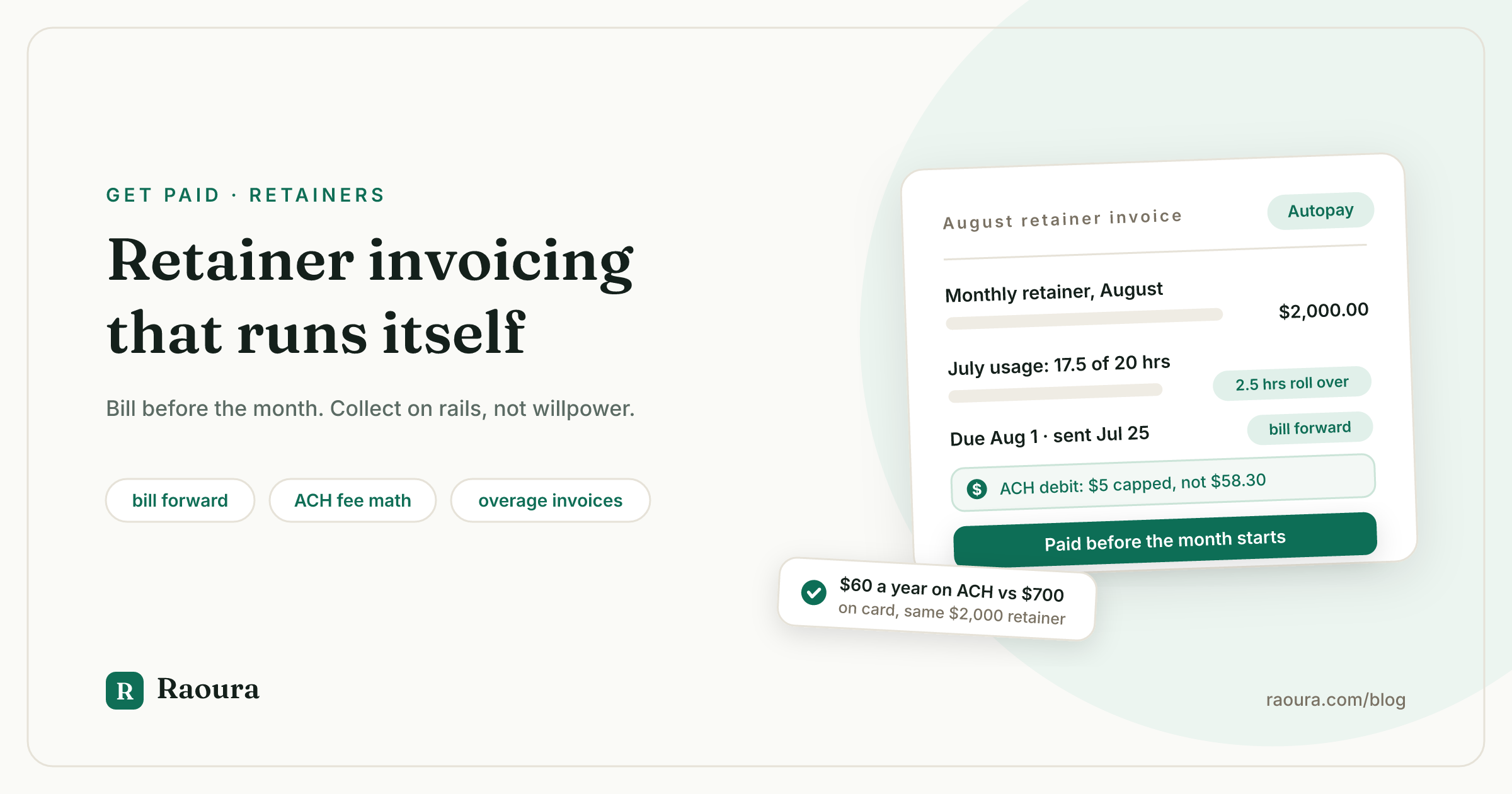
A retainer is the best billing arrangement in freelancing and the least explained. The whole point is that the money arrives on the same date every month before the work starts, which means the invoicing should be the most boring part of your business: same amount, same date, same line item, paid without a conversation.
Yet the pages that rank for "retainer invoice" mostly hand you a blank template and wish you luck, and the questions that actually decide whether your retainer pays on time (bill before or after? what exactly goes on the invoice? what do you do with the four extra hours the client used?) go unanswered everywhere.
This guide is the operating system: what a retainer invoice is and is not, when it goes out, what the line items say, how to move the payment to rails that cost $60 a year instead of $700, how to invoice overages and prorated first months, and what to do the day the payment fails. It pairs with the freelance retainer agreement template, which covers the contract side: this article assumes the agreement exists and handles the money mechanics.
What a retainer invoice is (and what the ranking pages skip)#
A retainer invoice bills a fixed, recurring fee in advance of the period it covers, and of the six pages we fetched ranking for the term in July 2026, exactly one mentioned the single most important rule: send it before the work starts. The rest treat a retainer invoice as a regular invoice with a different title, which misses the point entirely. A regular invoice documents work already done and opens a waiting period. A retainer invoice opens the month: it is the gate the month's work sits behind.
The audit was clarifying about how thin this SERP is:
- A legal-billing vendor ranks first with trust-account guidance that does not apply to freelancers.
- One major invoicing platform's "retainer invoice template" download is actually an estimate spreadsheet.
- Another's sample retainer invoice displays a negative total, and its FAQ tells you to bill retainer clients with "your attorney invoice," a copy-paste artifact from a different template page.
- Nobody covers overage invoicing, proration, payment rails, or failed payments.
If your retainer billing has ever felt improvised, it is not because you missed the good manual. There was no manual.
Retainer invoice vs deposit invoice vs recurring invoice#
These three get used interchangeably and are three different documents: a deposit invoice happens once per project, a retainer invoice repeats on a calendar, and "recurring invoice" is a software feature, not a billing model. Knowing which one you are sending decides the amount, the timing, and what happens to the money if things end early.
| Deposit invoice | Retainer invoice | Recurring invoice (feature) | |
|---|---|---|---|
| What it bills | Part of one project's fee upfront (often 25 to 50%) | A fixed monthly fee for ongoing work or availability | Whatever you configure, on a schedule |
| How often | Once per project | Every cycle, usually monthly | Every cycle |
| Sent | Before the project starts | Before each period starts | Automatic on the schedule |
| Credited against | The project's final invoice | Nothing: it is the whole fee for that period | Depends on what it bills |
| If the relationship ends | Earned or refunded per the contract | Unused prepaid portion handled per the agreement | You cancel the schedule |
The practical takeaway: a deposit belongs to a project and a retainer belongs to a calendar. If you are billing a fixed fee month after month for the same engagement, you are running a retainer and it deserves retainer mechanics, not a fresh ad hoc invoice improvised on a different day each month.
And if your "retainer" bills after the work is done, it is not a retainer at all: it is Net 30 with a subscription costume, and you have handed back the cash-flow advantage that justified the discount you probably gave. The deposit math has its own guide; this article stays on the repeating kind.
Send it before the month, due before the month#
The retainer invoice for August goes out around July 25 and is due August 1, because a retainer bills forward: money first, then the month it pays for. This is the rule that separates a real retainer from wishful thinking, and it is worth being mechanical about. Invoice 5 to 7 days before the period starts, date the due date to the first day of the period, and put the pause rule from your agreement to work: if the fee has not arrived, the month's scope has not started.
Billing forward changes the psychology of late payment. On a regular invoice, a late client has your work and owes you money, and every day of delay costs them nothing. On a prepaid retainer, a late client is delaying their own service. You are not chasing an overdue debt: they are standing in front of a paused subscription.
That difference is why retainer clients who pay by autopay barely think about the invoice at all, and why the QuickBooks Small Business Insights survey found 56% of small businesses carrying unpaid invoices at an average of $17,500 owed, with 47% holding invoices more than 30 days overdue: nearly all of that pain lives in bill-after-the-work arrangements. Structure the retainer forward and you exit that statistic for this client entirely.
One exception worth naming: some agencies and larger companies will tell you their accounts payable process cannot prepay. Sometimes true, sometimes an opening position. The compromise that preserves the mechanics is invoicing on the 25th with the due date on the 1st and the pause clause intact. What you should not do is quietly slide to billing at month-end. That is a different product at the same price.
The line items: what a retainer invoice actually says#
A retainer invoice needs one primary line item with four facts in it: the word retainer, the period it covers, the scope cap, and the effective rate. Vague line items cause disputes and slow approvals, especially once an accounts payable person who has never met you is deciding whether this invoice matches a purchase order. Here is the line item pattern that survives scrutiny:
Monthly retainer, August 2026: up to 20 hours of design support at $100/hr ... $2,000.00
Then, depending on your agreement, up to three supporting lines:
July usage: 17.5 of 20 hours used. 2.5 hours roll over per Section 3 (August cap: 22.5 hours) ... $0.00
Overage, July 2026: 3 hours beyond cap at $125/hr (time log attached) ... $375.00
Prorated onboarding period, July 22 to 31 ... $800.00
The $0.00 usage line is the most underrated line in retainer billing, and we have never seen a ranking template include it. It costs nothing, it answers "what did we get last month" before the client asks, and it quietly proves the cap and rollover rules are being tracked, which is exactly what makes a client comfortable staying on autopay.
If your agreement includes rollover or overage rates and your invoices never mention them, those clauses are decaying: the first time you enforce one after months of silence, it feels like a rug pull. The invoice is where the agreement stays alive.
(New to invoice anatomy generally? Start with how to write an invoice and come back.)
The monthly cycle that runs itself#
A retainer billing cycle has four moving parts (generate, deliver, collect, reconcile), and every one of them can run without you touching it, which matters because manual monthly invoicing fails roughly one month in twelve to vacation, illness, or deadline crush. That failure estimate is ours, from our own review of how solo billing actually breaks: it is not the software that misses a month, it is the human who was going to "send it Friday." The cycle:
- Generate on a fixed date. The 25th, every month, same amount, same line item pattern. Whether software generates it or you duplicate last month's invoice, the date is non-negotiable and lives in a system, not your memory.
- Deliver the same way every time. Same email subject pattern ("August retainer invoice: [Your business]"), same payment link. Retainer invoices should be instantly recognizable, because recognizable invoices get approved on sight.
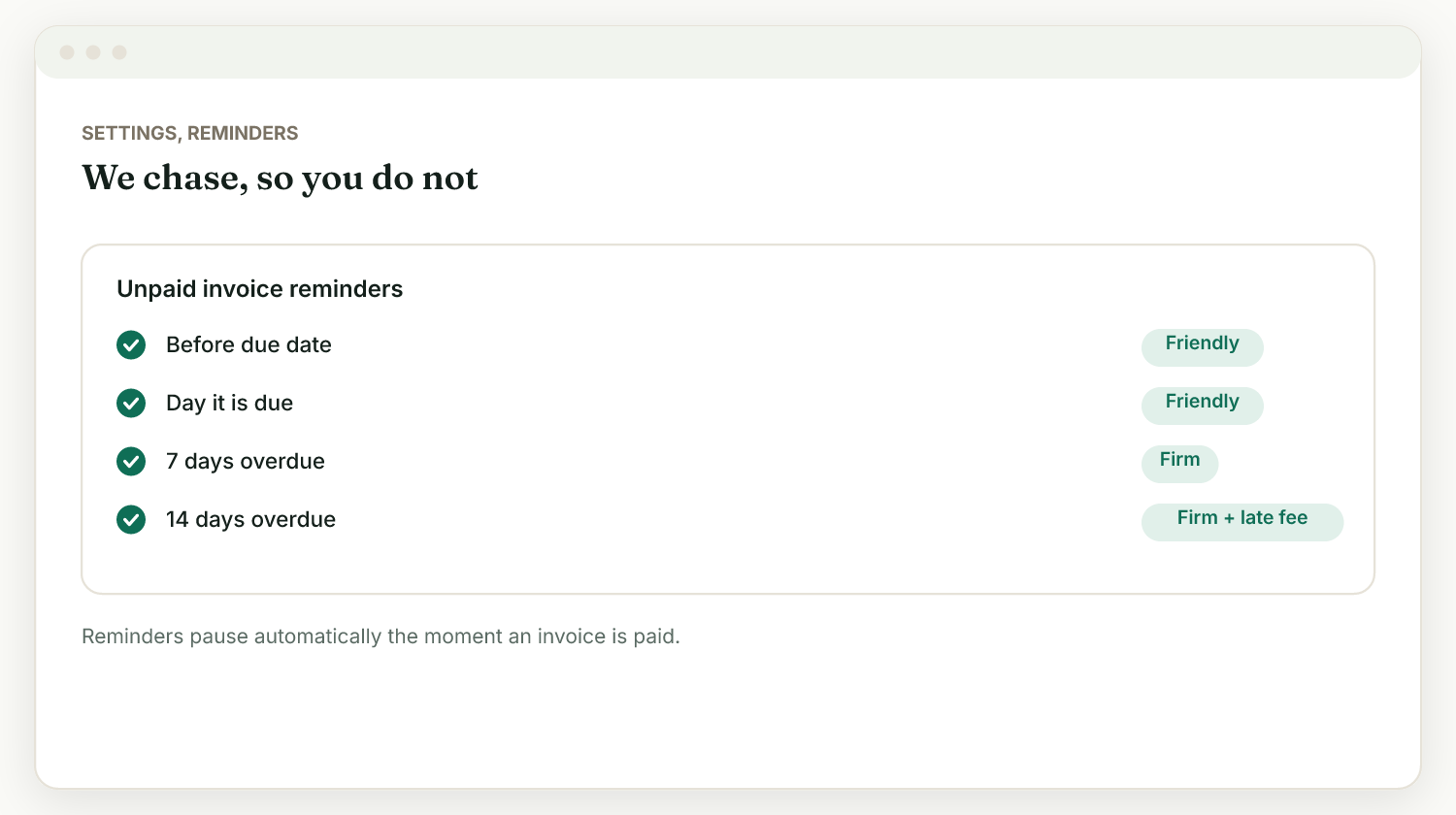
- Collect on rails, not on willpower. Saved payment method or bank debit wherever possible (fee math next section). Where autopay is not possible, automated reminders carry the invoice: a nudge before the due date, one on it, one after. The 3-7-14 reminder cadence exists for exactly the touches you will not want to send manually.
- Reconcile before the next cycle. Once a month, confirm: paid on time or not, hours used versus cap, any overage to bill. Five minutes, and it feeds the usage line on the next invoice.
If you take one thing from this article: the retainer that "runs itself" is not a personality trait, it is these four defaults set up once. The freelancers who chase retainer payments every month have usually automated none of them and are hand-cranking a subscription business monthly, which is the worst of both worlds.
The fee math: same retainer, $60 or $843 a year#
Moving a $2,000 monthly retainer from PayPal checkout to ACH bank debit cuts processing costs from $843 to $60 a year, a $783 difference on a single client, for the same money arriving on the same day. Recurring revenue makes payment rails matter far more than they do on one-off invoices, because every percentage point repeats twelve times. The math on a $2,000/mo retainer, using each provider's published US pricing as of July 2026:
| Rail | Published fee | Cost per month | Cost per year |
|---|---|---|---|
| Stripe ACH debit | 0.8%, capped at $5.00 | $5.00 | $60.00 |
| PayPal Pay by Bank | 1%, capped at $10.00 | $10.00 | $120.00 |
| Stripe card | 2.9% + $0.30 | $58.30 | $699.60 |
| PayPal card (invoicing) | 2.99% + $0.49 | $60.29 | $723.48 |
| PayPal checkout (invoicing) | 3.49% + $0.49 | $70.29 | $843.48 |
Two things fall out of that table.
First, bank debit is the natural retainer rail: the caps ($5 at Stripe, $10 at PayPal) mean the fee stops scaling with the retainer, so a $5,000 retainer still costs $5 to collect through Stripe ACH while the card version costs $145.30 every month.
Second, the ask is easy precisely because it is a retainer: "since this repeats monthly, I set it up as a bank payment, here is the link" is a one-time conversation that saves you $639.60 a year versus card on this one client at Stripe's rates. ACH settles slower than card (days, not minutes), which is another reason the invoice goes out on the 25th rather than the 1st.
The full rail comparison, including invoice-feature fees and international clients, lives in Stripe vs PayPal for freelancers and how to invoice international clients.
Overage and rollover: the second invoice#
Hours beyond the cap go on a separate month-end overage invoice at the overage rate, with a time log attached, and never get silently folded into next month's retainer invoice. Mixing them is the classic mistake: it muddies the clean recurring amount (breaking autopay and invoice recognition), it delays the overage money by a month, and it buries the "you went over" conversation instead of surfacing it.
The overage invoice is small and factual: "Overage, July 2026: 3 hours beyond the 20-hour cap at $125/hr, per Section 4 of our agreement. Time log attached." Send it in the first days of the new month, due on your standard terms. The time log does not need forensic detail, but dates, task descriptions, and durations turn a potentially awkward invoice into an administrative formality.
If overages happen two months in a row, that is not a billing event anymore: it is a pricing signal, and the move is raising the retainer tier at renewal rather than collecting overage fees forever.
Rollover goes the other direction and costs you an invoice line, not an invoice: state the banked hours and the new effective cap on the next retainer invoice, per whatever rollover policy your retainer agreement sets. If you sell hour blocks rather than calendar months, the mechanics differ enough that they get their own treatment (planned: prepaid hour blocks).
Proration: the mid-month start#
Prorate the first partial month at a daily rate using a 30-day convention, and anchor every subsequent cycle to the 1st, because a retainer that renews on the 22nd of every month is a retainer you will eventually misbill. Clients rarely sign on the first of the month, and the wrong move is starting a permanent billing cycle on whatever date they happened to sign.
The clean pattern, with real numbers: the client signs a $2,400/mo retainer on July 22. Daily rate: $2,400 / 30 = $80. Prorated bridge invoice for July 22 to 31 (10 days): $800, due immediately, work starts on receipt. Then the first full retainer invoice goes out July 25 for August, due August 1, and the engagement is on calendar rails forever.
The alternative (first full month starts July 22, renews on the 22nd) works right up until you have three clients on three anchor dates and reconciliation becomes a puzzle.
One caveat: if the signing date is within a few days of the 1st, skip the bridge invoice and just start the retainer on the 1st. An $80 prorated invoice costs more goodwill than it collects.
When the payment fails#
Bank debit payments fail about 2.2% of the time by GoCardless's published figures across 3 million payments, and their retries succeed more than 75% of the time, so the correct first response to a failed retainer payment is a scheduled retry, not an email. Failed payments are a normal part of running recurring billing, and treating the first failure as a non-event (automatic retry in 2 to 3 business days, a friendly automated notice to the client) preserves the relationship while the plumbing sorts itself out. GoCardless's failure-rate data also shows recurring payments in subscription-style categories failing as little as 1.5% of the time: recurring payers are reliable payers.
The escalation only becomes human at the second consecutive failure: a personal note, a fresh payment link, and a reminder of the pause rule, in that order.
And the pause rule is the backstop that makes all of this calm: per your agreement, a retainer month that is not paid has not started, so a failed payment never means you are working for free. It means the subscription is paused, exactly like every other subscription the client has.
If it stays unpaid past your grace window, you are not in retainer billing anymore, you are in standard collections territory, with late fees if your contract provides them.
What running it costs: the tool layer#
Recurring-invoice features start at $23/mo in mainstream accounting tools, but the entry plans carry catches: FreshBooks Lite caps you at 5 billable clients and reserves its Retainers feature for the $43 Plus plan, and PayPal charges $14.99/mo just for its recurring invoice series. Verified against each vendor's published pricing this month:
- QuickBooks Simple Start lists at $38/mo and supports recurring transactions, though Intuit's own help doc notes recurring invoices are saved as drafts for you to review and send.
- FreshBooks Lite lists at $23/mo with the 5-client cap.
- Xero's entry plan runs $25/mo after the intro period and caps you at 20 invoices a month (fine for retainers, tight once overages and projects stack up).
- Stripe Invoicing skips the subscription and takes 0.4% per paid invoice on top of processing.
All of them will generate the invoice; none of them will run the client relationship around it.
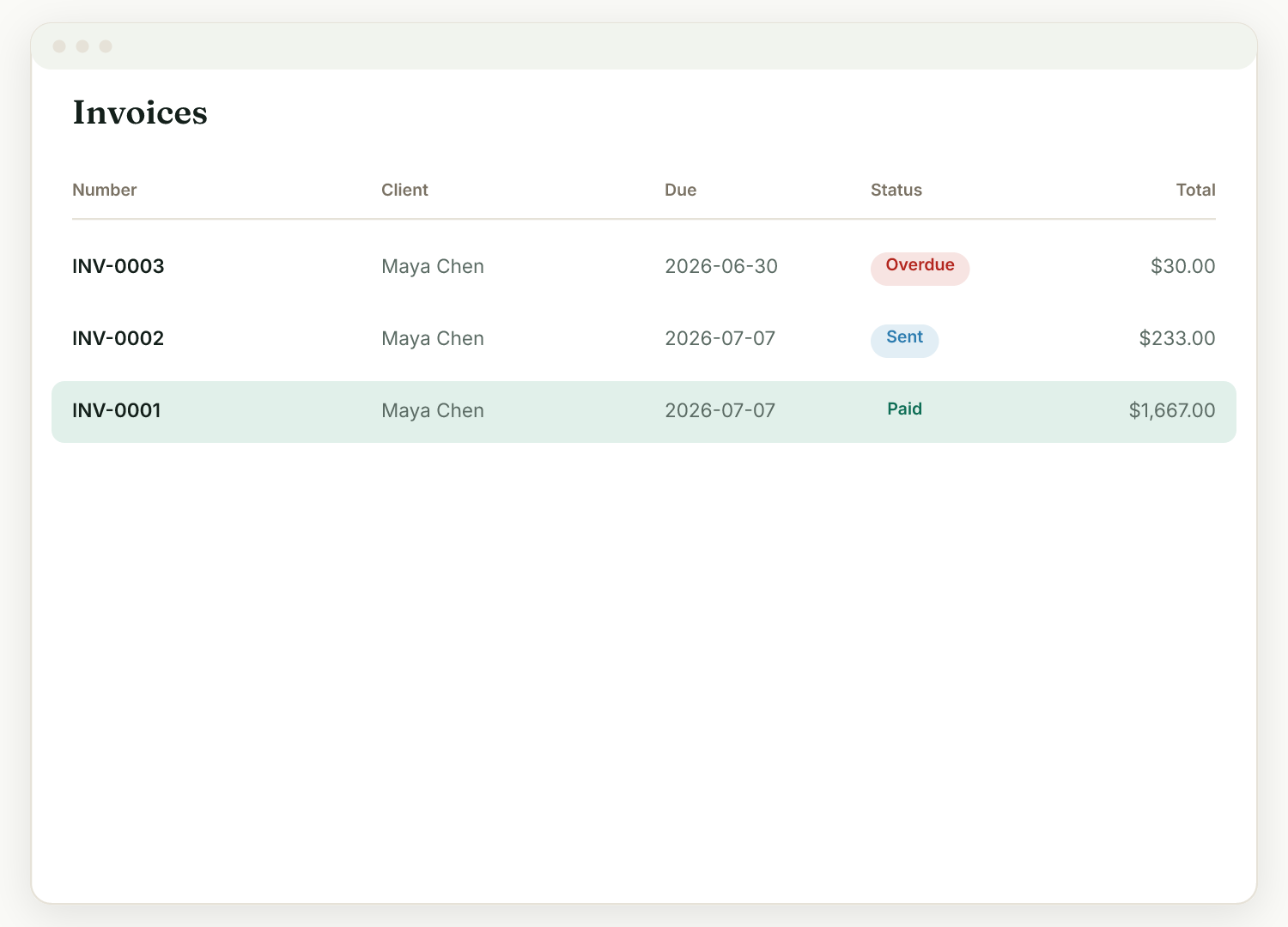
That relationship layer is the job Raoura is built for (disclosure: Raoura is our product). Raoura is client and project management for solo freelancers at one flat $17/mo: proposals, contracts, invoicing, and a branded client portal, with payments through your own Stripe account, so the rails and fees in the table above are yours at Stripe's published rates and nobody marks up your money. The retainer cycle from this article maps onto it directly: the month's invoice takes about a minute to create from last month's, the client pays it in the portal where every prior invoice and the contract already live, and the reminder layer runs the collection touches without you.
The before-due, on-due, and overdue reminders are the exact clockwork touches from step 3 of the cycle, set once in settings and applied to every invoice, in a friendly or firm tone you preview before turning on.
Whatever tool you pick, the test is the same: after setup, does next month's retainer invoice go out, get chased, and get reconciled if you spend the whole month heads-down in client work? If the answer is no, you own a template, not a system.
Verified July 2026. Stripe pricing (2.9% + 30 cents domestic cards, 0.8% ACH capped at $5, Invoicing at 0.4% per paid invoice) is from stripe.com/pricing and stripe.com/invoicing/pricing, fetched this month. PayPal invoicing rates (3.49% + $0.49 PayPal checkout, 2.99% + $0.49 card, 1% capped at $10 Pay by Bank, $14.99/mo Invoice Subscription Service) are from PayPal's US merchant fees page, fetched this month. QuickBooks Simple Start $38/mo, FreshBooks Lite $23/mo with its 5-client cap and Plus-only Retainers feature, and Xero's $25/mo 20-invoice entry plan are from each vendor's published US pricing, fetched this month. Late-payment figures (56% of small businesses owed money, $17,500 average, 47% with invoices 30+ days overdue) are from the QuickBooks 2025 Late Payments Report (Intuit QuickBooks Small Business Insights, 2,487 US small businesses, January 2025 wave). Bank debit failure figures (2.2% overall, 1.5% in subscription categories, 75%+ retry success) are from GoCardless's published failure-rate guide covering over 3 million payments. The SERP audit (6 ranking pages fetched for "retainer invoice" in July 2026: 1 mentioning invoice-before-work, 0 covering overage invoicing, proration, or failed payments) and the one-month-in-twelve manual billing failure estimate are our own.
Frequently asked questions
What is a retainer invoice?
A retainer invoice bills a client's fixed, recurring fee (usually monthly) in advance of the period it covers. Unlike a regular invoice, which documents completed work, a retainer invoice is sent before the work: the period starts when the payment arrives.
Do you invoice a retainer before or after the work?
Before. Send the invoice 5 to 7 days before the period starts with the due date on the period's first day. A retainer billed after the work is done is functionally a regular monthly invoice and gives up the cash-flow protection that defines a retainer.
What should a retainer invoice include?
Everything a standard invoice includes, plus four retainer-specific facts in the primary line item: the word "retainer," the period covered, the scope cap, and the effective rate. Strong retainer invoices also carry a $0.00 usage line reporting last month's hours against the cap and any rollover.
Is a retainer invoice the same as a deposit invoice?
No. A deposit invoice bills part of one project's fee upfront and is credited against the final bill. A retainer invoice bills the entire fee for a recurring period and repeats every cycle. They share the money-before-work principle and nothing else.
How do you invoice hours that go over the retainer?
On a separate overage invoice sent at the start of the next month, at the overage rate your agreement sets, with a time log attached. Do not fold overage into the next retainer invoice: it breaks the clean recurring amount and delays the money.
Can retainer invoices be fully automated?
Mostly. Generation, delivery, reminders, and collection (via saved payment method or bank debit) can all run on schedule; QuickBooks, FreshBooks, Xero, Stripe Invoicing, and client platforms like Raoura each cover different slices. The one step to keep manual is the monthly reconcile: five minutes checking payment, usage, and overage before the next cycle.
Run your client work in one place
Send a proposal, get it signed, invoice, and get paid, with a branded portal your clients will actually use. One flat plan at $17/month, and we never take a cut of your payments.
Try Raoura free for 14 daysNo credit card required. Set up in minutes.
Keep reading
7 17hats Alternatives for Solos Who Don't Need $60/mo Software (2026)
17hats now costs around $60 per month on a single all-inclusive plan, which is a lot for one freelancer. Here are 7 alternatives from $0 to $36 per month, with honest tradeoffs for each.
The Best Client Portal Software for Freelancers in 2026: 10 Tools Audited, No Vendor Spin
Every page ranking for this query is a vendor putting itself at #1, and three of them still recommend a product that changed its name ten months ago. We audited 10 client portals against the six things that matter for a business of one: verified pricing, portal tier gates, client caps, white label, login friction, and payment fees.
Card vs ACH vs Wire for Big Freelance Payments
On a normal invoice, the payment rail barely matters. On a five-figure deposit or project payoff, it is the difference between a $5 fee and a $290 one, and the guides that cover this either skip wire transfers entirely or repeat a Form 8300 myth that is not true. Every fee and rule below is verified from Stripe, Nacha, the IRS, and current bank fee schedules.