Proposal vs Contract vs SOW: What to Send When
July 19, 2026
You send a proposal, the client replies "looks great, let's do it", and you start work. Three weeks later there is a disagreement about revisions, and you both scroll back through email trying to figure out what was actually agreed. Was the proposal the agreement? Was the "looks great" an acceptance? Does the revision limit you mentioned on the call count if it never made it into writing?
This confusion is not a niche problem. It is the default state of solo freelancing, because the three documents involved (proposal, contract, statement of work) have overlapping content, similar-sounding names, and wildly different jobs. Corporate teams have legal departments to keep them straight. You have this guide.
While researching this article we fetched the 4 top-ranking pages for "proposal vs contract" (PandaDoc, Better Proposals, Bonsai, and UpCounsel, July 2026). Our count: 0 of 4 mentioned the state freelance written-contract laws that now apply to millions of US freelancers, and 0 of 4 explained where the statement of work fits. That is the gap this guide closes.
The 30-second answer: three documents, three jobs#
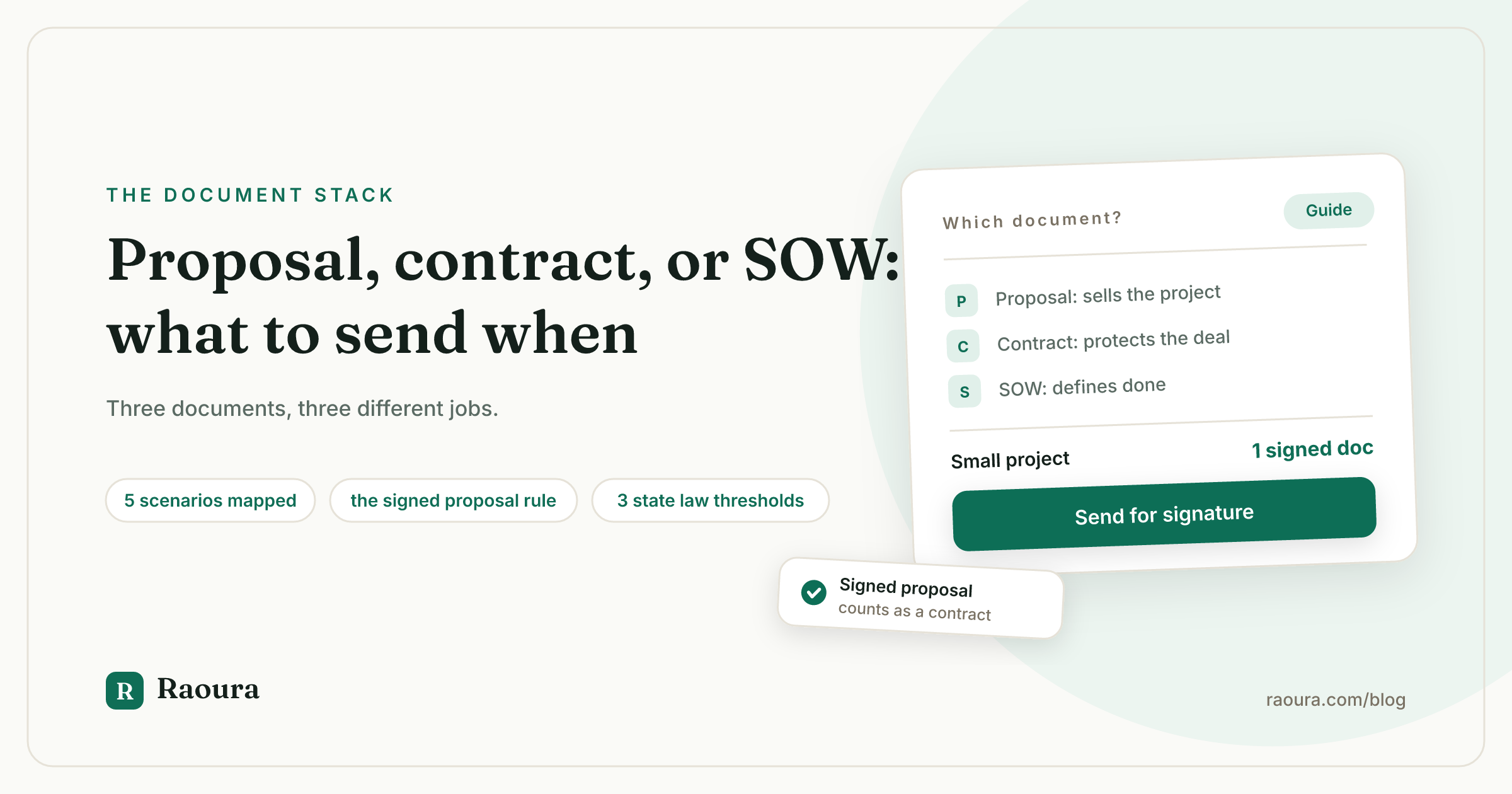
A proposal persuades, a contract protects, and a statement of work defines done: three documents, and a typical solo project needs exactly two of them in writing.
| Document | Its one job | Signed? | Legally binding? | When it exists |
|---|---|---|---|---|
| Proposal | Convince the client to hire you: the problem, your approach, the price | No (usually) | Only if it contains contract elements and both parties accept it | Before the deal |
| Contract | Set the legal terms of the relationship: IP, liability, late fees, termination | Yes | Yes | When the client says yes |
| Statement of work (SOW) | Define one project: deliverables, dates, price, acceptance criteria | Yes | Yes, once signed or attached to the contract | Per project |
Each document does one job:
- The proposal is a sales document. Its scope section should be written carefully (more on why below), but its job is to win the work, not to govern it.
- The contract is a legal document; it exists so that the worst-case scenarios (client never pays, client claims to own your entire portfolio, project dies halfway) have pre-agreed answers.
- The SOW is a definition document; it exists so that "done" is a checklist instead of a feeling. We cover its 9 sections in the statement of work guide.
One quotable rule: the proposal answers "why hire me", the contract answers "what if things go wrong", and the SOW answers "how will we both know this is finished".
Is a proposal legally binding?#
A proposal becomes legally binding when it meets the 3 formation elements of a contract: an offer, an acceptance, and consideration (something of value flowing both ways). Under US contract law, courts look for mutual assent to definite terms plus consideration, not for a document titled "Contract". The label at the top of the page does not decide anything; the content and the acceptance do. See Cornell Law School's contract overview for the formation elements.
In practice this cuts both ways for you:
It can protect you. If your proposal states the deliverables, the price, and the payment terms, and the client accepts it in writing ("yes, let's proceed" in an email can qualify), you likely have an enforceable agreement even though nothing was ever called a contract. This is why your proposal's scope and price should always be exact: it may end up being the operative document.
It can also trap you. If your proposal says "unlimited revisions until you are happy" as a sales flourish, and the client accepts the proposal, that flourish is now arguably a term. Anything you would not want enforced against you should not appear in the proposal.
And it can fail you when you need it. A proposal that leaves key terms open ("final scope to be discussed") or that the client never clearly accepted is not a contract, no matter how much work you have already done on the strength of a phone call. A signature added "for discussion purposes" does not create acceptance either.
The clean solution used by most established freelancers is the signed-proposal hybrid: a proposal whose final page contains the legal terms and an explicit acceptance block ("By signing, Client agrees to the scope, price, and terms above"). One document, one signature, no ambiguity about whether it was accepted. That is a real contract, deliberately, instead of an accidental one. If you are building that final page, start with what should be in a freelance contract.
What to send when: the decision table#
Across the 5 most common solo project scenarios, the right document stack ranges from 1 signed document to 3, and the deciding variables are project size, repeat business, and who is asking.
| Scenario | Send this | Why |
|---|---|---|
| Small one-off project (under about $2,000) | One signed hybrid: proposal with terms and acceptance block | Two documents is overkill; zero signed documents is how small projects go wrong |
| Mid-size new client ($2,000 to $10,000) | Proposal first; on yes, a contract with the scope attached as the SOW | The sales step and the legal step deserve separate documents once real money is involved |
| Repeat client, new project | New SOW referencing the existing contract | Legal terms are already signed; only the project definition changes. This is the MSA pattern, scaled to one person |
| Ongoing retainer | Contract plus a retainer agreement defining the monthly scope | Retainers fail on scope definition, not on legal terms |
| Corporate client with a procurement process | Their MSA (reviewed), your SOW per project | Large clients will insist on their paper for legal terms; the SOW is where you still control scope, acceptance, and dates |
The pattern behind the table: legal terms should be signed once per client, project definitions once per project, and the proposal exists only for deals you have not won yet. When a repeat client asks for a fresh 6-page proposal for a project you will obviously get, what they actually need is a 1-page SOW.
Freelancers who put agreements in writing are not just safer, they earn more: contract users reported 13.7% higher income than comparable freelancers without contracts in the ILR Review analysis of Freelancers Union survey data. It is correlation, but the mechanism (clear scope, enforceable payment terms) is exactly what this document stack provides.
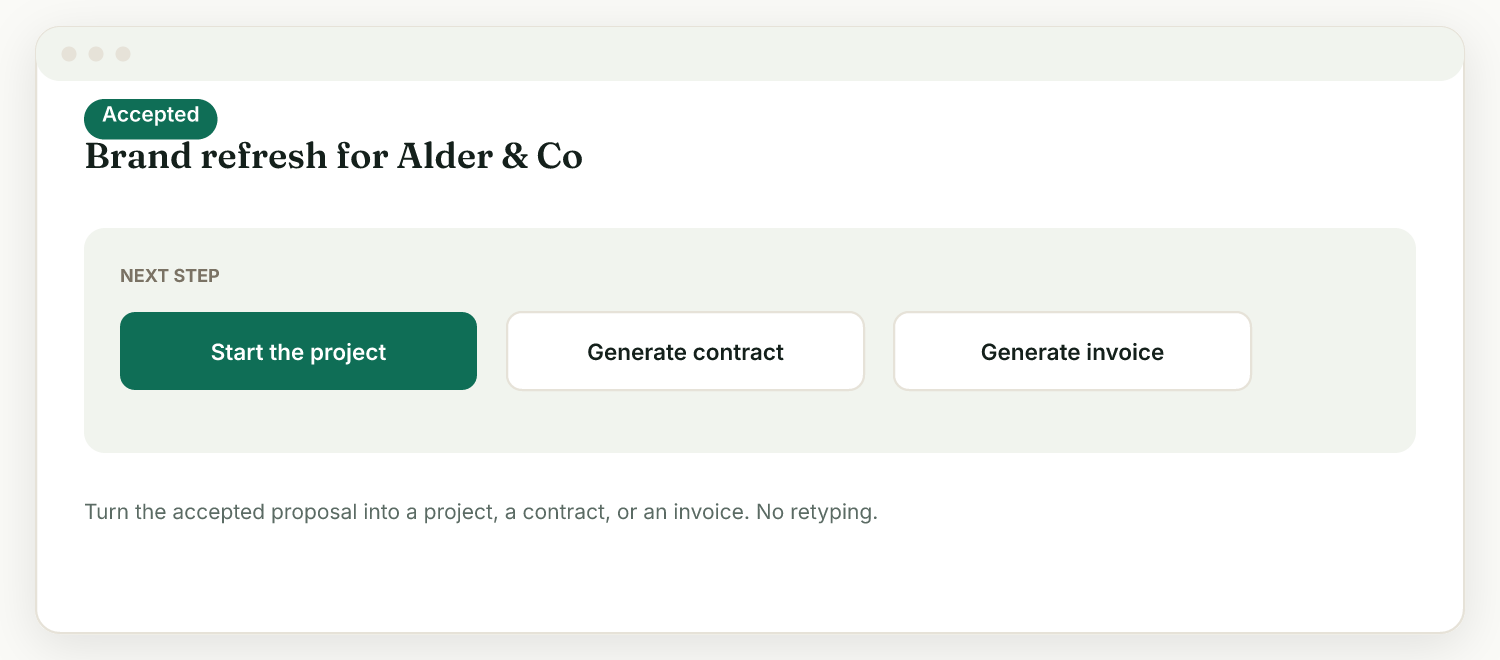
The reason freelancers skip steps in that table is retyping: the same scope gets written in the proposal, again in the contract, again in the invoice. Tools have mostly solved this. In Raoura, an accepted proposal converts into the contract, the project, or the invoice with one click, so the document stack above is three buttons instead of three retyping sessions (Disclosure: Raoura is our product).
When the law decides for you#
In New York, Illinois, and California, a written agreement is now legally required for freelance work above thresholds of $250 to $800, so "should I send a contract" is no longer always your choice.
| State | Law | Written contract required at | Payment due |
|---|---|---|---|
| New York | Freelance Isn't Free Act (statewide Aug 2024) | $800+ (aggregated over 120 days) | Contract date or within 30 days of completion |
| Illinois | Freelance Worker Protection Act (Jul 2024) | $500+ (aggregated over 120 days) | Contract date or within 30 days, double damages for violations |
| California | SB 988 (Jan 2025) | $250+ (aggregated over 120 days, professional services) | Contract date or within 30 days of completion |
Sources: NY DOL, Illinois DOL, California SB 988.
Two details matter for the proposal-vs-contract question specifically. First, the obligation sits on the hiring party, but the practical burden sits on you, because you are the one left unpaid when there is no paper.
Second, a signed hybrid proposal satisfies these laws fine, as long as it contains the statutorily required terms (the work, the price, the payment date). An unsigned proposal plus a "looks great" email is exactly the arrangement these laws were written to end.
The full picture, including what happens when you and the client are in different states, is in freelance payment laws by state.
The signature step: where deals are won and lost#
E-signed agreements close 15% more often and 60% faster than unsigned ones, according to Proposify's 2026 analysis of 742,000 proposals, and e-signatures have carried full legal weight in the US since the year 2000.
The ESIGN Act (15 U.S.C. 7001) says a contract may not be denied legal effect solely because it was signed electronically. There is no legal reason to print, sign, scan, or chase wet ink, and one top-ranking guide still advising "hand-signed for court" is simply out of date. The practical details (what makes an e-signature valid, audit trails, typed vs drawn signatures) are in are e-signatures legally binding.
The same Proposify dataset (State of Proposals 2026) has a less known finding worth stealing: counter-signed proposals, where you sign before sending so the client's signature is the only missing step, closed 65% more often and 25% faster than proposals the sender had not signed. Signing first signals commitment and removes a round trip. It costs you nothing.
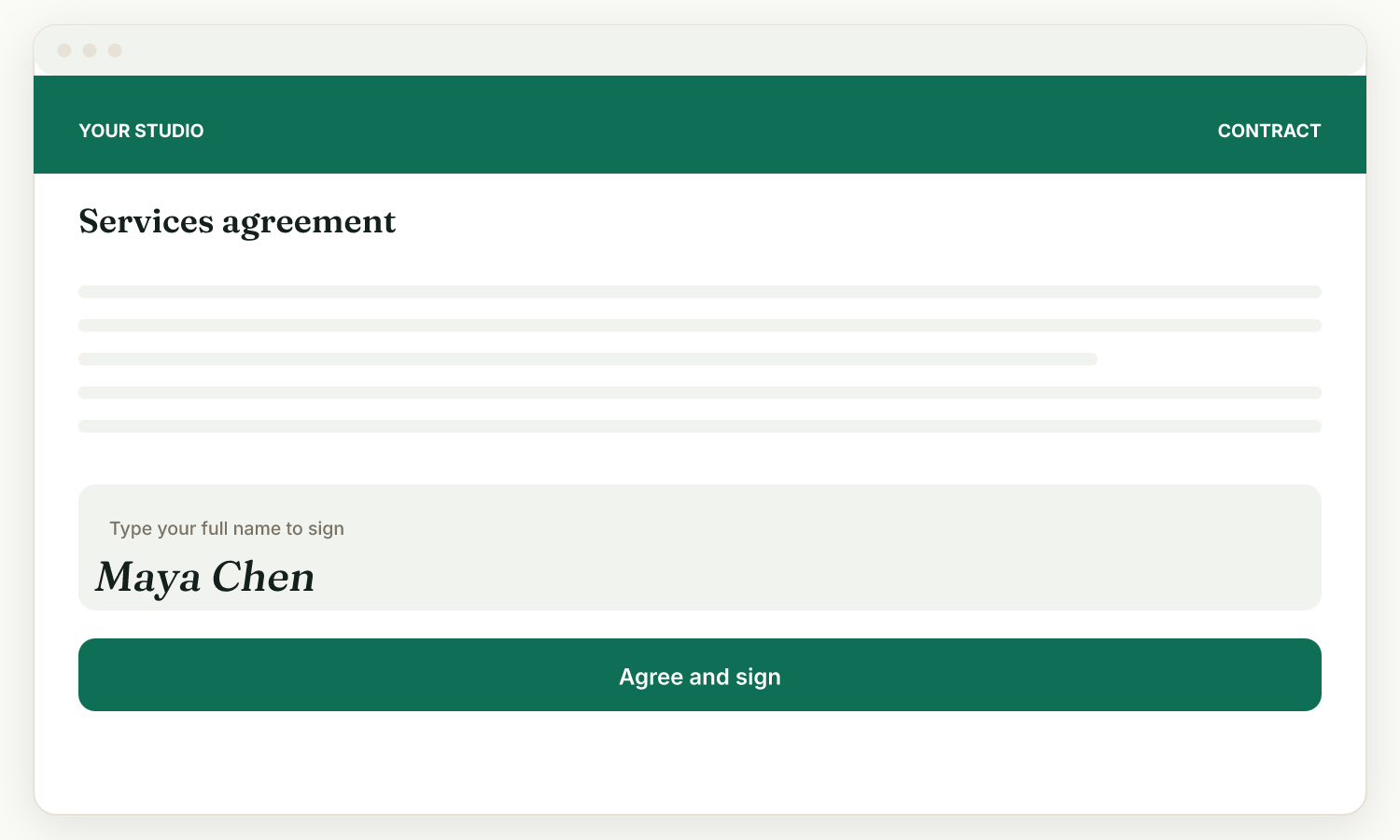
Whatever tool you use, the standard to hold it to: the client should be able to read and sign from a phone, both parties should get a copy automatically, and the record should show who signed and when.
Verified July 2026. Contract formation elements from Cornell Law School's Legal Information Institute; close-rate and counter-signing figures from Proposify's State of Proposals 2026 (742,000 proposals analyzed); income figure from the ILR Review analysis of Freelancers Union survey data (Rodgers, Horowitz, and Wuolo, 2014); state law thresholds confirmed against the NY DOL, Illinois DOL, and California Legislative Information; e-signature validity from 15 U.S.C. 7001. The 0-of-4 top-ranking-page observation is our own count, July 2026.
Frequently asked questions
Is a proposal legally binding?
Not by default. It becomes binding when it contains definite terms (work, price) and both parties accept it, because US contract law looks for offer, acceptance, and consideration, not for the word "contract" in the title. A signed proposal with an acceptance block is a contract; an unsigned proposal with vague terms is marketing.
Can a proposal replace a contract?
Yes, if you build it to. Add your legal terms (IP transfer on payment, late fees, termination, revision limits) and an explicit signature block to the proposal's final page. What cannot replace a contract is a bare proposal plus a verbal yes.
What is the difference between an SOW and a contract?
The contract governs the relationship (IP, liability, payment terms, termination) and is signed once per client. The SOW defines one project (deliverables, dates, price, acceptance criteria) and is created per project, referencing the contract. On small projects the two are commonly merged into one signed document.
What is an MSA and do freelancers need one?
A master service agreement is the corporate name for the once-per-client contract that individual SOWs attach to. Solo freelancers use the same pattern without the name: sign legal terms once, then send short SOWs for each new project. If a corporate client sends you their MSA, read it before signing; their defaults favor them.
Do I need a new contract for every project with the same client?
No. Sign the relationship terms once, then cover each new project with an SOW that references the original contract. You only need a new contract if the legal terms themselves change, for example moving from project work to a retainer.
In what order do the documents go?
Proposal (client says yes), then contract with the scope attached or referenced (both sign), then work, then invoice. On small projects: signed hybrid proposal, then work, then invoice. The invoice is never the first document a client sees with the price on it; by invoice time, the price should be old news.
Run your client work in one place
Send a proposal, get it signed, invoice, and get paid, with a branded portal your clients will actually use. One flat plan at $17/month, and we never take a cut of your payments.
Try Raoura free for 14 daysNo credit card required. Set up in minutes.
Keep reading
7 17hats Alternatives for Solos Who Don't Need $60/mo Software (2026)
17hats now costs around $60 per month on a single all-inclusive plan, which is a lot for one freelancer. Here are 7 alternatives from $0 to $36 per month, with honest tradeoffs for each.
The Best Client Portal Software for Freelancers in 2026: 10 Tools Audited, No Vendor Spin
Every page ranking for this query is a vendor putting itself at #1, and three of them still recommend a product that changed its name ten months ago. We audited 10 client portals against the six things that matter for a business of one: verified pricing, portal tier gates, client caps, white label, login friction, and payment fees.
Card vs ACH vs Wire for Big Freelance Payments
On a normal invoice, the payment rail barely matters. On a five-figure deposit or project payoff, it is the difference between a $5 fee and a $290 one, and the guides that cover this either skip wire transfers entirely or repeat a Form 8300 myth that is not true. Every fee and rule below is verified from Stripe, Nacha, the IRS, and current bank fee schedules.