Payment Reminder Email Templates: 10 Copy-Paste Emails by Days Overdue
Search for a payment reminder email template and you get handed an accounts receivable department. We fetched the five pages that rank for this keyword in July 2026 and counted: 45 templates between them, and all 45 are written in the corporate "we". "We have yet to receive payment from yourselves." "Our records indicate an outstanding balance." One of the five gates its templates behind a lead form that asks for your company revenue, and another still has lorem ipsum filler sitting in the published page.
That voice fails you twice. You are one person, so "our records indicate" reads as either pompous or evasive, and your client knows it. And the person you are nudging is not a stranger in an accounts payable queue: it is the same person who approves your next project. You need reminders that are impossible to take offense at and impossible to ignore, written the way one professional writes to another.
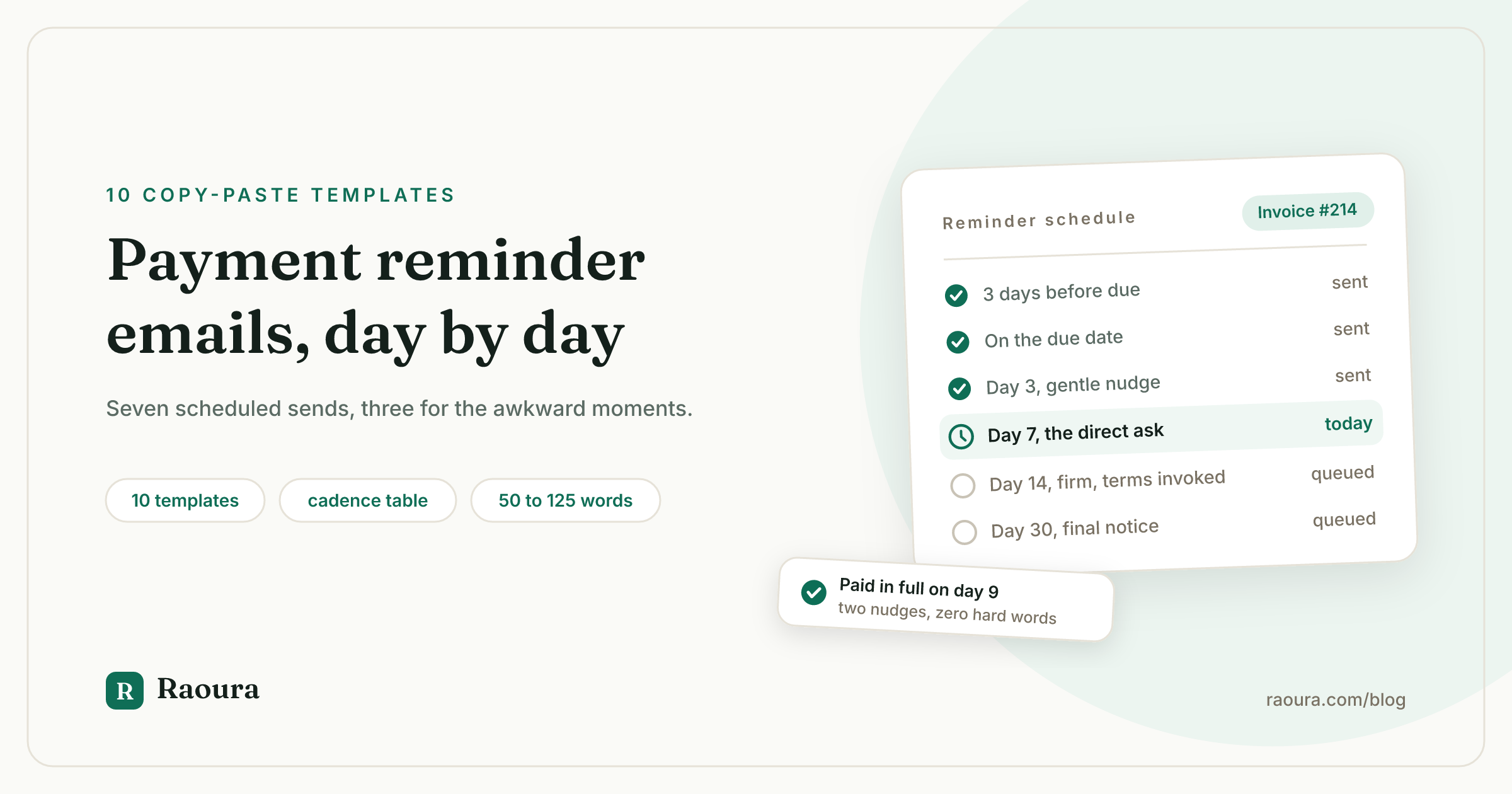
This page is the library: 10 templates, seven keyed to days overdue (starting three days before the due date, which is the highest-leverage email of the lot) and three for the moments that fall off the script, plus the cadence table that tells you when each one goes out. If you want the full collection system around these emails, that is how to get clients to pay invoices on time. If day 30 passes and the invoice is still open, the reminders have done their job and you move to the unpaid invoice escalation ladder. This article is the part you paste.
Why you send seven reminders, not one#
Businesses that follow up on 100% of their overdue invoices are 76% more likely to be paid within a week, according to Chaser's 2026 accounts receivable survey of 300+ finance professionals. The same research found that 92% of businesses are now typically paid after their invoice due date, up from 87% in 2022, and that 31% of businesses leave some invoices unchased every month. The stakes compound quietly: 56% of US small businesses are owed money from unpaid invoices, averaging $17,500 per business, per the QuickBooks 2025 Late Payments Report. Late payment is the default state of invoicing. Chasing is what changes it.
The freelance-specific numbers say the same thing with better news attached. Bonsai analyzed three years of invoicing data from over 100,000 freelancers and found that 29% of freelance invoices are paid at least a day late, but over 75% of those late invoices are paid within 14 days of the due date, and 90% within a month. Read that as a chasing strategy: most late payers are not refusing to pay. They forgot, the invoice is buried, or an approval is sitting in someone's drafts. A calm, scheduled sequence of nudges in the first two weeks resolves three quarters of late invoices without a single hard word. That is why the cadence below is dense early (three emails in the first week after the due date) and only turns firm after the data says something is actually wrong.
One more number for motivation: Xero's Small Business Insights data across 32,000+ US small businesses puts the average wait to get paid at 28.8 days, with late invoices settled 9.0 days past due on average. Nine days is two well-timed emails. This is a solvable problem.
The cadence: what to send when#
The full sequence is seven emails across 33 days: one before the due date, one on it, and five after, at days 3, 7, 14, 21, and 30. Every ranking guide agrees on the skeleton (nudge early, escalate slowly, change channel around day 30), but none of them explains why each touch exists, so here is the schedule with the job each email does.
| # | Send | Subject line | Tone | The job |
|---|---|---|---|---|
| 1 | 3 days before due | Invoice #214 due Friday, Mar 6 | Warm | Kill "I never received it" before it exists |
| 2 | Due date | Invoice #214 due today | Friendly | Make paying today the easy default |
| 3 | 3 days overdue | Quick nudge: invoice #214 | Light | Surface the forgotten invoice, zero pressure |
| 4 | 7 days overdue | Invoice #214, one week past due | Direct | Get a reply, not just a payment: ask for a date |
| 5 | 14 days overdue | Invoice #214, two weeks overdue: can we resolve this week? | Firm | Name the pattern, invoke terms, offer an exit |
| 6 | 21 days overdue | Invoice #214: pausing work until this is resolved | Serious | Change the cost of not paying |
| 7 | 30 days overdue | Final notice: invoice #214, 30 days past due | Formal | Close the reminder phase, open the escalation phase |
| 8 | When a promised date passes | Following up on the payment promised for Mar 20 | Steady | Convert a broken promise into a firm date |
| 9 | When partial payment lands | Received $1,000 of $2,500, invoice #214 | Appreciative | Bank the goodwill, pin down the balance |
| 10 | When payment lands | Paid in full, thank you | Grateful | Train the next invoice to arrive on time |
Two rules make the schedule work. First, never skip a step to seem polite: the sequence is only calm because it is complete, and a client who hears nothing for three weeks and then gets a "final notice" experiences you as erratic, not patient. Second, put these on a calendar (or let software send the early ones) the day you send the invoice, because the sequence you improvise under resentment is always worse than the one you wrote when you were calm.
The templates#
Every body below is under 125 words, because short reminders get read and long ones get filed. Each one assumes the invoice is attached again (never make the client search) and that there is one payment link one click away. Swap the bracketed details, keep the length.
1. Three days before the due date#
Subject: Invoice #214 due Friday, Mar 6
Hi Dana,
A quick heads-up that invoice #214 for the homepage redesign ($2,500) is due this Friday, March 6. I have attached it again so it is easy to find, and you can pay directly here: [payment link].
If anything on the invoice needs correcting, or if it needs to route through someone else on your side, just let me know and I will sort it today.
Thanks!
Sam
The pre-due reminder is the highest-return email in the sequence and the one most freelancers skip because it feels like nagging before anything is wrong. It is not nagging, it is service: it re-surfaces the invoice, removes the "never received it" excuse, and flushes out routing problems ("oh, send that to accounting@") while the invoice is still current. Bonsai's data shows most freelancers give clients two to four weeks to pay, which is plenty of time for an email to sink to page four of an inbox.
2. On the due date#
Subject: Invoice #214 due today
Hi Dana,
Invoice #214 ($2,500) is due today. Here is the payment link again: [payment link], and the invoice is attached.
If payment is already on its way, thank you, and please ignore this. If not, today is a great day for it.
Thanks so much,
Sam
Short, light, and sent in the morning so there is a full business day to act on it. The "if it is already on its way, ignore this" line matters: it lets the client who paid yesterday feel seen instead of scolded, which keeps every later email in the sequence readable.
3. Three days overdue#
Subject: Quick nudge: invoice #214
Hi Dana,
Just a gentle nudge on invoice #214 ($2,500), which was due on Friday. I know invoices slip through busy inboxes, so here it is again, attached, with the payment link: [payment link].
If there is a snag on your end, a missing PO number, a new approval step, anything, tell me and I will fix my side of it same day.
Thanks!
Sam
At three days you assume good faith completely, because the numbers back it: three quarters of late freelance invoices get paid within two weeks. The job here is only to surface the invoice. The offer to fix "a snag on your end" is doing quiet work, since it gives a client with a real blocker an easy way to say so now instead of at day 21.
4. Seven days overdue#
Subject: Invoice #214, one week past due
Hi Dana,
Invoice #214 ($2,500) is now a week past due, and I have not heard back on my earlier note, so I wanted to check in properly.
Could you let me know when payment will go out? If there is an issue with the invoice or the timing, I would much rather know than guess.
Payment link: [payment link]. Invoice attached.
Thank you,
Sam
The goal shifts at day seven: you are no longer asking for money, you are asking for a reply. A specific question ("when will payment go out?") is much harder to ignore than a restated request, and whatever answer comes back gives you the next move. A date means you set a calendar reminder for that date (template 8 if it passes). Silence means the sequence continues on schedule.
5. Fourteen days overdue#
Subject: Invoice #214, two weeks overdue: can we resolve this week?
Hi Dana,
Invoice #214 ($2,500) is now two weeks past its March 6 due date, and I have checked in twice without a response. I want to get this resolved this week.
Per the payment terms we agreed, a late fee of 1.5% per month applies from day 15, which I would honestly prefer not to charge. If cash flow timing is the problem, tell me, and we can set a payment date or split it into two payments. What I need today is a reply.
[payment link]
Thanks,
Sam
Day 14 is where the tone earns the word firm: you recap the history (due date, two contacts, no response), you invoke consequences you already have the right to, and you still leave two doors open (a set date or a split payment). Only mention a late fee if your contract actually provides for one; the freelance late fee guide covers how much and what is enforceable where. If your contract is silent on fees, drop that sentence and keep the deadline energy: "I want to get this resolved this week" does most of the work on its own.
6. Twenty-one days overdue#
Subject: Invoice #214: pausing work until this is resolved
Hi Dana,
Invoice #214 ($2,500) is now three weeks past due and I have not been able to reach you by email, so two things.
First, I am pausing work on the current phase as of Friday until the balance is settled, as our agreement provides. Second, I would like to move this to a quick call, since email is clearly not landing. I will try you Thursday at 10am unless another time works better.
The payment link, one more time: [payment link].
Sam
Two escalations happen at once here, and both are about changing the channel, not raising the volume. Pausing work makes nonpayment cost the client something concrete (only announce it if you have ongoing work and your contract supports it). And the phone call breaks the pattern: it is easy to ignore a fourth email, and much harder to ignore a calm human voice. Note what the template does not do: no anger, no guilt, no "I am very disappointed". Every sentence is a fact or a next step.
7. Thirty days overdue#
Subject: Final notice: invoice #214, 30 days past due
Dana,
Invoice #214 ($2,500, due March 6) is now 30 days past due. I have sent five reminders and attempted a call without resolution.
This is my final informal request. If payment is not received by April 12, I will pursue the remedies in our agreement, beginning with a formal demand letter, and late fees will continue to accrue as invoiced.
I would still much rather resolve this simply: [payment link].
Sam
[Your business name]
The 30-day email is the hinge between reminding and enforcing, and its power comes from the paper trail behind it: date-stamped, unanswered, unfailingly professional reminders are exactly the evidence a demand letter, a state complaint, or a small claims filing wants to see. From here the playbook changes entirely, and it lives in the unpaid invoice escalation ladder: demand letter at 30 to 60, small claims at 60 to 90. If you work in New York, Illinois, or California, state freelance payment laws can add double damages to your claim, which is worth mentioning in the demand letter, not here.
8. The promised payment date passed#
Subject: Following up on the payment promised for Mar 20
Hi Dana,
On March 14 you mentioned invoice #214 would be paid by the 20th. It has not arrived yet, so I wanted to flag it in case something failed on the way, a bounced transfer or an approval that did not go through.
Could you confirm it was sent, and if not, give me a date I can rely on? I am keeping the work schedule for the next phase pinned to it.
[payment link]
Thanks,
Sam
"The check is processing" is where sequences usually die, because each promise resets the freelancer's patience to zero. Do not reset: quote the promise back with its date, offer a face-saving technical explanation, and ask for a date you can "rely on", which signals that this one gets remembered too. If a second promised date passes, skip the remaining pleasantries and jump to whichever numbered step matches the calendar.
9. Partial payment arrived#
Subject: Received $1,000 of $2,500, invoice #214
Hi Dana,
Thank you, the $1,000 payment on invoice #214 came through today. I appreciate you moving on it.
That leaves $1,500 outstanding. Can you confirm when the balance will follow? If it helps, I can send a fresh invoice for the remainder so your records stay clean.
[payment link for the balance]
Thanks again,
Sam
A partial payment is a good sign (someone who intends to stiff you sends nothing), so thank them like you mean it, then pin the balance to a date in the same breath. The offer to reissue the invoice for the remainder is practical, not just polite: many accounting systems handle a clean new invoice better than a half-paid old one, and it removes the last administrative excuse.
10. Payment arrived: the thank-you#
Subject: Paid in full, thank you
Hi Dana,
Invoice #214 is paid in full, thank you! Receipt attached for your records.
It has been a pleasure working on the redesign. The next phase kicks off Monday as planned, and I will have the first update to you by Friday.
Sam
The thank-you is not decoration, it is training data for the next invoice. FreshBooks' analysis of over one million invoices found that invoices containing "thank you" get paid 89.61% of the time versus 78.62% for the average invoice, an 11-point gap from courtesy alone. Gratitude measurably moves payment behavior, so spend it deliberately: every on-time payment gets thanked, which makes your day-3 nudge on the next project feel like it comes from a friendly professional rather than a bill collector.
Five writing rules that run through all ten#
Keep every reminder between 50 and 125 words, put the invoice number and a deadline in the subject line, and say please and thank you, which FreshBooks' million-invoice study links to an 11-point higher payment rate. The rest of the rules the ranking pages agree on, and the data supports:
The subject line does half the job, because plenty of reminders get actioned from the inbox preview alone. "Invoice #214 due Friday" beats "Checking in" every time, and never mark a reminder urgent before day 14. Attach the invoice to every single email, even the seventh, because the client who finally decides to pay at day 21 should not have to scroll back through the thread to find it. One link, one ask per email: every extra request ("also, could you review the mockups?") gives the reader something easier to reply to than paying you. Escalate the greeting last: notice the templates go from "Hi Dana!" to "Hi Dana," to "Dana," across 33 days, and that shift does more tonal work than any sentence. And if a late fee is in your contract, name it at day 14, not before: FreshBooks' same study found invoices whose terms mention interest get paid 92.15% of the time, the strongest single wording effect they measured, but the fee only works as a consequence you clearly would rather not use. The payment terms guide covers setting all of this up before the invoice ever goes out, which is where the real fix lives.
Put the sequence on autopilot (the early emails, anyway)#
The first three emails in this sequence should never be typed by a human being, because they contain no judgment calls, and 31% of businesses admit some invoices simply never get chased at all. The pre-due reminder, the due-date note, and the day-3 nudge are pure clockwork, and clockwork is what software is for. Chaser's 2026 data makes the case bluntly: consistency, not toughness, is what gets invoices paid, and businesses that chase everything are 76% more likely to be paid within a week.
The judgment emails are a different matter. Day 14, day 21, and day 30 involve reading the relationship, deciding whether to invoke fees or pause work, and sometimes picking up the phone, so keep a human (you) on those.
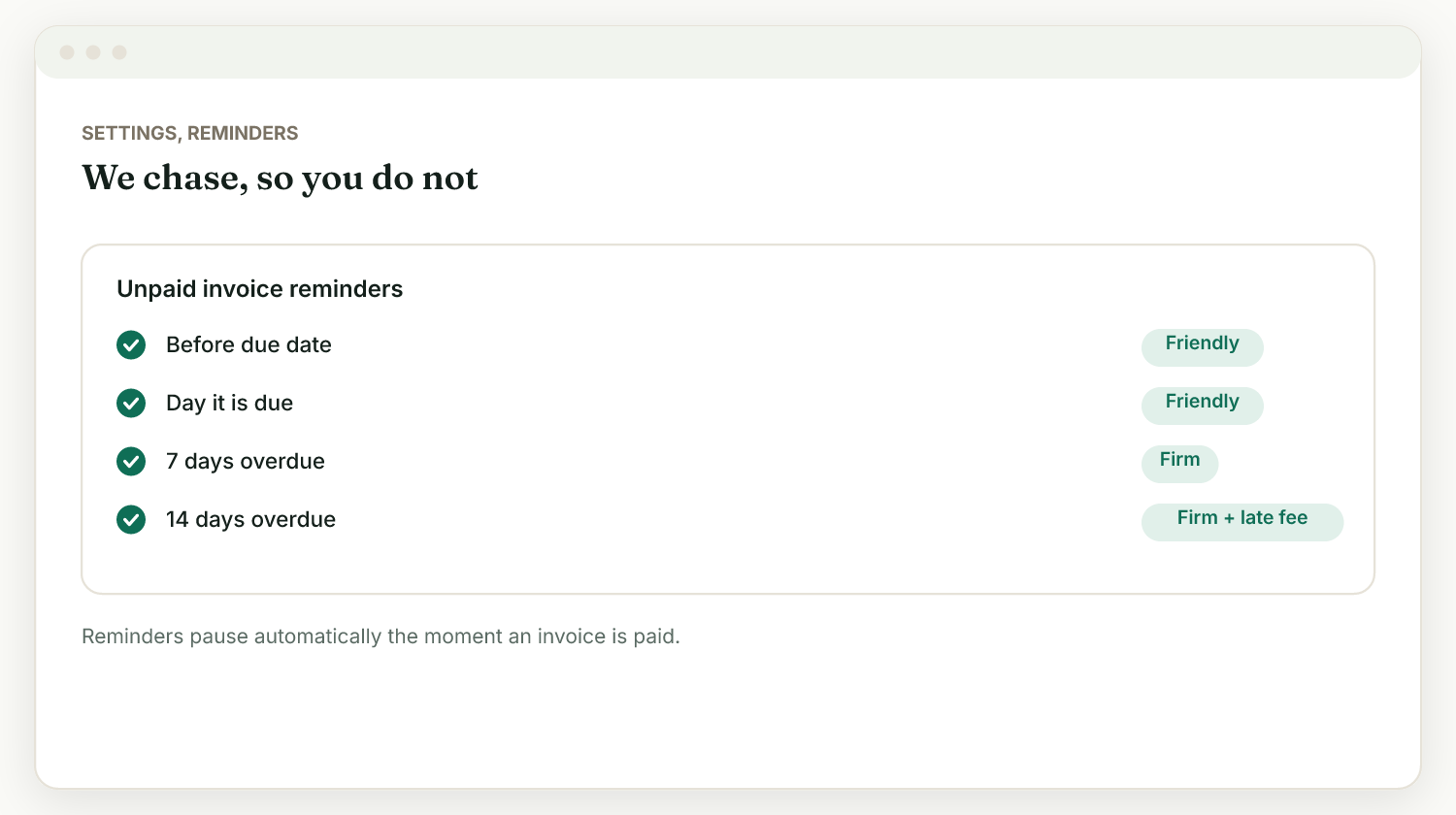
This split is exactly how we built reminders in Raoura: attach a reminder schedule to any invoice and the early nudges go out on time, every time, in your voice and from your domain, while anything past firm stays a draft until you approve it. Raoura is client and project management for solo freelancers, one flat plan at $17/mo, with invoicing, proposals, contracts, and a client portal where clients can see and pay everything you have sent them. Payments run through your own Stripe account, so the money never touches us and there is no markup on your invoice. (Disclosure: Raoura is our product.) If you would rather stay manual, the system works fine as calendar reminders plus this page; the tool just makes the clockwork part unskippable.
Verified July 2026. Chaser figures (92% of businesses typically paid late, up from 87% in 2022; the 76% follow-up effect; 73% vs 49% SMS-plus-email effect; 31% leaving invoices unchased) are from Chaser's 2026 accounts receivable research summary, checked this month. Freelance late payment rates (29% paid at least a day late, 75% of late invoices resolved within 14 days, 90% within a month) are from Bonsai's analysis of invoicing data from 100,000+ freelancers. Average payment timing (28.8 days to be paid, 9.0 days late on average) is from Xero Small Business Insights, US series, April 2026 release. Invoice wording effects (thank you 89.61% vs 78.62% baseline, please 88.07%, interest 92.15%) are from FreshBooks' analysis of over one million invoices, checked against the live study page. The 56% of US small businesses owed money ($17.5K average) figure is from the QuickBooks 2025 Late Payments Report, survey of 2,487 US small businesses. The ranking-page audit (45 templates across the top 5 pages, zero written in the first person, 1 of 5 gated behind a lead form) is our own review of the ranking pages for "payment reminder email template", July 2026.
Frequently asked questions
How many payment reminders should you send before escalating?
Seven over 33 days: one before the due date, one on it, then days 3, 7, 14, 21, and 30. After day 30 more emails stop helping, and the escalation ladder (demand letter, then small claims or a state complaint) is the higher-percentage play.
When is the best time of day to send a payment reminder?
Mid-morning on a Tuesday, Wednesday, or Thursday, in the client's time zone. That is the consistent recommendation across the AR guides we audited, and the logic holds for solos: Monday mornings your email drowns, and Friday afternoons it waits out the weekend and goes stale.
Is it rude to send a reminder before the invoice is even due?
No, and it is the single most effective email in the sequence. Framed as a heads-up with the invoice attached, it reads as organized rather than pushy, and it eliminates the "never received it" conversation entirely. Nobody has ever fired a freelancer for one polite pre-due reminder.
Should payment reminders mention late fees?
Only if your contract provides for them, and not before day 14. A fee that appears out of nowhere reads as a penalty invented in anger and poisons the negotiation. When it is in the contract, mentioning it works: FreshBooks found terms that mention interest correlate with a 92.15% payment rate, the strongest wording effect in their million-invoice study. Amounts and state legality are covered in the late fee guide.
Can I text a client about an unpaid invoice?
If texting is already a channel you two use for work, yes, around day 14 to 21, and keep it to one line with a link. Chaser's 2026 survey found businesses using SMS alongside email get paid within two weeks 73% of the time versus 49% for email alone. Do not open a new channel just to chase money; that reads as an ambush.
What if the client keeps promising payment and missing the date?
Use template 8 the first time a promised date passes. The second time, stop accepting dates and change the terms of the conversation: a call, a paused project, or the day-30 final notice, whichever the calendar supports. Two broken promises is a pattern, not bad luck.
What if the client has gone completely silent?
Silence through day 30 changes the diagnosis from "busy" to something worse. Run the sequence to its end for the paper trail, then follow the ghosted-after-delivery playbook, which covers verification (is the company still alive?), leverage, and recovery.
Run your client work in one place
Send a proposal, get it signed, invoice, and get paid, with a branded portal your clients will actually use. One flat plan at $17/month, and we never take a cut of your payments.
Try Raoura free for 14 daysNo credit card required. Set up in minutes.
Keep reading
7 Bonsai Alternatives Now That Bonsai Belongs to Zoom (2026)
Zoom acquired Bonsai in late 2025, Bonsai's blog has been quiet since March 2025, and the product is drifting toward agencies. Here are 7 alternatives for solo freelancers, with verified pricing and the fee math Bonsai does not lead with.
7 Dubsado Alternatives That Do Not Need a $2,000 Setup Specialist (2026)
Dubsado's power comes with a catch: new pricing of $35 to $55 per month, and a setup so involved that certified specialists charge $2,000 to $3,500 to do it for you. Here are 7 alternatives you can set up in an afternoon.
Late Fees for Freelancers: What Is Legal and What Actually Works
The standard freelance late fee is 1.5% per month, but almost everything else you have read about late fees is either vague or wrong. Here is what state law actually allows (with the statutes and court cases linked), the exact clause wording that holds up, the invoice data on whether late fees work, and the three states where the law now does the collecting for you.