The Minimalist Freelance Stack: Replacing 7 Tools With 3
Nobody sits down and decides to spend $1,000 a year on software. It happens one $12 subscription at a time. You needed to invoice someone, so you got FreshBooks. A client wanted to book calls, so Calendly. A contract needed signing, so DocuSign. Three years later your one-person business has a procurement problem.
The lists that rank for "freelance tool stack" will not help you fix it. We checked the four top-ranking pages in July 2026: three list at least one outdated price, and one still recommends Skype, which Microsoft retired in May 2025. Every one of them is written by a vendor with a product in the list, and none of them adds up what the recommended stack actually costs per month.
So let's do the thing none of them do: add it up, with prices verified against vendor pricing pages this month, and then cut it down.
What a typical freelance tool stack costs in 2026#
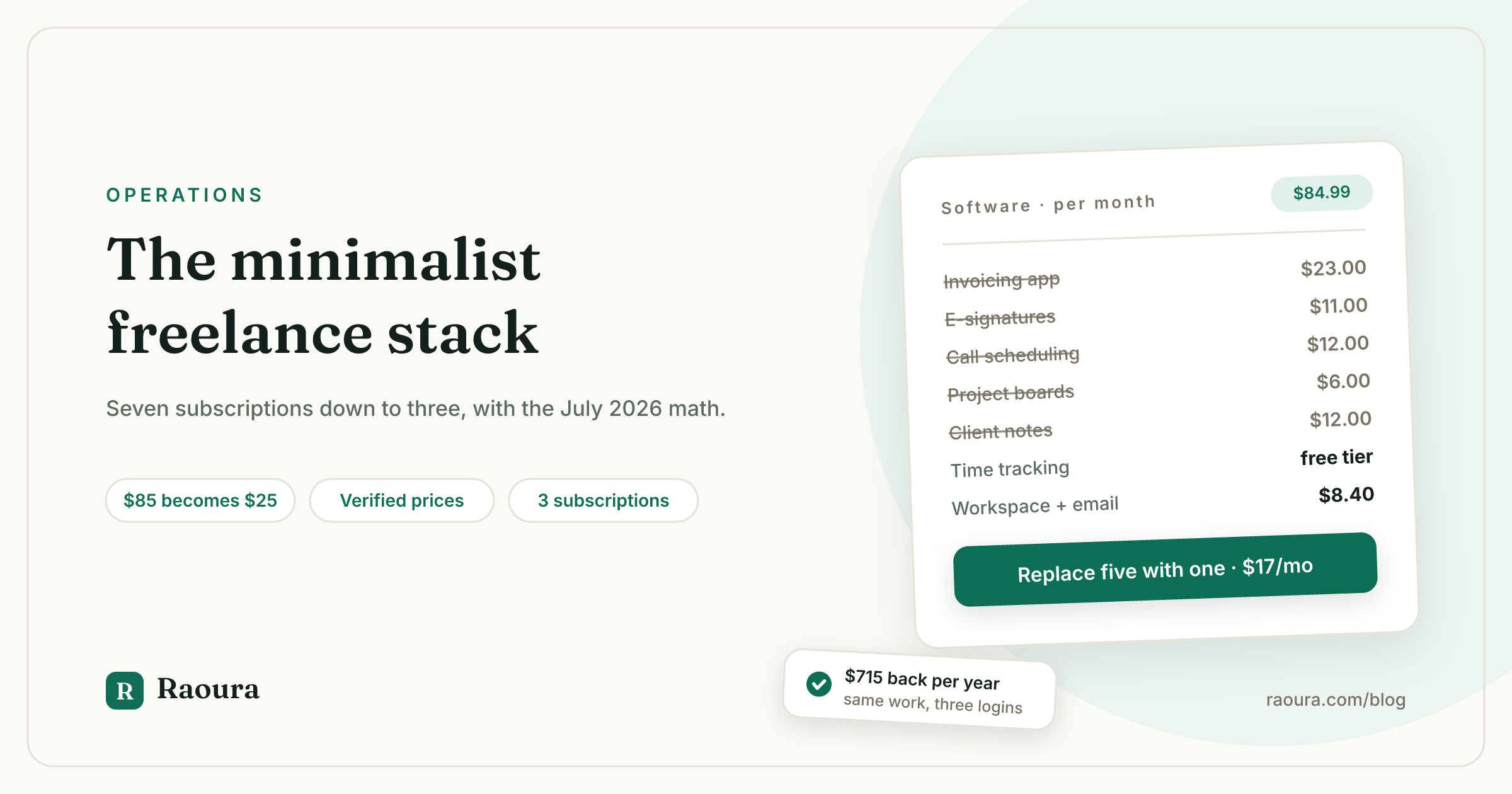
A typical solo freelance stack of 7 paid tools costs $84.99 per month at July 2026 prices, about $1,020 per year, before payment processing fees.
Here is a representative stack, built from the tools that appear on nearly every "best tools for freelancers" list. These are cheapest-realistic plans for one person, at prices we verified on each vendor's pricing page on July 6, 2026.
| Job | Tool and plan | Per month | Billing basis |
|---|---|---|---|
| Invoicing and payments | FreshBooks Lite | $23.00 | billed monthly |
| Proposals and e-signatures | DocuSign Personal | $11.00 | annual plan, billed monthly |
| Call scheduling | Calendly Standard | $12.00 | billed monthly |
| Project tracking | Trello Standard | $6.00 | billed monthly |
| Time tracking | Toggl Track Starter | $9.00 | billed annually |
| File storage and delivery | Dropbox Plus | $11.99 | billed monthly |
| Client notes and pipeline | Notion Plus | $12.00 | billed monthly |
| Total | $84.99 |
Swap in your own equivalents and the number barely moves. QuickBooks' cheapest self-employed plan is $20 instead of FreshBooks' $23. Asana Starter is $13.49 per user billed monthly instead of Trello's $6, and it requires a minimum of two seats, so it actually costs a solo more. HubSpot's paid Starter tier lists at $20 per seat. The band for a 7-tool stack is roughly $75 to $110 a month for one person.
And that is the subscription line only. Every card payment you accept adds processing fees on top, which we will get to, because that line is bigger than most of these subscriptions.
The overlap problem: four tools, one client#
At least 4 of the 7 tools in a typical freelance stack touch the same client workflow, and freelancers already lose around 6 hours a week to unbillable admin work.
Look at what happens to one client in the stack above. The proposal goes out through DocuSign. The project gets tracked in Trello. The invoice comes from FreshBooks. The files live in Dropbox. The client's history and notes sit in Notion. That is five tools handling one relationship, and none of them talk to each other.
The cost is not just the subscriptions. It is the handoffs. You copy the scope from the signed proposal into a Trello card. You retype the price into FreshBooks. You email a Dropbox link because the client lost the first one. You update Notion so future-you remembers what happened. Surveys consistently put freelance admin time at about 6 hours per week, with only 50 to 70 percent of working hours billable, and the tool-to-tool shuffle is a decent chunk of why.
Your client feels it too. They get a DocuSign email, a FreshBooks email, a Dropbox link, and a Trello invite, each with its own sender, login, and expiry. Half of freelance admin is answering questions clients could answer themselves if everything lived at one link. We made the full argument for that in You Don't Need a CRM. You Need These 5 Things.
The overlap is the insight the listicles miss: the question is not "what is the best tool in each category." It is "why do I have categories at all."
The minimalist stack: 3 subscriptions#
A minimalist freelance stack is 3 paid subscriptions: one client workflow tool, one email and docs workspace, and one specialist tool for your craft, roughly $25 to $45 a month in total.
1. One client workflow tool ($9 to $36/mo)#
This is the consolidation move. Proposals, e-signatures, invoicing, payments, project status, and a client portal in one product replaces DocuSign, FreshBooks, Trello-for-client-work, Dropbox-for-client-files, and the Notion client database in a single decision.
Disclosure: Raoura is our product, and this is exactly the category it lives in. Raoura is $17 a month on one flat plan: proposals that become signed contracts, invoices with deposits and milestones, projects, and a portal where your client sees everything at one magic link. Payments run through your own Stripe account with no markup from us.
It is not the only option, and a fair version of this table includes the competition, at prices from their pricing pages this month:
| Tool | Cheapest plan, billed monthly | Billed annually | Card processing |
|---|---|---|---|
| Raoura | $17.00 | $17.00 (same price, one plan) | Your own Stripe, no markup |
| Bonsai Basic | $15.00 | $9.00 | Platform fees on top |
| Moxie Starter | $12.00 | $10.00 | Via connected processor |
| HoneyBook Starter | $36.00 | $29.00 | Starting at 2.9% + 25c, plus 1.5% ACH |
| Dubsado Starter | $35.00 | $27.92 | Via connected processor |
| 17hats | $60.00 | $50.00 | Via connected processor |
If you want the deeper teardown of this category, we compared the portal-centric options in Best Client Portal Software for Freelancers and the switcher landscape in HoneyBook Alternatives for Solo Freelancers.
2. One workspace ($7 to $8.40/mo)#
Google Workspace Business Starter at $7 per user billed annually ($8.40 flexible) covers professional email on your domain, docs, spreadsheets, video calls, 30GB of storage, and Google Calendar's built-in appointment booking. That last one quietly replaces Calendly for most solo use: a booking page tied to your real calendar, at no extra cost. Microsoft 365 plays the same role at a similar price if you live in Word and Excel.
3. One craft tool ($0 to $20/mo)#
Whatever your work actually requires: Figma if you design, an IDE and hosting if you build, a grammar or research tool if you write, an editing suite if you shoot. This line varies too much to generalize, so budget for one paid craft tool and treat additions with suspicion.
The core of the minimalist stack, Raoura plus Google Workspace, is $25.40 a month billed monthly. Against the $84.99 typical stack, that is $59.59 a month back, about $715 a year, before you count the hours the handoffs were eating.
What the free tiers cover#
A working $0 layer exists for everything else in 2026: Toggl's free plan tracks unlimited time, Trello's free plan gives you 10 boards, and Calendly's free plan runs one event type forever.
The trick to staying at 3 subscriptions is knowing which free tiers are usable and where the walls are:
| Tool | Free tier | The wall |
|---|---|---|
| Toggl Track | Unlimited time tracking, projects, clients | No billable rates or saved reports |
| Trello | Unlimited cards, 10 boards | 10MB per file attachment |
| Calendly | Unlimited meetings | 1 event type, 1 connected calendar |
| Notion | Unlimited pages for individuals | 5MB uploads, 7-day version history |
| Wave | Unlimited invoices and bookkeeping | Card fees of 2.9% + 60c, no auto bank import |
| PandaDoc | Free eSign plan | 5 documents per month |
| HubSpot | Core CRM free forever | HubSpot branding, upsell pressure |
If you are not ready to consolidate at all, that table is also a complete $0 starter stack: Wave to invoice, PandaDoc to sign, Calendly to book, Trello to track, Toggl to time. You pay with per-card fees, feature walls, and the same handoff tax, but nothing per month.
The fee line no stack list includes#
Card processing costs $29 to $30 on every $1,000 invoice with every mainstream option, so the real differences are bank-transfer fees, markups, and who controls the money.
On a $1,000 card payment: Stripe's standard US rate of 2.9% + 30c takes $29.30. Wave's free plan at 2.9% + 60c takes $29.60. HoneyBook, starting at 2.9% + 25c, takes $29.25. The card rates have converged; nobody wins or loses a stack decision there.
The divergence is everywhere else. HoneyBook charges 1.5% on bank transfers, which is $150 on a $10,000 project paid by ACH. Wave's free plan makes its money back on that 60c and the Pro upsell. And on all-in-one platforms, payments route through the platform's merchant account, not yours: your money's path runs through their business. Raoura connects your own Stripe account instead, so Stripe's published rate is the whole story and payouts land on Stripe's schedule, not ours. We wrote up why that architecture matters in Why Your Client Tool Should Never Touch Your Money.
Run your own number: yearly card volume times the rate difference, plus any ACH percentage on your big projects. For plenty of freelancers this line is bigger than every subscription in the stack combined.
Your stack is more expensive than when you built it#
Three of the most recommended freelancer tools raised prices between February 2025 and December 2025, by as much as 89% in HoneyBook's case.
Stack costs do not just accumulate, they inflate. Recent history, all from vendor pages and announcements:
- HoneyBook raised Starter from $19 to $36 a month in February 2025, an 89% jump, with Premium reaching $129. We track the whole timeline in the HoneyBook price increase guide.
- Dubsado raised monthly pricing to $35 Starter and $55 Premier on December 1, 2025, alongside its 3.0 launch (existing subscribers were grandfathered).
- Google Workspace folded Gemini into Business plans in 2025 and moved Business Starter to $8.40 a month flexible.
- FreshBooks Lite has crept to $23 a month, up from the $15 to $17 that older listicles still quote.
This is why three of the four top-ranking stack articles carry wrong prices: tool lists age like milk. It is also an argument for fewer subscriptions. Every tool in your stack is a separate chance to get repriced, and a 7-tool stack gives you 7 renewal letters a year to not read. One flat plan is easier to audit, and easier to trust. Prices in this article were checked on July 6, 2026, and we recheck quarterly.
When 7 tools is the right answer#
If a specialist tool saves you one billable hour a month, it pays for itself at any hourly rate above $12, so keep every tool that is doing craft work rather than client admin.
Minimalism is a default, not a religion. Real cases for staying multi-tool:
- Scheduling is your business. Coaches and consultants running many session types, buffers, and paid bookings will outgrow Google Calendar's booking pages fast. Calendly Standard earns its $12.
- You bill by the tracked hour. Toggl's paid tiers exist because billable-rate reports matter when every hour is invoiced. An all-in-one's time tracking is rarely as good.
- Deep accounting needs. If you carry inventory, sales tax across states, or an accountant who lives in QuickBooks, keep real accounting software. A client workflow tool replaces invoicing, not bookkeeping.
- Team gravity. The moment you hire, per-seat collaboration tools start justifying themselves. That is a different article about a different business.
The test is the direction of the work. Tools that produce the deliverable are worth depth. Tools that shuttle the same client data between each other are overhead wearing a productivity costume.
Frequently asked questions
What is a freelance tool stack?
A freelance tool stack is the set of software a freelancer uses to run their business: invoicing, proposals, contracts, scheduling, project tracking, file sharing, and client records. A typical stack in 2026 is 5 to 8 paid subscriptions totaling $75 to $110 a month, though a consolidated stack can run under $30.
How much should a freelancer spend on software per month?
A useful ceiling is one billable hour per month. Most solo freelancers can cover the essentials for $25 to $45 a month: one client workflow tool ($9 to $36), one workspace like Google Workspace ($7), and one craft tool. Spending beyond that should trace to a specific, revenue-producing capability.
Are all-in-one freelance tools worth it?
Usually, for solos, yes: one tool handling proposals, contracts, invoices, and a client portal removes 4 to 5 subscriptions and the copy-paste work between them. The caveats are lock-in (check export options before committing) and depth (a built-in time tracker or bookkeeping module is rarely best in class). Disclosure: Raoura is our product and is one of the options in this category.
What is the best free tool stack for freelancers?
In 2026 you can run at $0 per month with Wave (unlimited invoices, 2.9% + 60c card fees), PandaDoc's free eSign plan (5 documents a month), Calendly free (1 event type), Trello free (10 boards), and Toggl Track free (unlimited time tracking). The costs are per-transaction fees, feature walls, and juggling 5 logins.
How often should you audit your tool stack?
Once a year, minimum, and any time a vendor emails about "updated pricing." List each subscription, its current price (from the vendor's pricing page, not your memory), and the last time it did something a cheaper or existing tool could not. Between price creep and feature overlap, most freelancers find at least one cancelable subscription per audit.
All prices verified against vendor pricing pages on July 6, 2026. Verified July 2026.
- /blog/what-freelancers-actually-need-instead-of-a-crm (overlap section)
- /blog/best-client-portal-software-for-freelancers (consolidation table)
- /blog/honeybook-alternatives-solo-freelancers (consolidation table)
- /blog/why-your-client-tool-should-never-touch-your-money (fee section)
- /blog/honeybook-price-increase-guide (price hike section)
Future internal links once drafted: I28 wave-vs-freshbooks-vs-quickbooks (invoicing swap paragraph), I29 cheap e-signature options (stack table DocuSign row), I30 annual vs monthly billing (price hike section), H24 software spend audit (FAQ audit answer), I03 what is a client portal (minimalist stack section). -->
Run your client work in one place
Send a proposal, get it signed, invoice, and get paid, with a branded portal your clients will actually use. One flat plan at $17/month, and we never take a cut of your payments.
Try Raoura free for 14 daysNo credit card required. Set up in minutes.
Keep reading
7 Bonsai Alternatives Now That Bonsai Belongs to Zoom (2026)
Zoom acquired Bonsai in late 2025, Bonsai's blog has been quiet since March 2025, and the product is drifting toward agencies. Here are 7 alternatives for solo freelancers, with verified pricing and the fee math Bonsai does not lead with.
7 Dubsado Alternatives That Do Not Need a $2,000 Setup Specialist (2026)
Dubsado's power comes with a catch: new pricing of $35 to $55 per month, and a setup so involved that certified specialists charge $2,000 to $3,500 to do it for you. Here are 7 alternatives you can set up in an afternoon.
Late Fees for Freelancers: What Is Legal and What Actually Works
The standard freelance late fee is 1.5% per month, but almost everything else you have read about late fees is either vague or wrong. Here is what state law actually allows (with the statutes and court cases linked), the exact clause wording that holds up, the invoice data on whether late fees work, and the three states where the law now does the collecting for you.