Kill Fees: What They Are and How Much Yours Should Be
July 19, 2026
The project does not die because you did anything wrong. The magazine changes editorial direction. The startup's funding round slips. The marketing director who hired you leaves, and her replacement wants "a fresh start with our own people." You are three weeks into a six week project, and the email says some version of "we've decided not to move forward."
What happens next is decided by one clause you either wrote into the contract months ago or did not. It is called a kill fee, and most freelancers first hear the term the day they need one.
This guide covers what a kill fee is, how much yours should be (with the percentage norms traced to actual professional sources, which almost nobody ranking for this term bothers to do), the exact clause wording, why stage-based fees are legally sturdier than flat ones, and how to negotiate when the kill fee is in the client's contract instead of yours. Verified July 2026.
What a kill fee is (and what it is not)#
A kill fee is a contract clause that pays you a fixed percentage of the agreed project fee, most commonly 25 to 50 percent and rising to 100 percent for late-stage cancellations, when the client cancels the work through no fault of yours. It compensates you for the time you committed, the work you did, and the other projects you turned down to hold the slot.
The term comes from magazine publishing, where an editor "kills" a commissioned story that will not run. But the mechanism applies to any freelance work that can be cancelled midstream: a brand identity, a website build, a video edit, a consulting engagement.
Three clean distinctions, because the ranking pages for this term contradict each other:
- A kill fee is not a deposit. A deposit is money you already hold; a kill fee is money the clause obligates the client to pay after cancelling. A deposit protects you without a fight. A kill fee sometimes requires one. How much deposit to charge is its own decision, and the strongest contracts have both.
- A kill fee is not a late cancellation fee. Photographers and event-based freelancers charge for cancellations inside a notice window (say, 48 hours before a shoot) because the slot cannot be resold. A kill fee covers project work that dies partway through production.
- A kill fee is not a penalty for firing you. It is compensation tied to work and committed capacity. That framing matters legally, as you will see below.
How much should a kill fee be? The sourced numbers#
Published professional anchors run from 25 percent of the fee for early-stage editorial kills to 100 percent when the work is substantially complete. Here is something we noticed while researching this piece: of the top pages ranking for "kill fee" today, not one cites a primary source for its percentages. The numbers below are traced to where they actually live.
| Profession | Published anchor | Source |
|---|---|---|
| Editorial and journalism | 25% (Writer's Digest's own stated kill fee) to 50% (National Writers Union negotiated agreement with Jacobin) | Writer's Digest, NWU |
| Design and illustration | 50% if cancelled before the final stage, 100% if the art is complete | Graphic Artists Guild model Letter of Agreement |
| Photography | 50% of fees plus all costs incurred, 100% inside 2 business days of the shoot (member example shared by ASMP, which cannot set prices for antitrust reasons) | ASMP licensing guide |
| Development and consulting | No professional body publishes a norm. Vendor glossaries quote 40 to 60 percent without sourcing. Use stage tiers instead of a flat number | (none exists) |
The honest summary: 50 percent mid-project and 100 percent on completed work is the defensible center of gravity, anchored by the Graphic Artists Guild's model agreement. Editorial runs lower because magazines hold the leverage, not because 25 percent is fair.
A flat percentage has a structural flaw either way: it overpays for a project killed in week one and underpays for one killed the day before delivery. Here is the math on a $4,000 project under four different protections:
| Project is cancelled... | No clause | 30% deposit only | Flat 50% kill fee | Stage tiers or milestone billing |
|---|---|---|---|---|
| At 25% done | Whatever you can argue for | $1,200 kept | $2,000 | $1,000 invoiced and kept |
| At 60% done | Whatever you can argue for | $1,200 kept | $2,000 | $2,000 already invoiced, current phase billable |
| Work complete, client shelves it | Whatever you can argue for | $1,200 kept | $2,000 | $4,000 |
The flat 50 percent fee pays you $2,000 for finished work worth $4,000. Stage tiers fix that, and they are also the version most likely to survive a legal challenge.
The clause: copy-paste wording with stage tiers#
Use three tiers keyed to project stage: work performed to date as a floor, 50 percent minimum once production has begun, and 100 percent once the work is substantially complete. This structure is adapted from the Graphic Artists Guild's model agreement and works for any deliverable-based project:
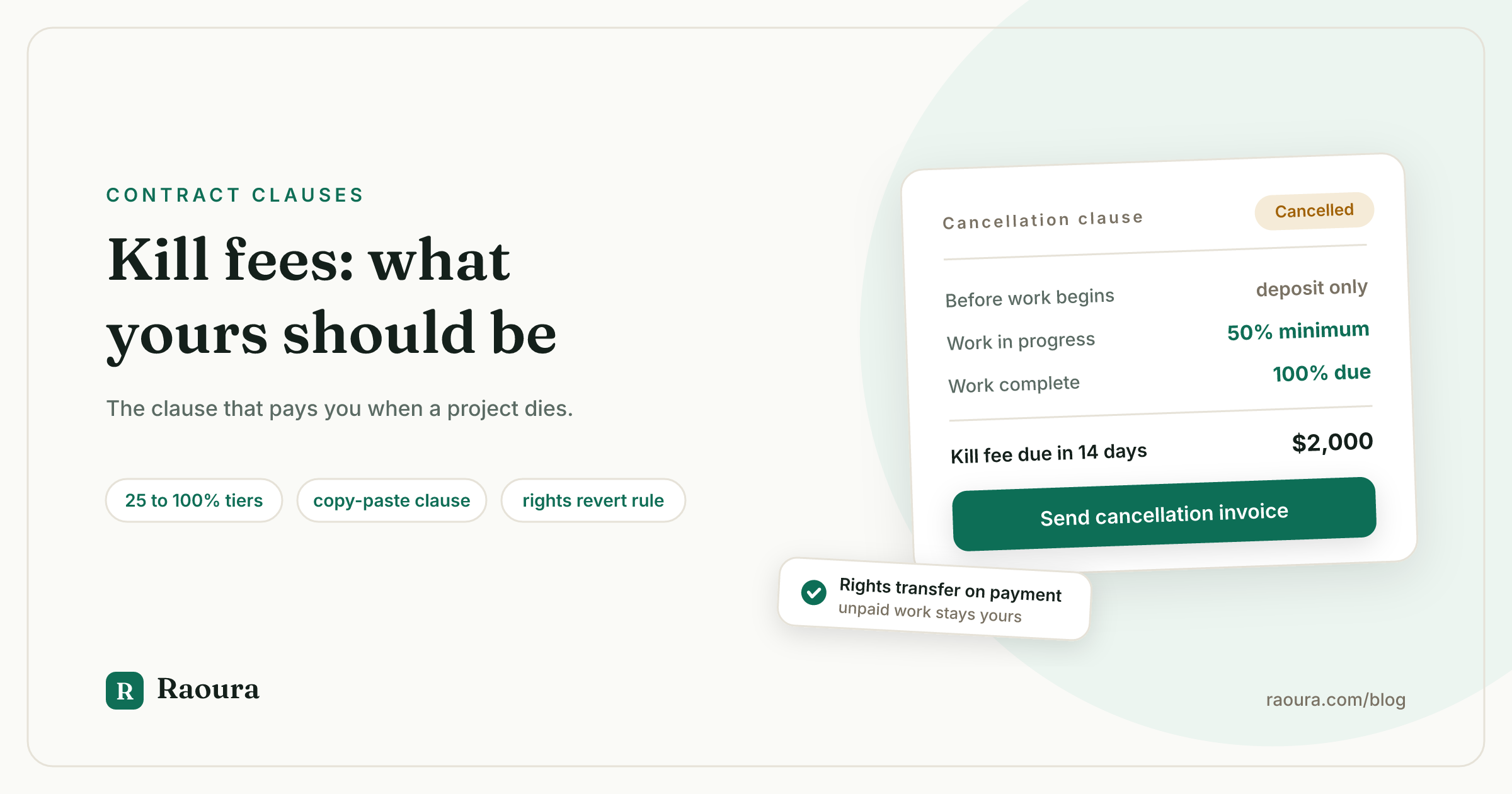
Cancellation (kill fee). Client may cancel or indefinitely postpone this project at any time by written notice. If Client cancels before work begins, Contractor retains the deposit and no further fee is due. If Client cancels after work has begun, Client will pay for all work completed to the date of notice, and in no event less than fifty percent (50%) of the total project fee. If Client cancels after the work is substantially complete, one hundred percent (100%) of the total project fee is due. Cancellation fees are payable within 14 days of the cancellation notice. Rights to all unpaid work remain with Contractor; rights transfer as described in this agreement only upon payment in full of the amounts due under this section.
Two details in that wording earn their place:
- "Or indefinitely postpone." The most common way projects die is not a cancellation email; it is a pause that never ends. The clause treats a project on indefinite hold as killed, which lets you invoke it after a defined silence instead of waiting forever.
- The rights sentence. In publishing, the norm is that a killed piece reverts to the writer, who can sell it elsewhere; Writer's Digest states this directly, and the Graphic Artists Guild's clause returns all rights to the artist on cancellation. Your version ties rights to payment: the client who pays the kill fee gets the work completed so far, and the client who does not pay owns nothing. That single sentence converts your kill fee from a request into leverage.
Where this clause sits among the others your contract needs is covered in our clause-by-clause contract guide, and the annotated contract template includes a version of it.
Will it hold up? The penalty problem#
Courts enforce cancellation fees that compensate and strike ones that punish: a clause demanding 100 percent on a project killed in week one reads as a penalty, while a fee tied to work performed reads as compensation. Contract law treats a pre-agreed damages amount (a liquidated damages clause) as valid only when actual damages would be hard to calculate and the amount is a reasonable estimate of them. As IP attorney Linda Joy Kattwinkel explains for freelance creatives, liquidated damages clauses "can be challenged in court, and efforts to get them invalidated are often successful" when the number does not bear a reasonable relationship to real losses.
A clause that pays for work performed, with a floor once you have committed the calendar slot and turned other work away, sits on the safe side of that line. The tiers are not just fairer; they are more enforceable.
There is also a legal backstop that did not exist a few years ago. New York's Freelance Isn't Free Act (statewide since August 2024), Illinois' Freelance Worker Protection Act (contracts of $500 or more), and California's SB 988 (contracts of $250 or more, effective January 2025) all require written contracts and payment within 30 days, with damages for violations.
None of these laws invents a kill fee for you; they enforce whatever your contract says. A signed cancellation clause plus one of these statutes turns "please pay my kill fee" into a claim with double damages behind it in Illinois, and attorney general complaint processes in New York. The state-by-state details are in our freelance payment laws guide, with the California specifics here.
(Usual caveat: this is general information, not legal advice. A killed project with serious money attached is worth an hour of a contract lawyer's time.)
Negotiating a kill fee that is in their contract#
When the kill fee lives in the client's paper, you have three moves: raise the percentage, add a trigger date, or trade it away for payment on acceptance. This is mostly an editorial problem, since magazines send their own contracts.
About that widely repeated statistic. You may have read that "75 percent of kill fee amendment requests succeed." We traced it to its source, and it is not a study: it is travel journalist Lola Mendez, writing on Freelancing With Tim, estimating her own personal success rate: "I'd say about 75% of the time I've requested to amend the kill fee clause the publication has agreed."
One experienced freelancer's track record, not an industry number. It is still genuinely useful evidence, just of a different claim: editors expect pushback on kill fee clauses, and a polite request to amend one is normal professional behavior, not an act of war.
The three asks, in escalating order of ambition:
- Raise the number. "I'm glad to work with a kill fee, and I'd like it at 50 percent rather than 25, since the reporting happens before the draft does." Anchor to the NWU's negotiated 50 percent.
- Add a trigger. "If the piece hasn't run or been formally killed within 90 days of acceptance, the full fee is due." This kills the limbo where a story is neither published nor killed and you can neither invoice nor resell it.
- Trade it out. Mendez's own preferred endgame: payment in full on acceptance, with the kill fee applying only before acceptance. Once an editor has accepted the work, cancellation is their business decision, not your risk.
If the client's contract has no kill fee at all and no payment on cancellation, that is a contract red flag worth fixing before signature, not after the kill.
The quiet upgrade: make cancellation boring#
Milestone billing caps your cancellation exposure at one phase of work, which on a four-phase project means no more than 25 percent of the fee is ever at risk. Everything above assumes the kill arrives as a dispute to be won. The stronger position is a project structured so cancellation is just an accounting event.
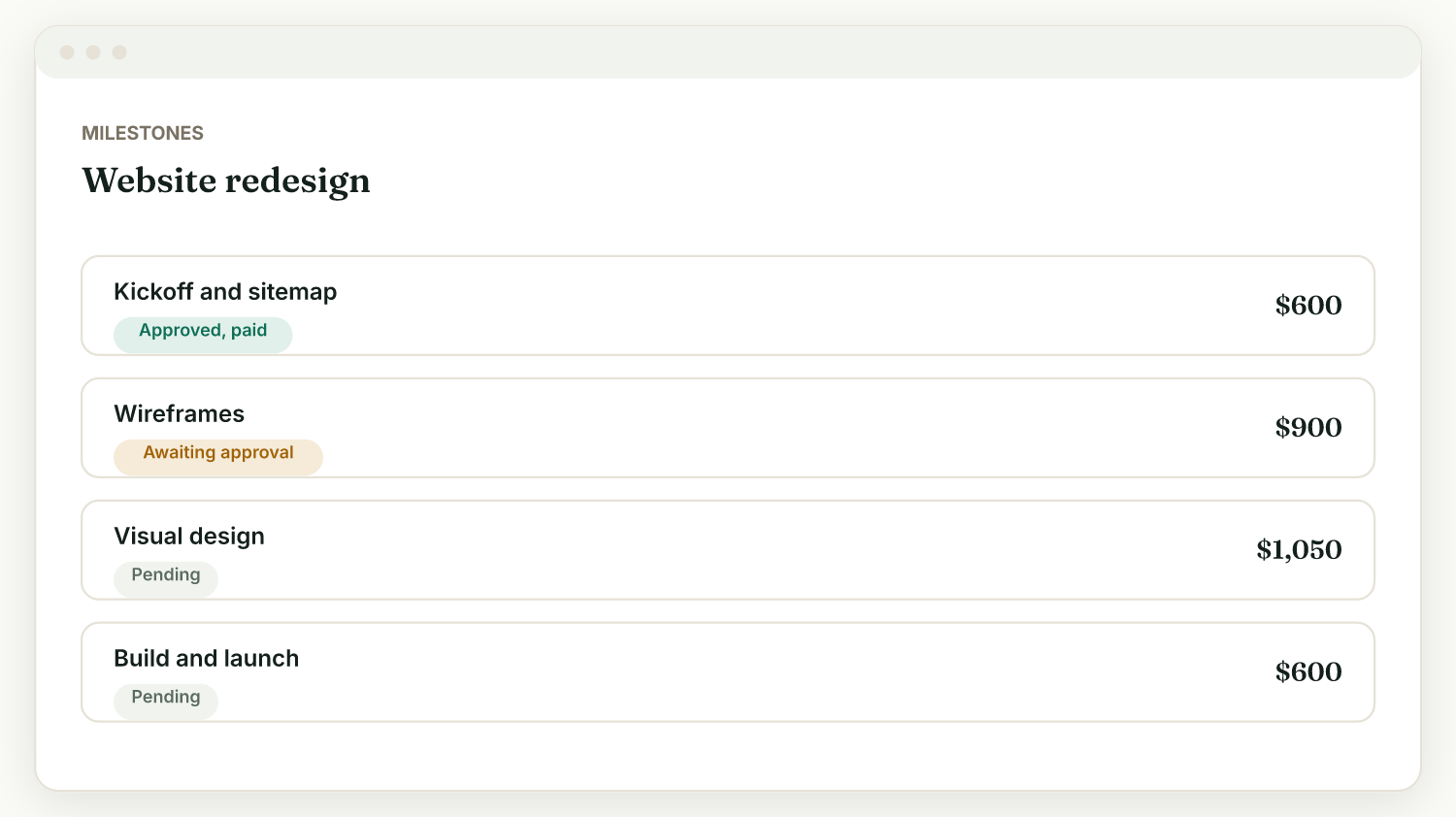
That is what milestone billing does: the project is split into phases, each phase is priced, invoiced, and paid as it completes, and you are never owed more than one phase of work. When a client cancels a milestone-billed project, most of the money is already in your account, the current phase is billable under the work-performed floor, and the kill fee clause only has to cover the gap instead of carrying the whole loss. A change order handles the scope growing; the kill fee handles the scope dying; milestones make both smaller events.
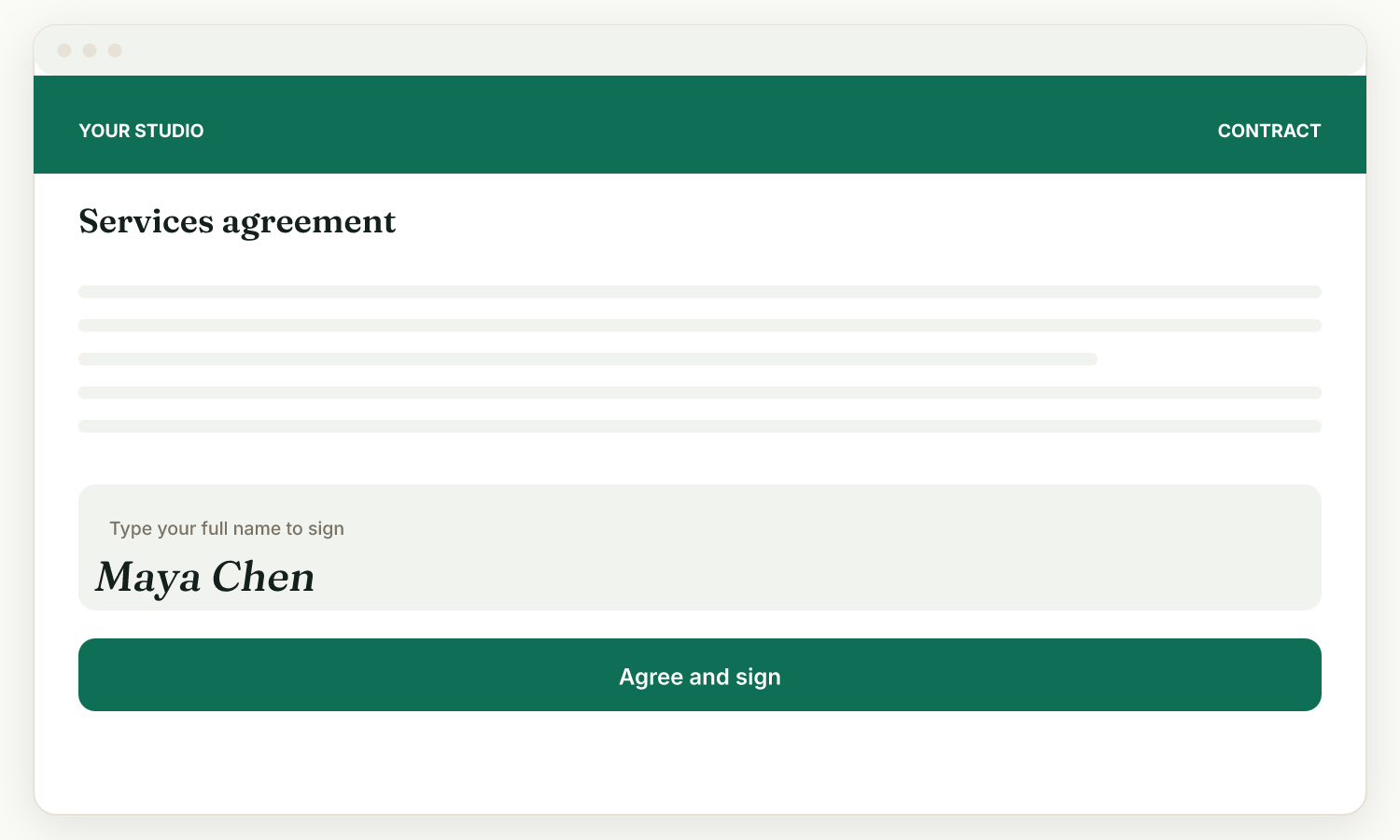
This is the shape of work Raoura is built around. (Disclosure: Raoura is our product.) Raoura puts your cancellation clause into a contract the client signs in their portal with one typed name, then runs the project as priced milestones both sides can see, so "what do I owe you if we stop here" always has a visible, agreed answer. One flat plan at $17 a month, and payments run through your own Stripe account, so the money a client owes you never sits with us.
Verified July 2026. Percentage anchors are from Writer's Digest (its stated 25 percent kill fee), the National Writers Union's negotiated Jacobin agreement (50 percent), the Graphic Artists Guild model Letter of Agreement (50 and 100 percent tiers, rights reversion), and a member example shared in ASMP's licensing guide. Enforceability draws on attorney Linda Joy Kattwinkel's liquidated damages guidance at owe.com. Statutes: NY General Business Law Article 44-A, Illinois FWPA, California SB 988. The circulating "75 percent of kill fee amendments succeed" figure is one journalist's self-reported estimate on freelancingwithtim.com, not survey data, and is framed accordingly above. No published kill fee standard exists for development or consulting work; we say so rather than inventing one.
Frequently asked questions
What is a kill fee?
A contract clause that pays the freelancer a set percentage of the agreed fee when the client cancels the project through no fault of the freelancer. It originated in magazine publishing and applies to any cancellable project work.
What is a typical kill fee percentage?
Published anchors: 25 to 50 percent in editorial work, and 50 percent before the final stage rising to 100 percent for completed work in the Graphic Artists Guild's model design agreement. A stage-tiered structure beats any single flat number.
Is a kill fee legally enforceable?
Generally yes, when it compensates for work performed and committed time rather than punishing the client. Arbitrary amounts with no relationship to actual losses can be struck down as penalties, which is why tiers tied to project stage are the safer structure.
What is the difference between a kill fee and a deposit?
A deposit is money you already hold before work begins; a kill fee is money the client owes you after cancelling. Deposits protect you without enforcement. The strongest contracts use both, plus milestone billing between them.
Who owns the work when a project is killed?
The publishing norm is that rights to a killed piece revert to the writer, who can resell it. For other work, write it explicitly: rights transfer only on payment in full, including the kill fee, so unpaid cancelled work stays yours.
Is a kill fee taxable?
Yes. A kill fee is ordinary business income, reported exactly like any other project fee on your Schedule C, and a client who paid you $600 or more across the year includes it in your 1099-NEC.
Can I negotiate a magazine's kill fee?
Yes, and editors treat the request as normal. The three standard asks: raise the percentage toward 50, add a deadline after which the full fee is due, or move to payment on acceptance so the kill fee only applies to unaccepted drafts.
Run your client work in one place
Send a proposal, get it signed, invoice, and get paid, with a branded portal your clients will actually use. One flat plan at $17/month, and we never take a cut of your payments.
Try Raoura free for 14 daysNo credit card required. Set up in minutes.
Keep reading
7 17hats Alternatives for Solos Who Don't Need $60/mo Software (2026)
17hats now costs around $60 per month on a single all-inclusive plan, which is a lot for one freelancer. Here are 7 alternatives from $0 to $36 per month, with honest tradeoffs for each.
The Best Client Portal Software for Freelancers in 2026: 10 Tools Audited, No Vendor Spin
Every page ranking for this query is a vendor putting itself at #1, and three of them still recommend a product that changed its name ten months ago. We audited 10 client portals against the six things that matter for a business of one: verified pricing, portal tier gates, client caps, white label, login friction, and payment fees.
Card vs ACH vs Wire for Big Freelance Payments
On a normal invoice, the payment rail barely matters. On a five-figure deposit or project payoff, it is the difference between a $5 fee and a $290 one, and the guides that cover this either skip wire transfers entirely or repeat a Form 8300 myth that is not true. Every fee and rule below is verified from Stripe, Nacha, the IRS, and current bank fee schedules.