The Freelance Writing Contract: Every Clause That Decides Who Owns Your Words and Whether You Get Paid
July 19, 2026
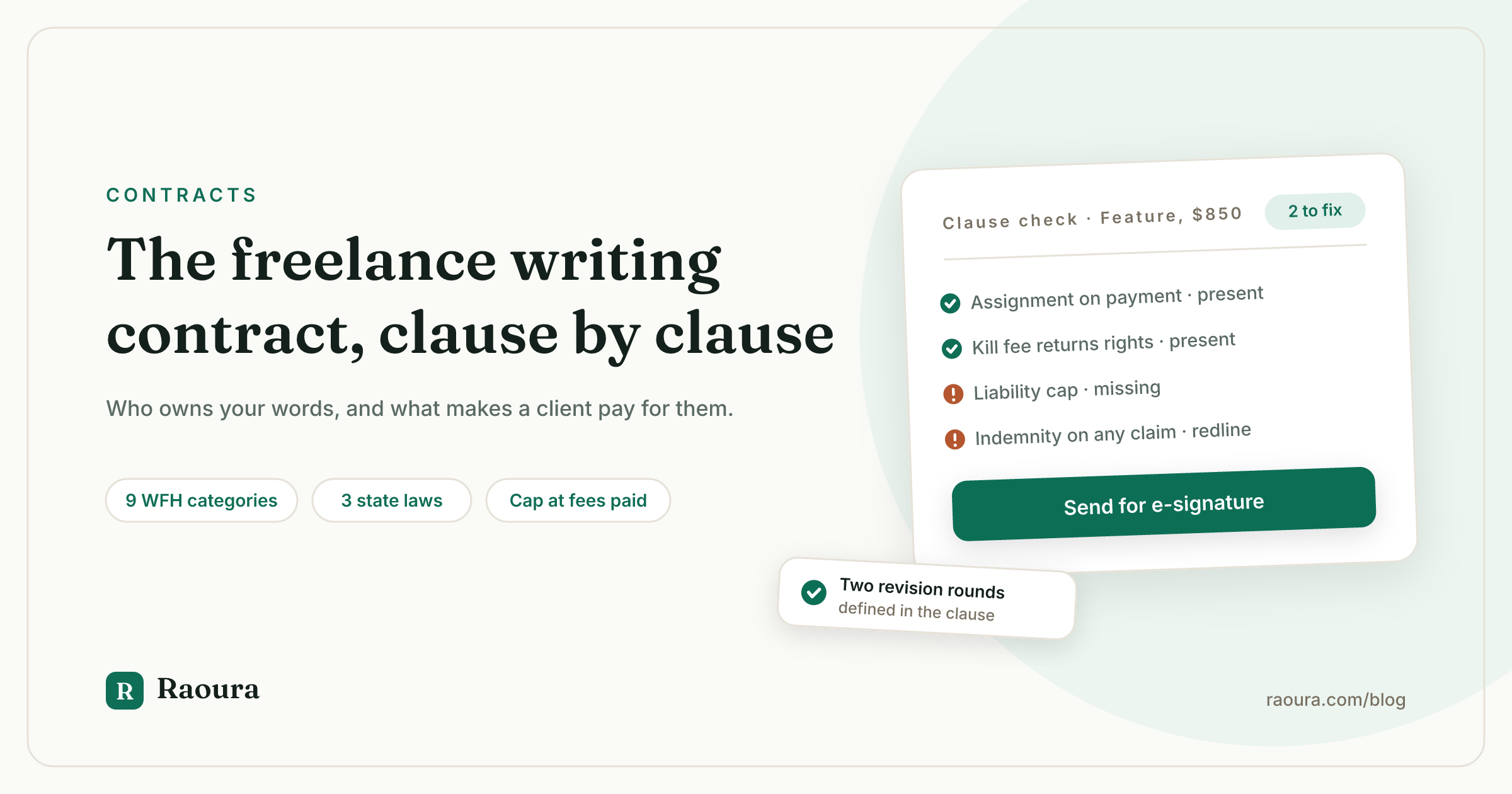
Before writing this we fetched the six pages ranking for "freelance writing contract" in July 2026 and read every clause each one ships.
The results are worse than you would guess. A legal-tech company with a "created and reviewed by Legal Pros" badge publishes a freelance writer contract with no intellectual property clause at all, which for a writing agreement is like a lease with no rent. An e-signature site's free template declares freelance writing a "work made for hire," a label that federal law does not permit for most writing work. And not one of the six pages contains a limitation of liability clause, even though several of them ask you to warrant that your work infringes nothing, with no cap on what that promise could cost you.
So this guide does the thing none of them do. It goes clause by clause, gives you the actual language ungated on this page, explains which law makes each clause work, and covers the two situations every competitor ignores: what to do when the client sends you their contract, and what an AI clause should say in 2026.
Nothing here is legal advice. It is a map of the decisions, with the statutes cited so you can check the work.
What the ranking pages actually contain#
Of the six pages ranking for this term in July 2026, zero include a liability cap, one omits the IP clause entirely, and only one addresses the state freelance payment laws that took effect in 2024 and 2025.
We built this table by reading each page's template text directly. It is the only original audit of this SERP we are aware of.
| Page | Template ungated? | IP clause | Kill fee | Liability cap | State payment laws | AI clause |
|---|---|---|---|---|---|---|
| Freelancers Union Contract Creator | Yes, free DOCX and PDF | Yes (renders broken) | Yes | No | Yes, 8 jurisdictions | No |
| Bonsai | No, signup required | Discussed, no text | Discussed | No | No | No |
| eSign.com | Yes, free DOCX and PDF | Yes, mislabeled as work for hire | No | No | No | No |
| Rocket Lawyer | Partial, trial to download | None | No | No | No | No |
| Location Rebel | Article only, templates paid | Snippet only | Conflated with termination fee | No | No | No |
| Kernochan Center (Columbia Law) | Sample only, not usable | Yes, as a bad example | No | No | No | No |
The best of them is the Freelancers Union Contract Creator, and it wins for one reason: it is the only free tool that ships jurisdiction-specific "Freelance Isn't Free" clauses with the correct thresholds. It is also the only one that gets the kill fee consequence right, namely that paying a kill fee entitles the client to no rights over the completed piece.
Everything below is what none of them cover.
Who owns freelance writing by default#
You do. Copyright in a piece of writing vests in the writer the moment it is fixed, and it stays there until you sign a written transfer, which means silence in a contract favors the writer, not the client.
This is the single most misreported fact in this category. One of the ranking pages states that "in most cases, if you are writing for a client, they own it." That is backwards as a default rule.
Rights move in exactly three ways, and they are not interchangeable, even though every template dropdown treats them as if they were.
| Mechanism | What the client gets | What you keep | Reversible? |
|---|---|---|---|
| Work made for hire | Client is the legal author from the start | Nothing, permanently | No, never |
| Assignment | Client owns the copyright | A statutory termination right, roughly 35 years out under 17 U.S.C. 203 | Yes, decades later |
| Exclusive or non-exclusive license | Only the uses you list, for the term you set | The copyright itself | Yes, on the terms you write |
That first row is why the work-for-hire label matters so much, and why so many templates get it wrong.
Why "work made for hire" usually does not apply to writing#
17 U.S.C. 101 allows a work made for hire in only two situations. Either an employee produced it within the scope of employment, or it was "specially ordered or commissioned" and falls inside nine enumerated categories, with the parties expressly agreeing "in a written instrument signed by them."
Here are all nine, in statutory order: a contribution to a collective work, a part of a motion picture or other audiovisual work, a translation, a supplementary work, a compilation, an instructional text, a test, answer material for a test, and an atlas.
Read that list again and notice what is missing. "Blog post" is not there. Neither is "website copy," "white paper," "email sequence," or "ghostwritten ebook."
A magazine feature running alongside other writers' pieces has a real argument under "contribution to a collective work," which the statute defines as a work such as a periodical issue or anthology assembling separate and independent contributions into a whole. A standalone blog post delivered to one client is a much harder fit. The Supreme Court settled the underlying principle in CCNV v. Reid: "only enumerated categories of commissioned works may be accorded work for hire status. The hiring party's right to control the product simply is not determinative."
The practical consequence is the part nobody writes down. If a client's contract says "work made for hire" and the work does not fit a category, that clause may simply do nothing, and if there is no backup assignment, the client walks away with an implied license and no ownership. That is bad for both of you, and it is the reason competent contracts pair the two.
The clause that handles it correctly:
The Work is a work made for hire to the extent permitted by 17 U.S.C. 101. To the extent the Work does not qualify as a work made for hire, Writer assigns to Client all right, title, and interest in the Work, such assignment to take effect only upon Client's payment in full of all amounts due under this Agreement.
That bolded condition is doing enormous work, and it is missing from every free template we read. One of them assigns everything on signature, which means an unpaid writer has already handed over the only leverage they had. Condition the transfer on payment and an unpaid invoice stops being a lawsuit and starts being a licensing problem for your client.
If ownership questions are the main thing you are here for, our freelance IP rights guide covers the whole framework across disciplines.
Registration, and the number that has not moved since 1999#
You do not have to register to own a copyright, but registration is what unlocks statutory damages and attorney's fees.
The current Copyright Office fee schedule shows $45 for a Single Application, meaning one work, one author, not made for hire. The Standard Application is $65.
Timing is the trap. Under 17 U.S.C. 412, statutory damages and fees are unavailable for infringement that began after publication unless you register within three months of first publication. Miss that window and you are limited to actual damages, which for a $400 blog post is a number no lawyer will take a case over.
The award range under 17 U.S.C. 504(c) runs from $750 to $30,000 per work, up to $150,000 if the infringement was willful. Worth noticing: those figures were set by Congress in December 1999 and have never been adjusted for inflation, so the $750 floor has been frozen for more than 26 years.
The payment clause, and the statutory leverage behind it#
Three states now require your client to give you a written contract, and all three let you recover double the unpaid amount plus attorney's fees.
This is the biggest content gap on the whole SERP. Only one competitor page surfaces these laws at all, and it does so as raw clause text with no explanation of what they give you.
| New York City | New York State | Illinois | California | |
|---|---|---|---|---|
| Citation | Admin Code Tit. 20 Ch. 10 | GBL Art. 44-A | 820 ILCS 193 | Bus. & Prof. Code 18100 to 18107 |
| In force since | May 15, 2017 | Aug 28, 2024 | July 1, 2024 | Jan 1, 2025 |
| Written contract required at | $800 (single or 120-day aggregate) | $800 | $500 | $250 |
| Default payment deadline | 30 days | 30 days | 30 days | 30 days |
| Late payment remedy | Double damages plus fees | Double damages plus fees | Double the underpayment plus fees | Up to twice the unpaid amount plus fees |
| No written contract remedy | Injunctive relief, up to $25,000 for a pattern | $250 statutory, or contract value if paired | $500 statutory, or contract value if greater | $1,000 |
Note the wording difference in the last two columns, because it matters in a demand letter. New York and Illinois say "double." California says "up to twice," which is a ceiling a court can come in under.
California is also the only one of the four that names your profession. Its coverage runs through Labor Code 2778(b)(2), which expressly lists freelance writers, translators, editors, copy editors, and illustrators (DIR guidance). The tradeoff is that a California freelancer outside the enumerated list gets nothing, which is the opposite of how the New York and Illinois statutes work.
All four require essentially the same terms in writing: both parties' names and mailing addresses, an itemization of the services and their value, the rate and method of compensation, and the payment date or the mechanism for determining it. New York State and Illinois add a fourth item, the date by which you must submit your list of services to meet the client's internal processing deadline.
Our state-by-state reference goes deeper on all of them, including the California and Illinois statutes clause by clause.
Does any of this actually work?#
Yes, measurably: New York City's enforcement agency logged 2,542 complaints in five years and 773 freelancers recovered $2,912,591 after filing.
That comes from DCWP's own five-year report on the Freelance Isn't Free Act. Two findings from it are worth carrying around.
First, this is small-invoice terrain. 22% of complaints involved contracts of $1,000 or less, and 51% were $5,000 or less. These laws were built for exactly the size of work freelance writers do.
Second, the response mechanic is the real weapon. Hiring parties responded to DCWP notices 74% of the time, and under the NYC and Illinois statutes a client who ignores a complaint for 20 days faces a presumption in the freelancer's favor. The City eventually sued one publisher, L'Officiel USA, over a pattern of nonpayment; the 2023 settlement paid over $275,000, double what was owed, to 41 freelance workers.
The honest counterweight, from the same report: of complainants surveyed, 40% recovered everything owed, 9% recovered part, and 49% recovered nothing.
What your payment clause should say#
Structure beats sentiment here. Four elements, and the payment terms evidence supports every one:
- Trigger payment on delivery or acceptance, never on publication. Publication dates slip for reasons that have nothing to do with you. If a client insists on publication as the trigger, add an outside date: payable on publication or 60 days after acceptance, whichever comes first.
- Define acceptance with a clock. "Client shall have 7 business days from delivery to provide written revision requests; absent such notice, the Work is deemed accepted." Without that sentence, silence is indefinite.
- Take a deposit on anything substantial. For new clients, 25% to 50% up front is the norm, and it filters out clients who were never going to pay.
- State a late fee. Typical is 1% to 1.5% per month on overdue balances, subject to state usury limits. The exact wording matters more than the rate; see our late fee and deposit clause library.
For long pieces, book projects, or site rewrites, none of this beats simply not being owed much at once. Milestone billing caps your exposure to one phase.
Kill fees, revisions, and scope#
A kill fee buys the client the right to walk away, not the right to keep your words.
That distinction is the one competitors miss most often, and it is worth a sentence in your contract in exactly those terms: payment of the kill fee terminates the assignment and returns all rights to the Writer.
On the percentage, be careful with what you read online. The widely repeated claim that trade organizations recommend 25% to 50% has no published source we could find at either the Authors Guild or ASJA. The only organizational numbers we could verify are the National Writers Union's, and they are higher. NWU's negotiated agreement with The Nation sets 50% of the fee if a piece is rejected without a revision request and 75% if rejected after a requested revision, payable within 30 days. Its graduated payment campaign goes further, asking for 50% on delivery of a first draft and describing that payment as "a guaranteed kill fee."
Our full guide to kill fees covers how to price yours by project type.
Revisions need a number and a definition, because "a round" is ambiguous by default:
This Agreement includes two (2) rounds of revisions. A "round" means one consolidated set of written comments delivered at one time. Additional rounds, and any change in topic, angle, audience, or word count of more than 15%, will be quoted separately as a change order.
Two rounds is the common norm and the reasoning behind it is worth reading before you pick a different number. The percentage trigger at the end is what converts a vague "that feels like a lot of extra work" feeling into a rule you can point at, which is the whole basis of the scope creep scripts that keep the conversation friendly.
Liability caps and indemnification: the clause nobody on this SERP has#
Not one of the six ranking pages contains a limitation of liability clause, while several ask you to warrant that your work infringes nothing, with no ceiling on what that promise can cost.
Think about the arithmetic. You are paid $400 for a blog post. You warrant that it is original, non-infringing, and non-defamatory. Someone sues the client over a sentence in it. Without a cap, your maximum exposure on that $400 piece is unlimited.
The Authors Guild has the clearest published position on this, and it is directly quotable. From its statement on unlimited author risk:
We believe that no author should bear unlimited financial liability for claims relating to his or her work. At most, an author's responsibility should be limited to the amount earned for that particular project.
Authors should have to warrant and indemnify only what they actually know.
Three fixes, in order of how much they matter.
1. Cap your total liability at fees paid#
Writer's total liability under this Agreement, for any cause and regardless of the form of action, shall not exceed the total fees actually paid to Writer under this Agreement. Neither party shall be liable for indirect, incidental, or consequential damages.
2. Narrow the warranty with a knowledge qualifier#
Publisher templates commonly ask you to warrant that the work is accurate, full stop. The Guild's model contract adds three words that change the risk profile entirely: "to the best of Author's knowledge." Warrant that you own the rights, that the work is original and previously unpublished, and that the facts are true to the best of your knowledge or based on reasonable research.
3. Tie indemnity to an adjudicated breach, not to any claim#
This is the sharpest point in the Guild's Section 15 commentary:
Many publishers' standard contracts require the author to indemnify them not only against judgments resulting from their authors' breaches of representations, but for costs incurred in defending against 'claims and demands' or 'alleged breaches of warranties.' This unfairly makes you a guarantor against any lawsuit brought against the work, no matter the validity.
So the ask is simple: change "any claim or alleged breach" to "a final, non-appealable judgment establishing a breach of Writer's representations," and add that the client will not settle any claim without your consent.
One correction while we are here, since it circulates widely in writing communities. The Authors Guild's own media liability insurance program stopped issuing new policies after December 31, 2022 and stopped renewals in March 2023, per the Guild's own page. If a guide tells you to get covered through your Guild membership, that guide is more than three years stale.
The AI clause, in both directions#
AI clauses in writing contracts run two ways in 2026, and the US Copyright Office's position is that prompting alone does not make you the author of the output.
Nobody ranking for this term addresses AI clauses at all. The only mention of AI on the entire SERP is one page recommending you generate your contract with ChatGPT, which is advice we would not follow.
Direction one: the client restricts your AI use. These clauses are now common, and they range from reasonable to unsignable. A representation that the deliverable contains no material generated by AI is reasonable if you can honestly make it. The same representation backed by uncapped indemnity is not, which is another reason the cap in the previous section is load-bearing.
Direction two: the client wants training rights. Look for language granting rights to use the work "for any purpose, including machine learning" or "to train models." That is a separate right with separate value, and it should be priced or struck, not absorbed into a standard assignment.
The copyright ground underneath all of this is settled enough to plan around. In its Part 2 copyrightability report, published January 29, 2025, the Office concluded:
The Office concludes that, given current generally available technology, prompts alone do not provide sufficient human control to make users of an AI system the authors of the output. Prompts essentially function as instructions that convey unprotectible ideas.
There is a practical, dollar-denominated consequence that we have not seen written down anywhere else. The Office's March 2023 registration guidance requires applicants to disclose more-than-de-minimis AI-generated content and to exclude it, and doing so requires the Standard Application. The Single Application is unavailable.
So a work containing AI-generated material costs $65 to register instead of $45, a $20 difference, on top of the fact that the AI-generated portion is not yours to register in the first place.
What to do when the client sends their contract#
This is the situation most freelance writers are actually in, and it is the single biggest gap on this SERP: every ranking page assumes you are the one drafting.
You will usually be handed a client MSA. Here is the 20-minute review, in the order that finds problems fastest.
- Search the document for "indemn." Read every hit. If indemnity attaches to claims rather than adjudicated breaches, or runs only one direction, that is your first redline.
- Search for "liability." If there is no cap on yours, add one at fees paid. If their liability is capped and yours is not, point at the asymmetry, which is usually the fastest way to get the change.
- Search for "hire," "assign," and "license." Confirm which mechanism is actually operating, and confirm the transfer is conditioned on payment. If the contract says work made for hire with no backup assignment, tell them, because that gap hurts them more than it hurts you.
- Find the payment trigger. Anything contingent on publication, client approval with no deadline, or their client paying them ("pay when paid") needs an outside date.
- Find the exclusivity term. Perpetual exclusivity with no additional payment is a rights grab. The CREATe study of nearly 500 UK freelance journalists found 47% had signed an exclusivity clause, "some which have lasted in perpetuity."
- Find the portfolio carve-out. If there is not one, ask for it: "Writer may display the Work in Writer's portfolio and identify Client as the recipient." Ghostwriting is the exception, and it should be priced as one.
- Check governing law and venue. A dispute over a $2,000 invoice in a state 2,000 miles away is a dispute you will not pursue.
Two more findings from that same CREATe study, since they describe the environment you are negotiating in: 47% of the journalists surveyed assign their copyright to publishers, and 40% did work with no contract at all. It is UK data, so treat it as directional rather than as a US benchmark, but the pattern is familiar to anyone who has pitched.
Our contract red flags guide has the broader version of this checklist, and what should be in a freelance contract covers the clauses common to every discipline.
A minimum viable writing contract#
If you take nothing else, a writing agreement is defensible with nine sections:
- Parties, with mailing addresses (required by all four payment statutes above).
- Scope: topic, angle, audience, word count, format, sources or interviews required.
- Deliverables and deadline, with your delivery date and their feedback deadline.
- Revisions: number of rounds, definition of a round, change order trigger.
- Fee and payment: amount, deposit, invoice timing, net terms, late fee, and the acceptance clock.
- Rights: the work-for-hire plus conditional assignment language above, or a defined license, plus byline and portfolio terms.
- Kill fee: percentage and the sentence returning rights to you.
- Warranties, indemnity, and liability cap: knowledge-qualified, adjudicated-breach, capped at fees paid.
- Boilerplate: independent contractor status, confidentiality (make it mutual), governing law and venue, termination for convenience with notice and payment for work performed, entire agreement.
Signatures matter less than people think in terms of formality and more than people think in terms of evidence. E-signatures are legally binding under the federal E-SIGN Act and state UETA, and the audit trail is usually better evidence than a scanned wet signature.
Where Raoura fits#
Disclosure: Raoura is our product, so weigh this section accordingly.
Everything above works in a Word document and a free e-signature tool. The reason we built the contract side of Raoura is narrower than "you need software": it is that the clauses in this article only protect you if the same ones go out every time, and the version that goes out at 11pm on a Friday is the one you will regret.
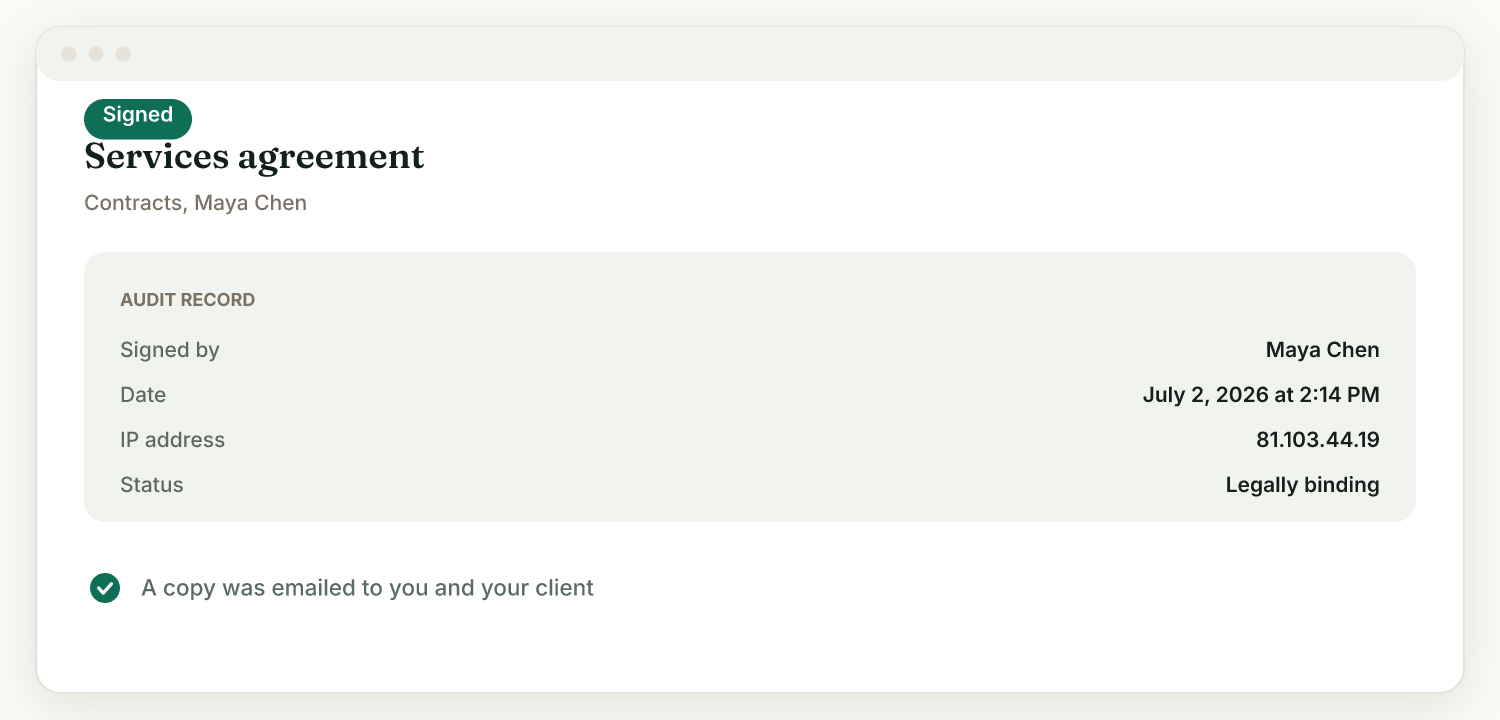
Raoura is $17 a month flat. Contract templates live in a library, so your kill fee, revision cap, liability cap, and payment-conditioned assignment are in every agreement by default rather than by memory. Contracts send for e-signature with a timestamped audit record, and the signed copy sits in the client's portal next to the invoice it belongs to. Payments run through your own Stripe account, so we never touch your money and never take a cut.
If you would rather start from a document, our annotated freelance contract template is free and ungated, and the writer's CRM guide covers the pipeline around it.
Frequently asked questions
Who owns the copyright to freelance writing?
The writer, by default, from the moment the work is fixed in tangible form. Ownership moves to the client only through a signed written transfer: a valid work-made-for-hire agreement within one of the nine categories in 17 U.S.C. 101, or a written assignment. A contract that is silent on rights leaves copyright with the writer and gives the client an implied license to use what they commissioned.
Is a freelance writing contract legally binding without a lawyer?
Yes. A contract needs offer, acceptance, consideration, and mutual assent, not an attorney. What a lawyer adds is judgment about the clauses that carry real financial risk, mainly indemnification, liability caps, and IP transfers. If your budget allows one review ever, spend it on the template you will reuse for years rather than on a single project agreement.
Can a blog post be a work made for hire?
Usually not on its own. The nine categories in 17 U.S.C. 101 do not include blog posts, website copy, or white papers. A piece written as one contribution among many to a periodical or anthology can qualify under "contribution to a collective work." Because the fit is uncertain, competent contracts pair the work-for-hire label with a backup assignment, and the assignment is what usually does the actual work.
What is a normal kill fee for freelance writing?
There is no verifiable trade-organization standard, despite widespread claims of a 25% to 50% norm. The only published organizational figures we could trace are the National Writers Union's: 50% of the fee for a piece rejected without a revision request, and 75% if rejected after a requested revision. Whatever number you pick, state that paying it returns all rights to you.
Do I need a written contract by law?
In three states and New York City, your client does. Illinois requires one at $500, New York State and New York City at $800, and California at $250, each measured on a single contract or the aggregate over 120 days. The obligation falls on the hiring party, and failing it exposes them to statutory damages between $250 and $1,000 depending on the jurisdiction, on top of double damages for late payment.
Should I register the copyright on articles I write?
Only where the economics justify it. Registration costs $45 for a single work by a single author, and it must happen within three months of first publication to preserve statutory damages and attorney's fees for infringement that starts after publication. For a body of similar pieces, group registration of short online literary works is $65 for the batch, which is usually the better route for a working writer.
What should an AI clause say in my writing contract?
Two things, running in opposite directions. If you use AI tools, do not sign an unqualified "no AI content" representation backed by uncapped indemnity. If the client wants to use your work to train models, treat that as a separate right to be priced or struck rather than folded into a general assignment. And note that AI-generated material is not copyrightable, so it is not yours to transfer either.
Sources verified July 2026: 17 U.S.C. 101, 203, 412, and 504(c) via uscode.house.gov and Cornell LII; CCNV v. Reid, 490 U.S. 730 (1989); the US Copyright Office fee schedule, its March 2023 AI registration guidance (88 Fed. Reg. 16190), and its Part 2 copyrightability report of January 29, 2025; NYC DCWP's Freelance Isn't Free Act five-year report; 820 ILCS 193; NY GBL Article 44-A; California SB 988 and DIR independent contractor guidance; the Authors Guild model contract Sections 14, 15, and 16 and its media liability insurance notice; National Writers Union published agreements; and the CREATe (University of Glasgow) 2024 freelance journalist survey. The SERP audit table reflects the six pages ranking for "freelance writing contract" as read in July 2026. This article is information, not legal advice.
Run your client work in one place
Send a proposal, get it signed, invoice, and get paid, with a branded portal your clients will actually use. One flat plan at $17/month, and we never take a cut of your payments.
Try Raoura free for 14 daysNo credit card required. Set up in minutes.
Keep reading
7 17hats Alternatives for Solos Who Don't Need $60/mo Software (2026)
17hats now costs around $60 per month on a single all-inclusive plan, which is a lot for one freelancer. Here are 7 alternatives from $0 to $36 per month, with honest tradeoffs for each.
Are E-Signatures Legally Binding?
Every page ranking for this question is a signature vendor quoting itself. This one quotes the statutes: e-signatures have been binding in the US since 2000 under the ESIGN Act, 49 states run on UETA, courts have enforced a text message and a thumbs-up emoji, and the nine federal carve-outs almost never touch client work. Plus the four ways an e-signature actually fails, and what to keep in case a client denies signing.
The Best Client Portal Software for Freelancers in 2026: 10 Tools Audited, No Vendor Spin
Every page ranking for this query is a vendor putting itself at #1, and three of them still recommend a product that changed its name ten months ago. We audited 10 client portals against the six things that matter for a business of one: verified pricing, portal tier gates, client caps, white label, login friction, and payment fees.