Are E-Signatures Legally Binding?
July 19, 2026
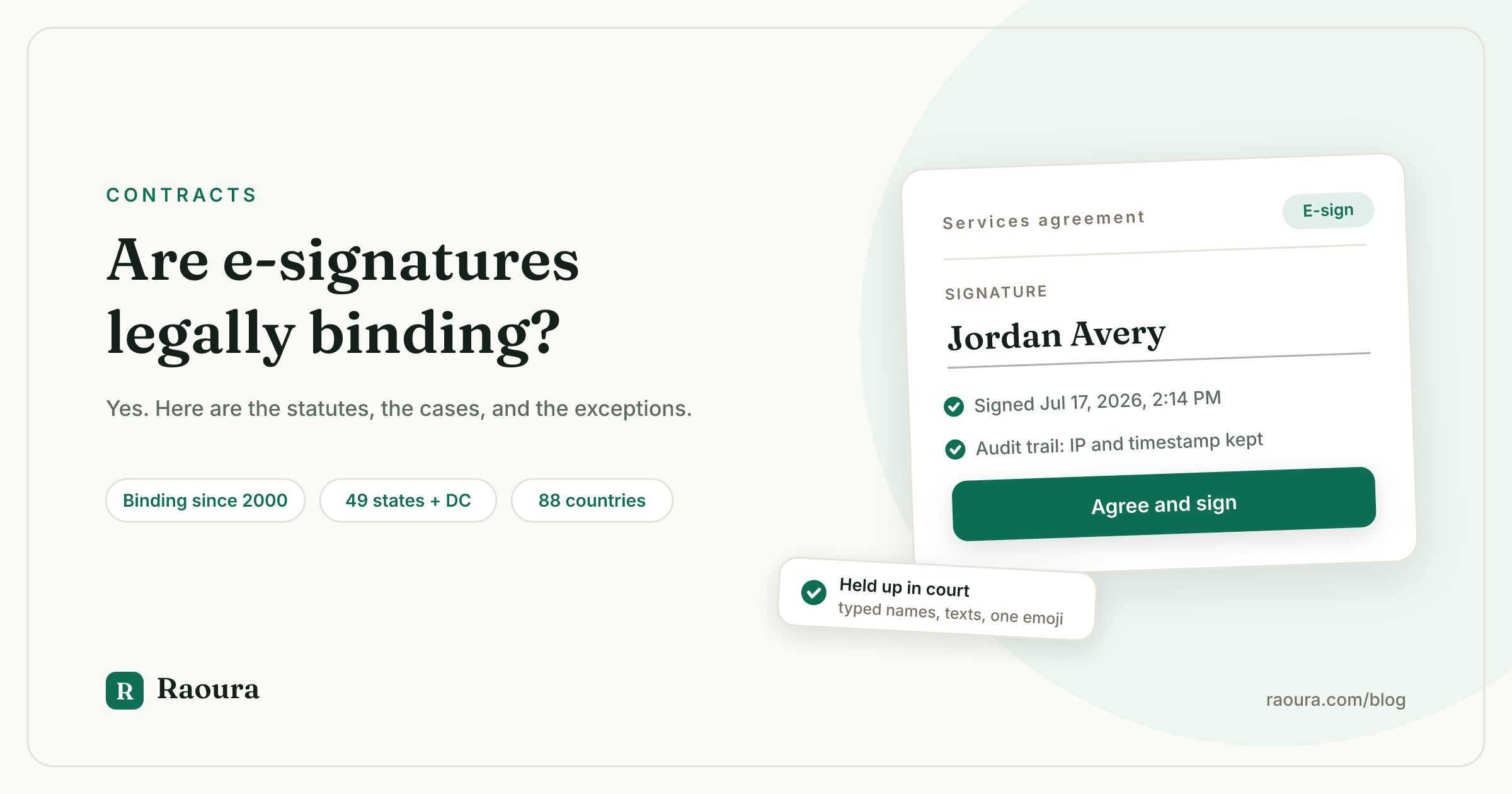
A new client reads your contract, hovers over the signature box, and asks the question you half-dread because you have never actually checked: "Is this e-signature thing legally binding, or should I print and scan it?"
You have probably answered "yes, totally" on instinct. Your instinct is right, and this article gives you the receipts: the two US statutes that make it true, the nine narrow exceptions, the court cases where far sloppier signatures held up, the four ways an e-signature actually fails, and what happens when your client is in Berlin, London, or Toronto.
Here is a warning about the pages currently ranking for this question, though. In July 2026 we fetched four of the top results (DocuSign, Adobe, PandaDoc, and a law school blog), and three of the four describe the federal law's carve-outs as documents that "cannot be e-signed." That is not what the statute says, and it is the kind of sloppiness you get when the only people writing about signature law are the people selling signature software.
So let us do it with the statutes open.
The short answer#
Yes: since October 1, 2000, the federal ESIGN Act has barred courts from denying a contract legal effect solely because it was signed electronically, and e-signature legislation modeled on the same UN framework now exists in 88 countries covering 171 jurisdictions.
For a freelancer, the practical version is even stronger. Client service agreements, proposals, statements of work, NDAs, change orders, and invoices sit squarely inside the protected zone in every US state and in every country your clients are realistically emailing you from.
The interesting questions are not "does it count," because it does. They are "what makes one fail" and "what should I keep so I can prove it later." Both are covered below.
The two US laws that make your e-signature stick#
Two laws do the work: the federal ESIGN Act of 2000, and the Uniform Electronic Transactions Act (UETA), adopted by 49 states plus DC, Puerto Rico, and the US Virgin Islands, with New York covered by its own equivalent, ESRA.
The federal layer is the ESIGN Act, 15 U.S.C. 7001. Its core rule is one sentence long: for any transaction in or affecting interstate or foreign commerce, a signature, contract, or record "may not be denied legal effect, validity, or enforceability solely because it is in electronic form." Your client hiring you across state lines, or across the internet at all, is interstate commerce.
The same section adds useful details people skip: nobody can be forced to accept electronic documents (7001(b)), consumers get special disclosure rights before you can go paperless with them (7001(c)), and notarization itself can be done electronically (7001(g)).
The state layer is UETA, the uniform state law ESIGN was designed to defer to. Per the UNCITRAL status table, every US state except New York has enacted it, along with DC, Puerto Rico, Guam, and the US Virgin Islands. UETA says the same thing as ESIGN with more machinery: a record or signature may not be denied legal effect solely because it is electronic, and if a law requires a signature, an electronic signature satisfies it.
The New York asterisk matters less than every vendor page implies. New York never adopted UETA, but its Electronic Signatures and Records Act (ESRA) has given e-signatures "the same validity and effect" as handwritten ones since 2000. For client work, nothing changes in New York. ESRA carves out wills, trusts, powers of attorney, and health care directives, none of which you are sending a client anyway.
One definition to hold onto, because everything later hangs on it. ESIGN defines an electronic signature as "an electronic sound, symbol, or process, attached to or logically associated with a contract or other record and executed or adopted by a person with the intent to sign the record."
Notice what is not in there: no drawn squiggle, no certificate, no particular app. A typed name, a click on an "I agree" button, a checked box, even a recorded voice can qualify. The load-bearing words are intent to sign.
What you legally cannot e-sign (and why it is almost never your problem)#
The ESIGN Act's exceptions in [15 U.S.C. 7003](https://www.law.cornell.edu/uscode/text/15/7003) cover 9 narrow categories, and none of them are documents a freelancer sends a client.
Here is the full list, straight from the statute:
| Carved out of ESIGN under 15 U.S.C. 7003 | Ever relevant to client work? |
|---|---|
| Wills, codicils, and testamentary trusts | No |
| Adoption, divorce, and other family law matters | No |
| UCC transactions, other than Articles 2 and 2A (sales and leases of goods stay e-signable) | No |
| Court orders, notices, and official court documents | No |
| Notices canceling utility service (water, heat, power) | No |
| Notices of default, repossession, foreclosure, or eviction tied to a primary residence | No |
| Notices canceling health or life insurance benefits | No |
| Product recall and safety failure notices | No |
| Documents accompanying hazardous materials transport | No |
Two things the ranking pages get wrong about this list.
- The scope. Your service agreement, SOW, NDA, retainer, change order, and every invoice you will ever send are not on it. The list exists to protect people from being evicted or losing life insurance by email, not to complicate a logo project.
- The meaning. Being on this list does not make a document impossible to e-sign, it only removes the federal guarantee. Section 7003 is a carve-out from ESIGN's safe harbor, and states remain free to authorize electronic versions under their own law, which is exactly what the states that now allow electronic wills have done.
Three of the four top-ranking pages we checked flatten this into "these documents cannot be e-signed." The statute does not say that.
Courts have enforced far less formal signatures than yours#
Courts have upheld a typed name at the bottom of an email, a text message, and a thumbs-up emoji as binding signatures, which means your properly executed e-signature platform PDF is comfortably inside the case law.
Three cases worth knowing, because they define how low the bar actually sits:
In Forcelli v. Gelco Corp. (New York, 2013), an insurance adjuster ended a settlement email with "Thanks Brenda Greene." The court held that a typed name, under circumstances showing intent to sign, was a subscribed writing. The $230,000 settlement stuck.
In St. John's Holdings v. Two Electronics (Massachusetts Land Court, 2016), a broker's text message that ended with his name, referencing an unsigned letter of intent, satisfied the Statute of Frauds for a real estate deal under the Massachusetts UETA. A text message. For land.
In South West Terminal v. Achter Land (Saskatchewan, 2023), a farmer replied to a photographed grain contract with a thumbs-up emoji. The court found a binding contract and awarded the buyer 82,200 Canadian dollars.
In Meyer v. Uber (Second Circuit, 2017), clicking a signup button beneath reasonably conspicuous terms was enough to bind a user to a contract he never read.
Now read those cases from the other direction, because this is the part no signature vendor will tell you. The same law that makes your contract enforceable makes your casual reply enforceable. If a client emails "we will pay $3,000, half up front, you keep working until we are happy" and you type back "sounds good!", you may have just signed those terms, unlimited-revisions clause and all.
E-signature law is not a feature of DocuSign. It is the water you are swimming in.
That cuts both ways, which is why the confirmation email strategy for small projects works, and why you should treat your own replies to a client's proposed terms with the same care as a signature page.
The four ways an e-signature actually fails#
An e-signature gets challenged on 4 fronts: intent to sign, agreement to do business electronically, attribution (proving who clicked), and record delivery, and all four have statutory hooks a client's lawyer knows how to pull.
This is the section missing from every page that ranks, so here it is with the statute open.
- Intent. The signature must be "executed or adopted by a person with the intent to sign." A name in an email cc line, a signature block auto-appended to every message, or a document the signer plausibly never opened can all be attacked on intent grounds. This is why real signing flows make you click a clearly labeled button.
- Agreement to transact electronically. UETA applies "between parties each of which has agreed to conduct transactions by electronic means," and agreement can be inferred from conduct. Between businesses, including a freelancer and a client, replying by email is usually agreement enough. The strict disclosure regime in 7001(c) applies to consumers, but a one-line clause in your contract ("the parties agree to conduct this transaction by electronic means and to accept electronic signatures") removes the argument entirely. Our annotated contract template carries one.
- Attribution. UETA section 9 says an electronic signature is attributable to a person if it was "the act of the person," provable "in any manner, including a showing of the efficacy of any security procedure." Translation: when a client claims "someone else must have clicked that," you win with evidence, and the evidence is the audit trail: the email address the signing link went to, the timestamp, the IP address, the sequence of views and clicks. This is the one place where a signing platform actually earns its keep over a bare email thread.
- Retention and delivery. The sleeper clause: 7001(e) says an electronic record may be denied legal effect if it is not in a form that all entitled parties can keep and accurately reproduce. If your client never receives a copy of what they signed, you have handed them an argument. Always deliver a completed copy to every signer, automatically if possible.
So the dispute-proofing checklist costs you nothing:
- Use a signing flow with a clear signature action.
- Keep the surrounding emails.
- Put the e-signature consent clause in the contract.
- Save the audit trail or completion certificate as a PDF.
- Make sure the client gets a copy the moment signing completes.
Five minutes of setup, one time.
E-signing with international clients#
A US freelancer's e-signed contract holds up in every major client market: the EU under eIDAS Article 25, the UK under its retained version of the same rule plus the Law Commission's 2019 confirmation, and Canada under PIPEDA and provincial law.
The freelancer version of the international picture, with primary sources:
| Client location | Governing rule | What it means for your contract |
|---|---|---|
| European Union | eIDAS, Regulation 910/2014, Article 25 | An e-signature cannot be denied legal effect solely for being electronic. Ordinary service contracts need only a simple electronic signature. |
| United Kingdom | Law Commission, 2019 and the Electronic Communications Act 2000 | E-signatures are valid for contracts, including deeds, where the signer intends to authenticate. |
| Canada | PIPEDA Part 2 and provincial laws like Ontario's Electronic Commerce Act | Electronic and paper documents sit on equal footing; e-signatures satisfy signature requirements. |
| Most of the rest of the world | UNCITRAL Model Law framework | Legislation based on the same UN model exists in 88 states across 171 jurisdictions. |
The EU adds one wrinkle worth knowing: eIDAS defines three tiers of signature. Simple (what you use daily), advanced (cryptographically linked to the signer), and qualified (certificate-based, issued through a vetted provider). Only a qualified electronic signature is automatically equivalent to a handwritten one across all member states, but that equivalence only matters for documents where EU law demands a handwritten signature, which your design retainer does not.
For freelance service contracts with EU clients, the simple signature your platform produces is fine, and Article 25(1) protects it explicitly.
One freshness note for 2026: the EU's updated regulation, eIDAS 2.0, obliges every member state to offer citizens a free EU Digital Identity Wallet by the end of 2026, which will make qualified signatures dramatically easier for EU clients to produce. If you ever land the rare client who insists on QES, the friction is about to drop.
What this means for your client workflow#
The complete legal requirement fits in 3 habits: a signing flow that shows intent, an e-signature consent clause in the contract, and a delivered copy plus audit trail for every signer.
Notice what is not on that list: an expensive subscription. A scope-and-price email answered with an explicit "agreed" is already a binding written contract, which is the whole small-project strategy.
When you want a proper signature page, free tiers exist. PandaDoc's free plan, for example, covers 60 documents a year with 2 recipients each per its own support docs, which is plenty for many solo practices.
And remember that in a growing set of states, getting client work in writing is not optional anyway: the freelance payment laws in New York, Illinois, and California require a written contract at thresholds as low as $250, and an e-signed PDF or confirmed email chain satisfies every one of them.
The same writing requirement shows up in copyright law: transferring ownership of your work to a client requires a signed written instrument, and an e-signature does that job too.
Where a standalone signature tool starts to chafe is the seams: the contract lives in one app, the proposal in another, the deposit invoice in a third, and you are the integration. This is the workflow problem Raoura was built around, so a disclosure before the next paragraph: Raoura is our product.
Raoura costs $17 per month on one flat plan and treats the signature as one step in the flow rather than a separate product: the client reads the agreement in their browser, types their full name, and clicks a single button labeled "Agree and sign," which is exactly the unambiguous intent action the case law rewards.
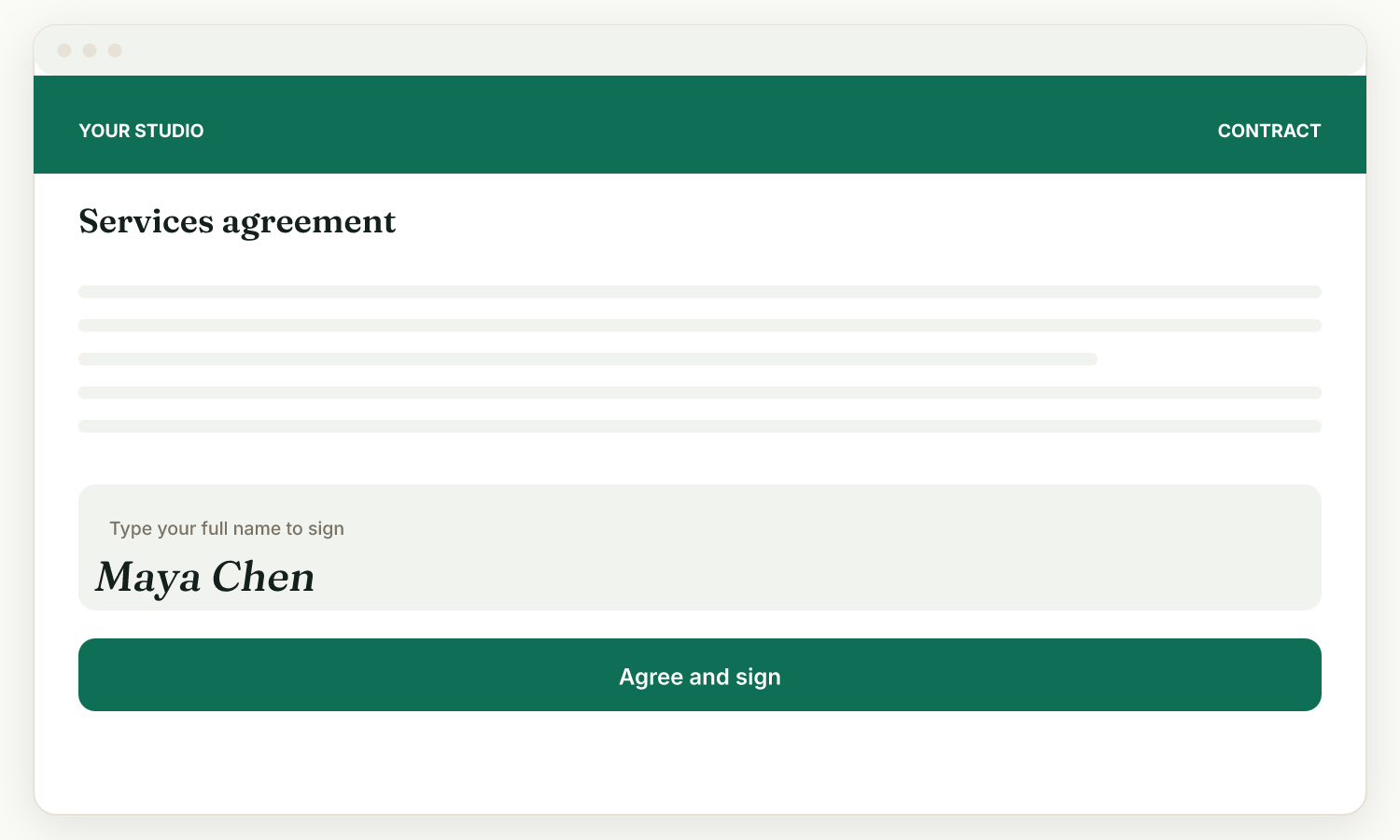
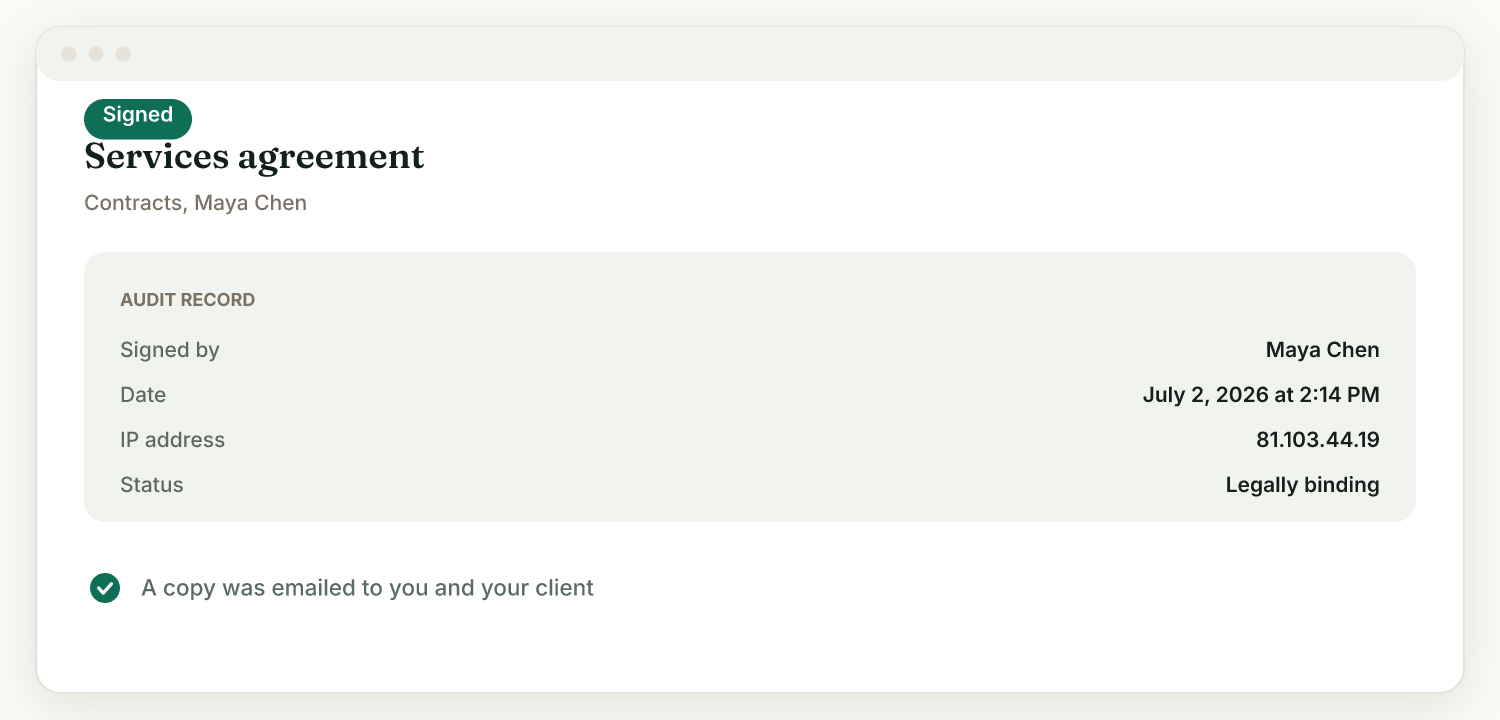
Every completed signature produces the evidence file this article told you to keep: who signed, when, from which IP address, with a copy delivered to both parties automatically, and the deposit invoice can fire the moment the signature lands.
Verified July 2026. Primary sources: 15 U.S.C. 7001 and 7003 (Cornell LII, statute text); UETA via the Uniform Law Commission and the UNCITRAL enactment status table (88 states, 171 jurisdictions, fetched July 2026); NY ESRA via its.ny.gov; eIDAS Regulation 910/2014 Article 25 (EUR-Lex); European Commission EU Digital Identity Wallet policy page; UK Law Commission, Electronic Execution of Documents (2019); Office of the Privacy Commissioner of Canada, PIPEDA; Forcelli v. Gelco Corp., 109 A.D.3d 244 (2d Dept 2013); St. John's Holdings v. Two Electronics (Mass. Land Ct. 2016); Meyer v. Uber Technologies, 868 F.3d 66 (2d Cir. 2017); South West Terminal v. Achter Land, 2023 SKKB 116 (CanLII); PandaDoc Free plan support documentation; Illinois DOL FWPA FAQ. This article is general information, not legal advice.
Frequently asked questions
Is a typed name a legal signature?
It can be. The ESIGN Act defines an electronic signature as any sound, symbol, or process adopted with intent to sign, and in Forcelli v. Gelco a typed "Thanks Brenda Greene" at the end of an email bound an insurer to a $230,000 settlement. What matters is the intent shown by the circumstances, not the format.
Can a client get out of a contract by claiming they never signed it?
Only if you cannot attribute the signature to them. UETA section 9 lets you prove attribution "in any manner," including the security procedure used. A signing link sent to the client's own email, plus the audit trail showing when and from where they clicked, defeats the claim in almost every real dispute. Keep the surrounding emails too.
Do I need DocuSign, or is an email agreement enough?
For most freelance work, a clear email exchange is already a binding written contract: scope, price, and an explicit "agreed" reply. A signing platform adds an unambiguous intent action and an audit trail, which is worth having as project sizes grow, but the law does not require any particular tool, and free tiers like PandaDoc's 60-documents-a-year plan exist.
Are e-signatures legally binding internationally?
In every market a US freelancer is likely to bill: yes. The EU's eIDAS Article 25 protects them, the UK Law Commission confirmed their validity in 2019, Canada's federal and provincial law puts electronic documents on equal footing, and UNCITRAL counts e-commerce legislation based on the same UN model in 88 countries across 171 jurisdictions.
What documents cannot be e-signed?
Under 15 U.S.C. 7003, the federal guarantee does not cover wills, family law documents, court papers, and certain consumer notices (eviction, foreclosure, utility shutoff, insurance cancellation, product recalls, hazmat transport). None are client-work documents, and the carve-out only removes the federal safe harbor; state law can and sometimes does authorize electronic versions anyway.
Does an e-signature work for a copyright assignment?
Yes. US copyright law requires a transfer of ownership to be in writing and signed by the owner, and e-signatures satisfy that requirement like any other. The bigger trap is not the signature format, it is signing away more rights than you priced for, which is a contract-reading problem, not a technology one.
Do e-signed contracts satisfy freelance payment laws like New York's or California's?
Yes. These laws require a written contract above their thresholds, and electronic records qualify. Illinois' Department of Labor says outright that a qualifying freelance contract can be "a paper document, an email, text message, or some other communication."
Run your client work in one place
Send a proposal, get it signed, invoice, and get paid, with a branded portal your clients will actually use. One flat plan at $17/month, and we never take a cut of your payments.
Try Raoura free for 14 daysNo credit card required. Set up in minutes.
Keep reading
7 17hats Alternatives for Solos Who Don't Need $60/mo Software (2026)
17hats now costs around $60 per month on a single all-inclusive plan, which is a lot for one freelancer. Here are 7 alternatives from $0 to $36 per month, with honest tradeoffs for each.
The Best Client Portal Software for Freelancers in 2026: 10 Tools Audited, No Vendor Spin
Every page ranking for this query is a vendor putting itself at #1, and three of them still recommend a product that changed its name ten months ago. We audited 10 client portals against the six things that matter for a business of one: verified pricing, portal tier gates, client caps, white label, login friction, and payment fees.
Bonsai Pricing (2026): What Free Actually Includes
Bonsai advertises plans from $9 per user per month, but the $9 and $15 tiers cannot send an invoice, the trial requires a credit card, and the only truly free plan is a view-only archive you get after canceling. Here is the full per-seat and fee math, verified against Bonsai's own pages.