The Real Cost of Upwork in 2026: A Full-Year Breakdown of the 0-15% Fee, Connects, and Everything Else
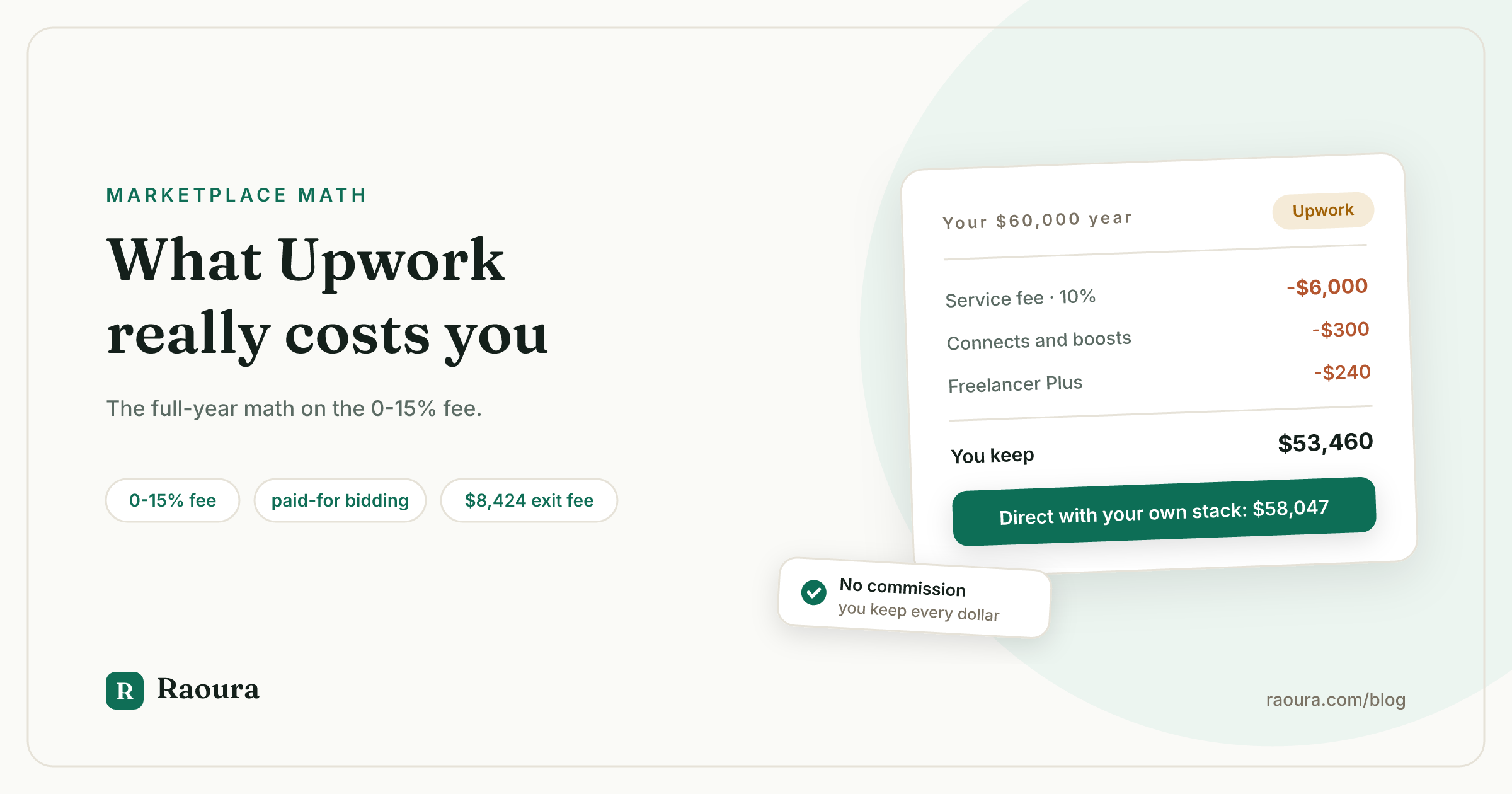
Ask Upwork what it costs and you get a tidy answer: the service fee runs 0% to 15% per contract. Ask your bank account at the end of the year and you get a different one, because the service fee is only the largest of five separate ways the platform is paid out of your work.
This article does the math the fee page will not. We add up every layer for a realistic solo freelancer year: the variable fee, the Connects you burn bidding, the boosting auctions, the subscription you probably hold, the withdrawal fees, and the two costs nobody prices at all, the 10-day wait for your own money and the four-figure toll for leaving with a client. Then we put that number next to what the same year costs when you run clients directly. Every figure was checked against Upwork's own help pages and investor filings in July 2026, and where a number is an estimate, we say so.
The short version: a US-based solo freelancer earning $60,000 on Upwork typically hands over $6,500 to $9,500 a year, roughly 11 to 16% of income, before counting unpaid bidding time or payment delays. The same year run on your own stack costs about $1,950, or 3.3%. Here is how it breaks down.
Layer 1: the service fee that used to be simple#
Since May 2025, Upwork charges freelancers a variable service fee of 0% to 15%, set per contract, and it does not publish the formula. The official policy says the fee "is set based on factors that help support a balanced and competitive environment across different types of work," which is a sentence that tells you nothing except that the number is not up to you. You see the percentage when you submit a proposal or receive an offer, it locks when the contract starts, and it stays locked for that contract.
In practice, reports from freelancers since the change cluster the way you would guess: crowded categories like virtual assistance, general content writing, and basic web work tend to draw fees at the top of the range, while scarce specialties see lower ones. Upwork's own worked examples on the policy page both use 10%, and third-party analyses of agency accounts (like GigRadar's, which tracks thousands of them) put blended averages between 11% and 13.5%.
But there is a better number, and it comes from Upwork itself. In its full-year 2025 financial results, Upwork reported $787.8 million in revenue against $4.03 billion of work flowing through the platform. Divide those and Upwork's total take is 19.6 cents of every dollar clients spend. That includes fees charged to both sides plus Connects and subscriptions, so it is not your personal rate, but it is the honest measure of what the marketplace removes between what clients pay and what freelancers keep. For reference, the same calculation gave roughly 14% in 2022. The direction is not subtle, and the company's own 2026 guidance projects revenue growing faster than the volume of work again this year.
Layer 2: you pay to apply#
Connects cost $0.15 each, a single proposal costs 6 to 16 of them, and you do not get them back when you lose. Upwork's Connects policy is explicit about the asymmetry: Connects are returned if the client cancels the posting or Upwork removes it, but not when "the client rejects your proposal, the client chooses another freelancer, the job expires without a hire, you withdraw your proposal." Industry estimates suggest a large share of postings never hire anyone at all, and every Connect spent on those is simply gone.
Then there is boosting. To compete for the top four slots on a posting, you bid extra Connects in an auction on top of the base cost. A fully boosted bid can run 40+ Connects, which is real money, $6 or more, to be more visible for one job. One detail from Upwork's own documentation deserves a wider audience: the company runs what it calls placebo auctions on randomly selected jobs, where boosting is displayed but does nothing and the Connects are not charged, as an experiment. You are bidding in an auction that is sometimes not real.
Most freelancers applying seriously also hold Freelancer Plus at $19.99 a month, which includes 100 Connects (a $15 face value), proposal insights, and a 0% fee on Direct Contracts. That is another $240 a year that exists mostly to subsidize the bidding system.
The full-year model: what a $60,000 Upwork year actually costs#
Here is the whole picture for a solo freelancer billing $60,000 through Upwork in a year, with the assumptions stated so you can bend them to your own situation. We assume a 10% average service fee (the middle of observed reality), about 10 serious proposals per contract won at an average 10 Connects each plus occasional boosts, a Plus subscription, and free ACH withdrawal (US bank).
| Cost layer | Typical year | If your fee runs 15% |
|---|---|---|
| Service fee (on $60,000) | $6,000 | $9,000 |
| Connects and boosting (~120 proposals) | $300 | $300 |
| Freelancer Plus ($19.99 x 12) | $240 | $240 |
| Withdrawal fees (US ACH) | $0 | $0 |
| Total | $6,540 (10.9%) | $9,540 (15.9%) |
Outside the US, add $0.99 per bank transfer (about $50 a year on weekly withdrawals) and a currency conversion markup that Upwork's payment partners apply to the exchange rate, commonly estimated around 2 to 3%, which on a $60,000 year is potentially another $1,200 to $1,800. Upwork confirms the markup exists without publishing its size, so treat that range as an estimate.
Now the same year without the marketplace:
| Cost layer | Direct clients, your own stack |
|---|---|
| Card processing via your own Stripe (2.9% + $0.30 on ~30 invoices) | $1,749 |
| Client management tool (proposals, contracts, invoices, portal) | $204 ($17/mo) |
| Commission on your income | $0 |
| Total | $1,953 (3.3%) |
And if your clients pay by ACH bank transfer instead of card (0.8% capped at $5 per payment), processing drops to about $150 and the whole stack costs under $400, or 0.6% of income. We walked through that card-versus-bank math in more detail in our deposit guide.
The gap is $4,600 to $7,600 a year on a $60,000 income, every year. That is a vacation, a retirement contribution, or six weeks of not needing a new client, transferred to a marketplace for the service of standing between you and people you often found yourself.
One fairness note: GigRadar's widely quoted "22 to 34%" figure for Upwork's real cost includes the imputed value of unpaid bidding time at $25 an hour, and it models agencies sending hundreds of proposals a month. Our table counts only cash. If you priced your own proposal-writing hours the way GigRadar does, the Upwork column would grow by thousands more, and the direct column would grow too, but by less, because referrals and repeat clients do not require twelve competitive bids.
Layer 3: the wait, which is also a cost#
Money you earn on an Upwork hourly contract becomes withdrawable roughly 10 days after the work week ends. The billing cycle runs Monday to Sunday, the client then has until the following Friday to dispute hours, and payment lands the Wednesday after that. Fixed-price milestones can sit in a client review window of up to 14 days (inaction auto-approves), followed by a security hold of about five more days before the funds are yours to move. Then withdrawal itself takes two to five business days by ACH.
None of this shows up in a fee table, but if you have ever floated rent while $3,000 of approved work sat in "pending", you know it is a cost. Direct invoicing with card or instant bank payment settles into your account in days, and you, not a marketplace's dispute calendar, decide the terms.
Layer 4: the exit toll#
Leaving Upwork with a client you met there costs 13.5% of that client's estimated annual value if you do it inside two years. This is the part most freelancers discover late. Upwork's Conversion Fee policy requires all work and payments to stay on the platform for two years per client relationship, and the buyout is calculated as 13.5% of your hourly rate multiplied by 2,080 hours. Upwork's own examples: a $30/hour freelancer pays $8,424 to convert a client; at a $50/hour profile rate it is $14,040. Going around the rule instead risks permanent account suspension.
There is a legal, free exit: after two years, the relationship can move off-platform at no charge. Which means the real strategy question is not "Upwork or not," it is what you do with a client relationship as it approaches that anniversary, and we cover the clean off-ramp step by step in our guide to moving Upwork clients to direct contracts legally.
Your client is paying too#
The freelancer side is only half the meter. Clients pay their own marketplace fee of 5% (3% for eligible US clients paying from a checking account), plus a one-time Contract Initiation Fee of $0.99 to $14.99 on every contract, including rehires of the same freelancer. On a $5,000 project, your client may be paying roughly $265 above your price for the transaction to happen on Upwork.
That matters for a practical reason: when you eventually propose working directly, the pitch is not "pay me the same, but I keep more." It is "we both stop paying a toll." A client spending $20,000 a year with you is spending about $1,000 a year on marketplace fees for the privilege. After the two-year mark, that money is negotiating room that belongs to the two of you.
When Upwork is still worth it#
An honest cost breakdown has to say this clearly: for finding your first clients, Upwork's fees buy something real. You get demand you did not have to generate, payment protection on hourly contracts, and a dispute process, and if you are in a category where the variable fee lands at 5%, the math above softens considerably. 785,000 active clients spent money there last year. If your alternative to a 10% fee is zero clients, the fee is cheap.
The math turns against the platform at a specific, predictable moment: when your income shifts from new strangers to repeat clients and referrals. A repeat client on Upwork costs you the same percentage forever, while costing the platform nothing new to provide. That is exactly the revenue Upwork's fee structure is built to hold onto, with the two-year rule as the fence. The freelancers who win at this treat Upwork as a discovery channel, not a home: find clients there, deliver excellently, and graduate each relationship the legal way as it matures.
When you do graduate a client, you need the things the marketplace was quietly providing: a professional way to send proposals, contracts with e-signature, invoices that collect payment, and one place for the client to see it all. (Disclosure: this is our product. Raoura is exactly that stack for solo freelancers, at $17 a month flat, with payments going through your own Stripe account straight to your bank. We never hold your money and never take a percentage, which, after this article, is a sentence we suspect lands differently.)
Run your client work in one place
Send a proposal, get it signed, invoice, and get paid, with a branded portal your clients will actually use. One flat plan at $17/month, and we never take a cut of your payments.
Try Raoura free for 14 daysNo credit card required. Set up in minutes.
Keep reading
HoneyBook Alternatives (2026): True Costs, Export Limits, and 8 Tools Compared
Most HoneyBook alternative roundups compare sticker prices and stop there. We computed the true annual cost of 8 alternatives at $60k revenue including processing fees, documented exactly what HoneyBook lets you export, and wrote a switching playbook that won't break your in-flight projects.
Scope Creep: How to Say No to 'Just One Quick Change' Without Losing the Client
Roughly 72% of freelance projects hit scope creep, and it quietly costs freelancers thousands a year. Here are the copy-paste scripts, the change-order template, and the prevention system that stops it.
You Don't Need a CRM. You Need These 5 Things.
Solo freelancers keep getting sold agency software: pipelines, team seats, automations they'll never build. Here are the five things a one-person business actually needs, and why everything else is bloat you're paying for.