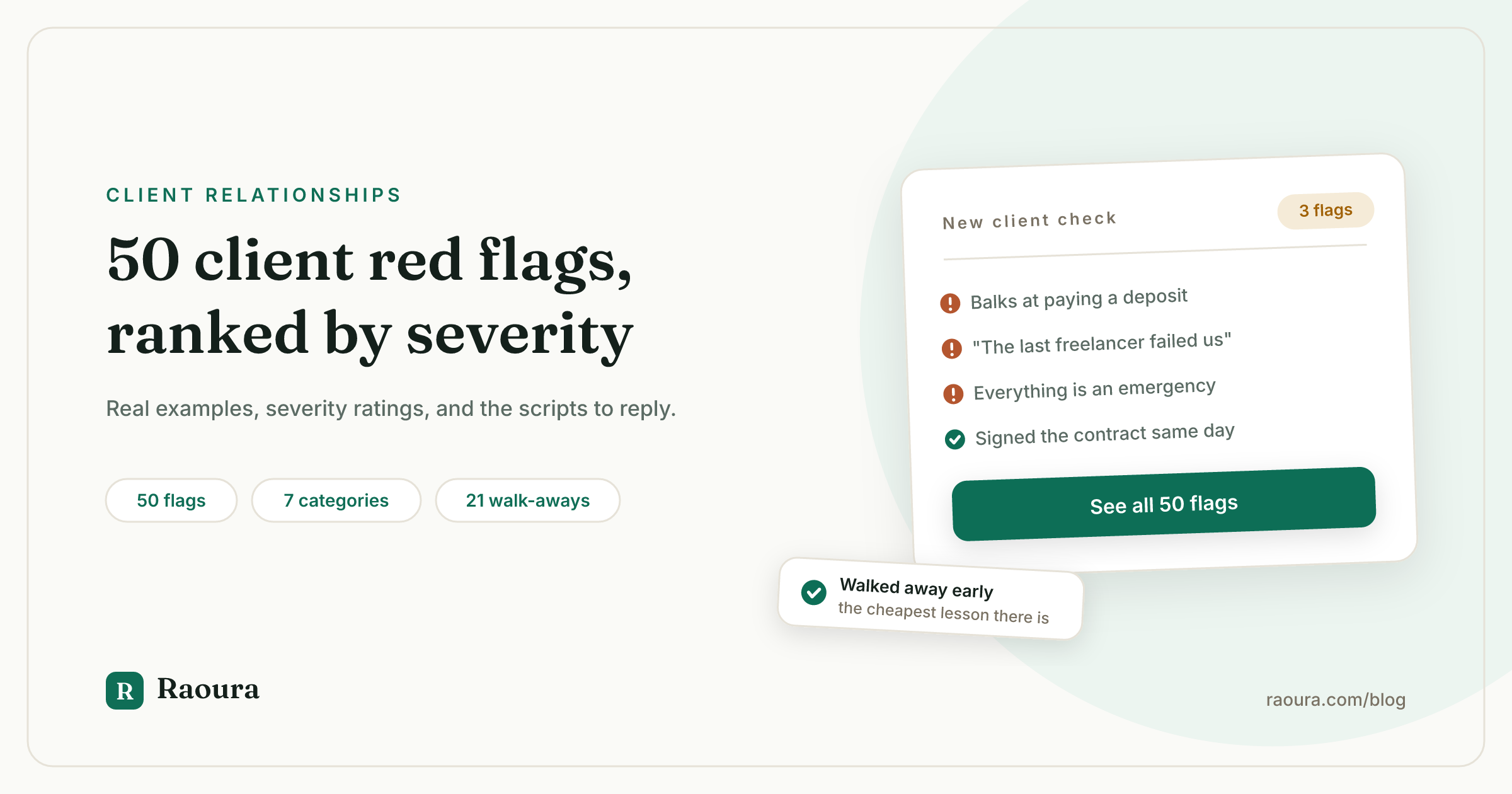
The Client Red Flags Database: 50 Real Warning Signs, Ranked by Severity
July 6, 2026
Almost every freelance horror story starts the same way: "Looking back, the signs were all there."
The client who ghosted after delivery sent one-word replies during the sales call. The client who refused to pay the final invoice also argued about the deposit. The client who demanded a fourteenth revision round opened the relationship by explaining how the last two designers failed them.
Bad clients are consistent. They show you who they are early, usually before you sign anything. The problem is that most freelancers have never seen the patterns written down in one place, so each of us learns them one invoice write-off at a time. The average freelancer who gets stiffed loses almost $6,000 a year to nonpayment, and 71% of freelancers struggle to collect payment at least once in their career, per a Freelancers Union survey of more than 5,000 freelancers.
This is the database we wished existed: 50 red flags, sourced from real freelancer accounts across design, writing, development, and consulting, organized into 7 categories, each with a severity rating. Bookmark it and run every new prospect against it.
One observation of our own before we start. We audited the five top-ranking "client red flags" guides on Google in July 2026. Between them they list 58 flags, the longest single list is 17, and not one of the five cites a single statistic. This page exists because the topic deserved better.
How to use this database#
Every one of the 50 flags below carries one of three severity levels: Walk away (21 flags), Charge for the risk (12 flags), or Watch closely (17 flags).
| Severity | What it means | Typical response |
|---|---|---|
| Walk away | The pattern almost never improves and the downside is severe | Decline politely, keep the referral door open |
| Charge for the risk | Workable, but only with protection priced in | Bigger deposit, tighter contract, rush fees, milestone billing |
| Watch closely | Could be innocent, could be the first data point | Proceed, but verify with a paper trail before going deeper |
A single "watch closely" flag is information, not a verdict. Two or three from the same category is a pattern. Any "walk away" flag is exactly that, no matter how good the money looks. The freelancers quoted throughout this article all said some version of the same thing: the project they regret most is the one where they saw the flag and negotiated with themselves about it.
What ignoring red flags actually costs#
56% of US small businesses are owed money from unpaid invoices, averaging $17,500 per business, per QuickBooks' January 2025 survey of 2,487 businesses.
The costs of a bad client are not abstract. The verified numbers:
- 52% of freelancers name being asked to work for free as a top client red flag, and 51% name not being paid on time, in Skynova's survey of 615 freelancers. These are the two most common flags in the wild.
- 71% of freelancers have struggled to collect payment at least once, and the average unpaid freelancer loses almost $6,000 a year, about 13% of income (Freelancers Union).
- 52% of projects experience scope creep or uncontrolled changes, up from 43% five years earlier (PMI Pulse of the Profession).
- 56% of small businesses report being owed money on unpaid invoices, and 47% have invoices more than 30 days overdue (QuickBooks, 2025).
Every flag below is a cheaper lesson than any of those numbers.
Category 1: Money and payment behavior (flags 1 to 10)#
10 of the 50 flags are about money, because payment behavior before the contract predicts payment behavior after it: 51% of freelancers name late payment as a top client red flag.
- They balk at paying a deposit. Severity: Walk away. A deposit is the industry norm, and a client who refuses one after you explain it is telling you they want all the risk on your side of the table. One designer held final files until payment as her contract allowed, and the client who had promised "you have our word" was outraged that his word was not accepted as currency. Our guide to how much deposit to charge covers the norms by project type.
- The budget shrinks after you engage. Severity: Walk away. The job post advertised a healthy budget, but once you are on the call it turns out the real number is a fraction of it. Freelance designer Morgan Overholt treats the bait and switch as an instant deal-breaker: a client who opens the relationship with a false number will keep negotiating with false numbers.
- The opening offer is insulting. Severity: Watch closely. A lowball from a small business that does not know market rates is ignorance and can be fixed with a rate card. A lowball from a company that clearly knows better is a message. A fintech writer describes being offered a quarter of her usual rate by a prominent finance brand that could easily afford more; she read it correctly as a statement about how they valued the work.
- They want to pay in exposure, revenue share, or "when we get funded." Severity: Walk away. Deferred payment is no payment. 52% of freelancers name being asked to work for free as a top red flag, making it the most common one in Skynova's data. Equity or revenue share on top of your normal rate is a conversation; instead of your rate, it is a donation.
- They argue over every line item. Severity: Charge for the risk. More than 1 in 5 freelancers say a client arguing over every invoice item is a top red flag. A client who nickel-and-dimes the proposal will nickel-and-dime every invoice. If you proceed, quote fixed-price only, and put your payment terms in writing before work starts.
- The budget is a secret. Severity: Watch closely. "Just give us your best price" from a client who refuses any range means one of two things: they have no budget, or they plan to use your number against you. Anchor with a range and watch the reaction.
- They propose an unusual payment method. Severity: Walk away. Overpayment by check with a refund of the difference, payment routed through a third party you have never heard of, or crypto from a stranger: these are classic fraud patterns, not quirks. Legitimate clients pay by card, bank transfer, or a recognizable platform.
- Nobody can explain how payment actually happens. Severity: Watch closely. 85% of freelancers say it is a red flag when a client's accounts payable process is not clearly explained. If your contact cannot tell you who approves invoices and on what schedule, your invoice is about to enter a maze. Ask before signing, not after delivering.
- They renegotiate after delivery. Severity: Walk away. The client who receives the work and then discovers reasons it is worth less ("I basically did half of this myself") is running a discount play. Overholt tells of a self-described "designer" client who mangled the source files, forced hours of repair, then refused full payment because he had "done half the work". Pay-then-dispute clients repeat the move on every project.
- They are candid about owing other people money. Severity: Charge for the risk. "We will catch up on the old invoice next month" or vendors chasing them publicly means you are volunteering to join a queue. If you take the work anyway, take a larger deposit and bill by milestones so you are never owed more than one phase.
Category 2: Free work and spec traps (flags 11 to 16)#
52% of freelancers say being asked to work for free is a top red flag, which makes this the single most common category in survey data.
- The paid gig starts with an unpaid test project. Severity: Walk away. Instructional designer Devlin Peck describes producing spec work early in his career and being 95% sure it was combined with other applicants' free work into a finished product, with nobody hired. A short paid trial is legitimate. An unpaid one is sourcing free labor.
- It is a contest, and only the winner gets paid. Severity: Walk away. A doctor's office asked several designers to each produce the branding work up front, with payment only for the chosen one. That is not a brief, it is a raffle where you supply the prize.
- The discovery call keeps turning into consulting. Severity: Watch closely. Prospects who use free calls to extract recommendations, tool choices, and mini tutorials may have never intended to hire anyone. One call is sales. A second hour of questions with no contract is a session you should be invoicing.
- Your "test" deliverable shows up on their site. Severity: Walk away. Writers report clients publishing unpaid test posts without ever paying or responding again. If a client wants to evaluate real deliverable work, they can pay for real deliverable work.
- "Do this one cheap, there is a lot more work coming." Severity: Watch closely. The pipeline of future work that justifies today's discount almost never materializes, and if it does, it arrives at the discounted rate you just established. Price today's project on today's scope.
- The compensation is "great exposure." Severity: Walk away. Exposure does not clear invoices, and the clients most eager to offer it typically have the least of it to give. Decline politely and file it with the 52% of freelancers who flagged free work requests.
Category 3: Communication patterns (flags 17 to 24)#
8 flags cover communication, because no client is ever more responsive than during the sales conversation. What you see now is the best it will ever be.
- Chaotic scheduling before the contract. Severity: Watch closely. Rescheduled calls, missed appointments, and lost email threads during the courtship phase are a preview of the project. They are currently trying to impress you.
- They vanish mid-sales, then reappear with urgency. Severity: Watch closely. Consultant Stefan Palios describes clients who are enthusiastic during the sale and unreachable once work begins; the pattern usually shows up first as a sales conversation that goes silent for weeks, then returns as an emergency. Your project will inherit the same rhythm.
- Endless interviews and onboarding, zero paid work. Severity: Walk away. Overholt went through multiple interview rounds, hours of unpaid training, and proprietary software installs for a client who then sent no paid work for four months. Process without payment is a hobby they are running with your time.
- They withhold the information you need. Severity: Watch closely. A content writer describes clients who go quiet exactly when briefs, access, or approvals are needed, then expect the deadline to hold. If getting a simple brief is hard now, getting sign-off later will be harder. A structured client onboarding process surfaces this flag in week one, when it is still cheap.
- There is no single decision maker. Severity: Charge for the risk. Feedback by committee, or every deliverable waiting on a CEO who is not in any meeting, multiplies revision rounds. If you proceed, name one approver in the contract and define what a revision round is.
- They expect instant replies at all hours. Severity: Watch closely. A prospect messaging at 11pm and following up at 7am is showing you their expectations for the entire engagement. Set response-time norms in writing before you sign.
- Everything must stay verbal. Severity: Watch closely. A client who prefers calls for every decision and never confirms anything in writing is, at best, disorganized. At worst, they are avoiding a paper trail. Follow every call with a recap email and watch whether they push back on the record existing.
- They are rude before the contract. Severity: Walk away. Rude to you on price, rude to a waiter, rude about the assistant who scheduled the call. Pre-contract behavior is a job interview where they know they are being watched. This is the audition version of them.
Category 4: Scope and expectations (flags 25 to 32)#
52% of projects experience scope creep per PMI, and all 8 scope flags in this category are visible before you sign anything.
- "Quick and easy, shouldn't take long." Severity: Charge for the risk. A freelance creative told Digiday that flat-rate clients open with "can you just throw this in, it will take five minutes" until the retainer spins out of control, and notes the quiet condescension of the framing: they are estimating your craft at five minutes. Clients do not get to estimate your hours. That is the quote's job.
- They dictate the timeline to shrink the price. Severity: Charge for the risk. "This is two days of work, tops" is budget-priming, not scheduling. Requote on your own estimate, in writing, and treat their number as an opening bid.
- They resist a written scope. Severity: Charge for the risk. "We will figure it out as we go" is how a developer's simple PHP blog project ballooned feature by feature into a mini social network. No written scope means the scope is whatever the client remembers wanting. A one-page statement of work is the fix, and resistance to it is the flag.
- The retainer keeps absorbing "one more thing." Severity: Watch closely. Retainers without a scope cap become all-you-can-eat buffets. Watch for the pattern in month one and respond with a defined hour block or a scope creep script before it calcifies into the norm.
- Deliverables inflate between brief and delivery. Severity: Watch closely. A 15-year freelance writer catalogs the standard inflation set: word counts that grow, interviews that get added, revision rounds that multiply, then CMS uploads and image sourcing tacked on unpaid. Each addition is small. The habit is not.
- The "part-time" engagement has full-time expectations. Severity: Walk away. Peck signed a vague year-long contract sold as 15 to 20 hours a week that concealed the expectations of a full-time job. If the hours are capped, the availability expectations must be too, in writing.
- They expect unlimited revisions. Severity: Charge for the risk. "We will know it when we see it" plus no revision cap equals an infinite project. Define a round, cap the rounds, and price additional rounds in the contract.
- "Done" keeps moving. Severity: Charge for the risk. If the client cannot state what finished looks like, every delivery is a draft. Write acceptance criteria into the scope: objective, checkable, dated.
Category 5: Respect and boundaries (flags 33 to 39)#
5 of the 7 flags in this category are walk-aways, the highest ratio in the database. Money problems can be contracted around. Contempt cannot.
- Condescension in any form. Severity: Walk away. Overholt describes a recurring pattern of belittling remarks and jokes about her age and appearance from certain clients. A client who diminishes you during the honeymoon will do it in every feedback round.
- They raise their voice, ever. Severity: Walk away. Designer Colleen Gratzer recounts a book-layout prospect who had already churned through two designers and screamed at her over the expectation of being paid. Anger as a negotiation tool only escalates once money is actually owed.
- They test boundaries early. Severity: Walk away. Gratzer also describes a large monthly client who called her at her day job and on weekends to apply pressure, for years; she stayed because the project was big, and calls the result mentally abusive. The first boundary violation is a test. Fail it once and the fee for enforcing boundaries later goes up permanently.
- "You should be grateful for this opportunity." Severity: Walk away. Gratitude framing inverts the transaction: you are a vendor being paid for value, not a fan being granted access. Clients who see it otherwise pay late, if at all.
- They neg your work to pre-discount it. Severity: Walk away. "Your portfolio is not quite what we usually go for, but we are willing to take a chance" is a price move dressed as feedback. Someone who hires you while calling your work weak is buying a discount, not a deliverable.
- They treat you like an employee. Severity: Charge for the risk. Mandatory standups, timesheet surveillance, 9-to-5 availability: if a client wants employee behavior, they can price in employee overhead. Either charge for the availability or restate the engagement as deliverable-based.
- They refuse your process. Severity: Watch closely. The client who will not fill in the intake questionnaire, skips the kickoff call, and says "just start" is opting out of the steps that prevent disputes. Your onboarding process is load-bearing. Treat resistance to it as data.
Category 6: Contract and legal behavior (flags 40 to 45)#
Even clients agree the paperwork matters: 42% of employers say a freelancer refusing to sign a contract is a red flag, per Skynova, and the signal cuts both ways.
- They refuse to sign anything. Severity: Walk away. As the Timing team puts it, refusing to sign may mean they intend to violate the agreement and do not want a paper trail. There is no version of "no contract" that favors you. Our clause-by-clause guide to what belongs in a freelance contract makes the ask painless.
- Their contract is a minefield. Severity: Charge for the risk. Real clauses freelancers have found in client paper: disputes may only be filed in the client's home jurisdiction, the freelancer pays the client's legal fees, and the client can exit at any time while the freelancer cannot. Redline it or counter with your own. We keep a full database of contract red flags worth reading before you sign anyone's paper.
- The IP clause claims everything you own. Severity: Walk away. Some contracts grab not just the deliverables but your templates, frameworks, and tools, or everything you produce during the engagement period. Know who owns what by default and never sign away your background IP for a project fee.
- The non-compete covers your whole industry. Severity: Walk away. A clause barring you from serving "competitors" defined broadly enough to cover your entire client base is a purchase of your business for the price of one project. Narrow it to named companies and a short window, or walk.
- "It's standard boilerplate, just sign." Severity: Watch closely. Pressure to sign without reading is always inversely correlated with how standard the boilerplate is. Take 24 hours. A legitimate client will not lose interest because you read the agreement.
- They want work to start before signature. Severity: Watch closely. "We will get the paperwork sorted while you get going" moves all the risk to you: work delivered without a contract is work you may be arguing about later. Hold the line; the same-day e-signature exists precisely so this excuse does not.
Category 7: History and urgency (flags 46 to 50)#
A client who has burned through 2 or more freelancers on the same project is showing you the one constant in the equation, and it is not the freelancers.
- "The last freelancer was terrible." And the one before. Severity: Walk away. One bad experience is plausible. A pattern is a review of the client. Overholt asks what went wrong and walks if the answers are vague or vicious; Gratzer's screaming book client had already churned through two designers. You will be the third story they tell.
- Everything is an emergency. Severity: Charge for the risk. A rush job from a brand-new client is a trust fall with a stranger: Overholt refuses rush work from new clients outright, while Gratzer's colleagues charge double, noting that a client's disorganization otherwise becomes your emergency. Rush fees exist because urgency is real work. Uncompensated urgency is just panic outsourcing.
- Their reputation precedes them, badly. Severity: Watch closely. Twenty minutes of vetting catches expensive problems: reviews from other vendors, court records for payment disputes, employees describing chaos. If other people they owed money to are visible online, you have your forecast.
- The company is visibly struggling. Severity: Charge for the risk. Layoffs, unpaid vendors, pivots announced monthly. You can still take the work, but on survival terms: larger deposit, shorter payment terms, milestone billing so your maximum exposure is one phase, and stop-work rights the moment an invoice goes past due.
- Your gut already said no. Severity: Watch closely. The meta-flag. Freelancers rarely regret the projects they declined; the regret concentrates almost entirely in the projects where the signs were visible and rationalized away. If you are rereading this database looking for permission, that is the flag.
The 10 flags that should always end the conversation#
Of the 21 walk-away flags, these are the 10 with the worst risk-to-reward ratio in the accounts we reviewed. Any one of them, alone, is enough.
| # | Flag | Category | Why it never improves |
|---|---|---|---|
| 4 | Pays in exposure or "when we get funded" | Money | Deferred payment is structured nonpayment |
| 7 | Unusual payment method | Money | It is a fraud pattern, not a preference |
| 12 | Only the contest winner gets paid | Free work | The business model is unpaid labor |
| 19 | Endless onboarding, no paid work | Communication | Your time is already being spent for free |
| 24 | Rude before the contract | Communication | This is their best behavior |
| 34 | Raises their voice | Respect | Anger escalates once real money is owed |
| 35 | Tests boundaries early | Respect | Every concession reprices the next one |
| 40 | Refuses any contract | Legal | No paper trail only ever protects one side |
| 42 | IP clause claims your tools and templates | Legal | You are selling your business, not a project |
| 46 | Serial freelancer churn | History | You are the next chapter of the same story |
What to do when you spot one#
The response to most red flags takes under 60 seconds and fits in one of four scripts.
- For the deposit balker: "A deposit is standard for my client engagements. It reserves the project slot and covers the setup work. I am happy to split the balance across milestones so no single payment is large."
- For the rate anchor: "That budget will not cover this scope. Here is what I can deliver at that number, and here is the quote for the full scope. Happy to proceed with either."
- For the rush job: "I can hit that deadline. Rush delivery is billed at 1.5x because it displaces other scheduled work. The standard timeline at the standard rate is X weeks."
- For the contract refuser: "I work under a short written agreement on every project. It protects both of us and takes five minutes to e-sign. I will send it now so we can start this week."
The deeper fix is structural. Most of the money flags lose their teeth when your default workflow is deposit first, contract signed before work starts, milestone billing so you are never owed more than one phase, and automatic reminders when an invoice slips. If that workflow lives in a tool instead of your memory, red flag clients either conform to it or select themselves out before you have lost anything. That is the workflow Raoura is built around: proposal, contract, deposit invoice, and milestone billing in one place, at $17 per month flat (Disclosure: Raoura is our product). But the workflow matters more than the tool, and you can run it from any stack.
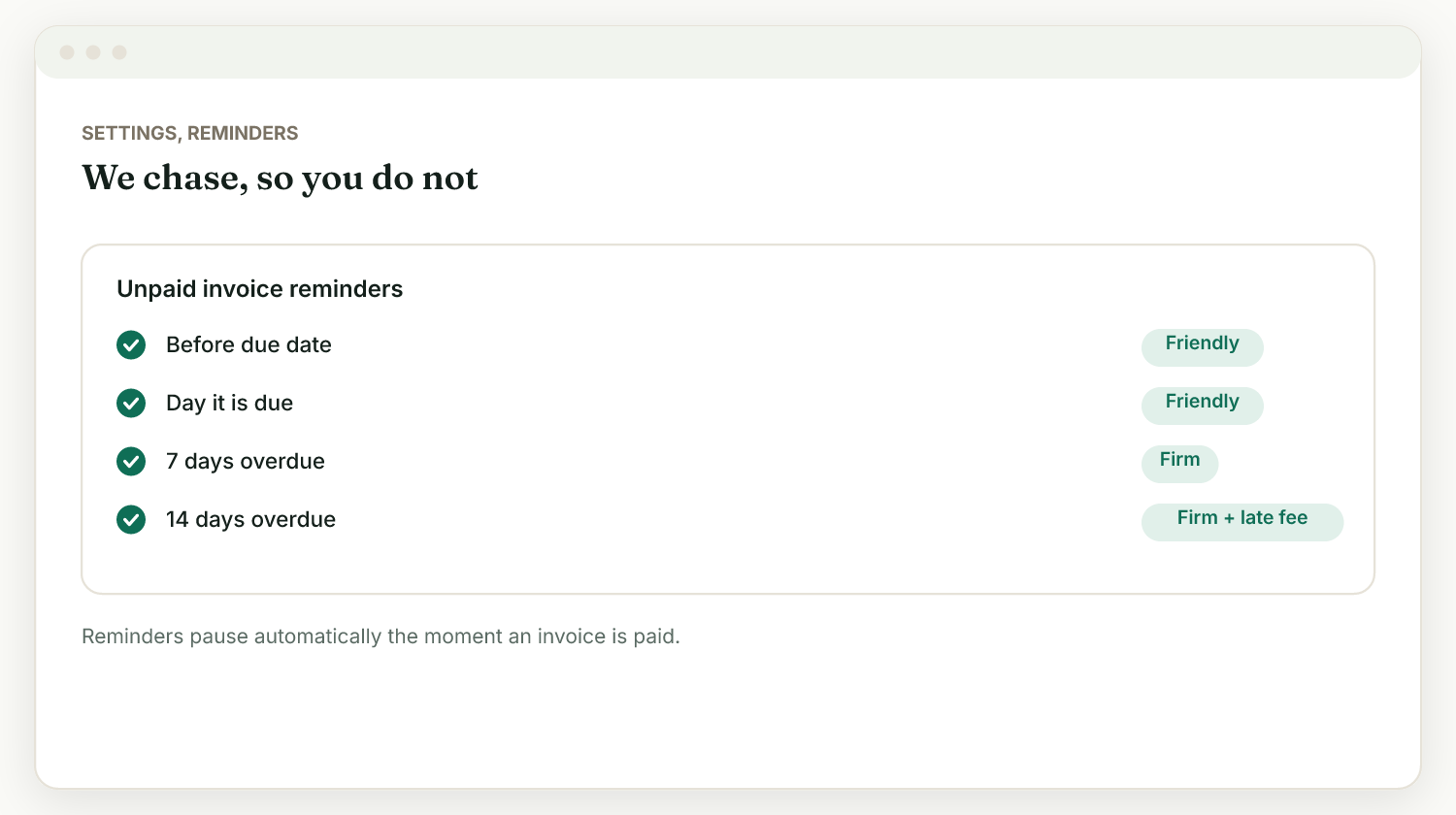
And if a flag has already turned into an unpaid invoice, we have the escalation ladder and the recovery playbook for post-delivery ghosting.
Frequently asked questions
What are the most common client red flags for freelancers?
Being asked to work for free (52%) and not being paid on time (51%) are the two most commonly reported client red flags, per Skynova's survey of 615 freelancers. More than 1 in 5 freelancers also flag clients who argue over every invoice line item.
Should I ever take on a client with red flags?
It depends on the severity. In this database, 21 of the 50 flags mean walk away, 12 mean proceed only with protection priced in (bigger deposit, milestone billing, rush fees, tighter contract), and 17 mean proceed while verifying. A single mild flag is information. Multiple flags from the same category are a pattern.
How do I turn down a client with red flags politely?
Decline without an audit of their behavior: "Thanks for thinking of me. After reviewing the scope, I am not the right fit for this project, and I do not want to hold up your timeline." You do not owe a diagnosis, and delivering one converts a quiet exit into an argument.
What percentage of freelancers have payment problems?
71% of freelancers have struggled to collect payment at least once in their career, per a Freelancers Union survey of more than 5,000 freelancers, and the average unpaid freelancer loses almost $6,000 per year. On the client side, 56% of US small businesses report being owed money on unpaid invoices (QuickBooks, 2025).
Do red flags show up before the contract is signed?
Overwhelmingly, yes. Nearly every account sourced for this database describes signals that appeared during the first conversations: deposit resistance, timeline dictation, badmouthing past freelancers, boundary testing, and contract avoidance are all visible before any work begins. No survey has quantified exactly what share of bad engagements telegraph themselves early, which is why this database ranks flags by observed severity instead.
All statistics verified against their primary sources in July 2026. Flag examples are paraphrased from the linked first-person accounts.
Run your client work in one place
Send a proposal, get it signed, invoice, and get paid, with a branded portal your clients will actually use. One flat plan at $17/month, and we never take a cut of your payments.
Try Raoura free for 14 daysNo credit card required. Set up in minutes.
Keep reading
7 17hats Alternatives for Solos Who Don't Need $60/mo Software (2026)
17hats now costs around $60 per month on a single all-inclusive plan, which is a lot for one freelancer. Here are 7 alternatives from $0 to $36 per month, with honest tradeoffs for each.
Are E-Signatures Legally Binding?
Every page ranking for this question is a signature vendor quoting itself. This one quotes the statutes: e-signatures have been binding in the US since 2000 under the ESIGN Act, 49 states run on UETA, courts have enforced a text message and a thumbs-up emoji, and the nine federal carve-outs almost never touch client work. Plus the four ways an e-signature actually fails, and what to keep in case a client denies signing.
The Best Client Portal Software for Freelancers in 2026: 10 Tools Audited, No Vendor Spin
Every page ranking for this query is a vendor putting itself at #1, and three of them still recommend a product that changed its name ten months ago. We audited 10 client portals against the six things that matter for a business of one: verified pricing, portal tier gates, client caps, white label, login friction, and payment fees.