The True Cost of Free CRMs: HubSpot Free for Freelancers (2026)
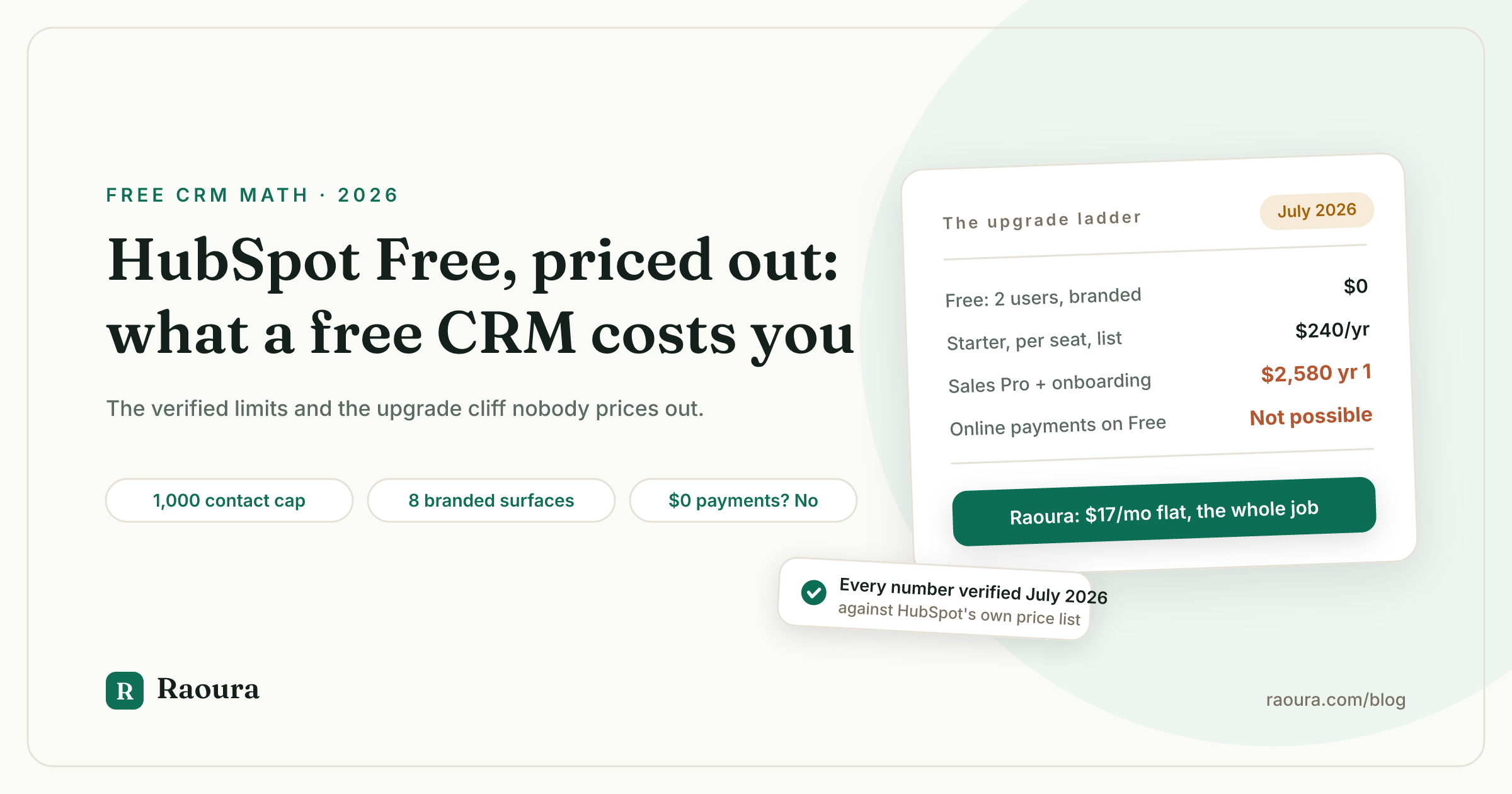
TL;DR: HubSpot's free tier in July 2026 is capped at 2 users, 1,000 contacts, 2,000 marketing emails per month, 1 deal pipeline, and 10 custom properties, with HubSpot branding stamped on 8 different client-facing surfaces. It cannot collect an online payment at all: HubSpot payments requires a paid plan and a US, UK, or Canada business. The upgrade path runs $0, then $20 per seat per month on Starter, then $90 to $100 per seat plus a mandatory $1,500 onboarding fee on Sales Hub Professional, which makes year one of "outgrowing free" cost about $2,580. If your business is one person sending proposals and invoices, a freelancer platform in the $10 to $29 per month range does the actual job on day one. Disclosure: Raoura, our $17 per month flat-price tool, appears near the end.
Search "hubspot free for freelancers" and you will find a strange thing: almost every page ranking for it is written by a competing CRM vendor, and almost every one of them gets HubSpot's own numbers wrong. Several still describe a free tier with "unlimited users" and a million contacts. That tier no longer exists. One freelancer-focused listicle repeats "no contact limits" six times while HubSpot's own pricing FAQ says the cap is 1,000.
So before you build your client list inside a free CRM, it is worth doing the thing none of those pages do: read HubSpot's actual price list, count what free includes, and run the math on what happens when you grow. That is this article. Every number below was checked against HubSpot's pricing pages and its legal Product and Services Catalog in July 2026.
What HubSpot Free actually includes in 2026#
HubSpot's free edition in July 2026 allows 2 users, 1,000 contacts, and 2,000 branded marketing emails per calendar month, with no time limit. Those are HubSpot's own published numbers, from its pricing page and its Product and Services Catalog, the legal document where the exact limits live.
Here is the full picture, verified against those two sources:
| Free tier feature | The actual limit (July 2026) |
|---|---|
| Users | 2 |
| Contacts | 1,000 total |
| Marketing email | 2,000 sends per calendar month, HubSpot branding |
| Meeting scheduling | 1 personal meeting link, HubSpot branding |
| Deal pipelines | 1 per account |
| Custom properties | 10 total |
| Email templates | 3 per account |
| Automation | 1 automated email per form, 1 automated action; no multi-step workflows |
| Reporting | 10 dashboards, 50 reports each |
| Landing and website pages | 30 each, HubSpot branding |
Two things worth saying in HubSpot's favor, because this is not a hit piece. First, free really is free forever: no trial clock, no credit card. Second, some limits are more generous than competitors claim. Gmail and Outlook inbox sync is included on free, despite third-party articles saying otherwise, and you get 10 reporting dashboards, not "basic reports only."
But notice what the limits are shaped for. One pipeline, lead capture forms, email blasts, dashboards: this is a funnel for sales teams, sized to create friction exactly where a growing team would pay. A solo freelancer's business is shaped differently, and that mismatch is where the real costs hide. We made the fuller version of that argument in You Don't Need a CRM. You Need These 5 Things.
The numbers most "HubSpot free" reviews get wrong#
Of the five top-ranking third-party pages we checked in July 2026, four published at least one headline limit that contradicts HubSpot's own price list. The most common ghosts: "unlimited users" (it is 2), "1,000,000 contacts" (it is 1,000), "no email sync" (sync is included), and Starter at "$45 per month" (list is $20 per seat, currently promoted at $7 for new customers).
There is also a quieter change that nobody seems to have noticed. When HubSpot announced seat-based pricing in March 2024, the announcement promised "five users included at the Free tier." The pricing page today says "Free for up to 2 users." That is our own observation from comparing the two pages side by side, and it matters for freelancers specifically: user two is how you add a VA or a subcontractor, and the ceiling dropped by more than half without a headline.
The lesson is not that HubSpot is uniquely sneaky. It is that free-tier terms move, and they move in one direction. When your client list is the asset, the terms of the place you store it are part of your business risk.
What "free" costs you every week#
On HubSpot's free tier, your branding appears on 8 client-facing surfaces you cannot change: forms, live chat, one-to-one email, marketing email, landing pages, website pages, blog, and your meeting link. Except it is not your branding, it is HubSpot's. Every touchpoint a client sees carries someone else's logo until you pay to remove it. For a freelancer whose whole pitch is looking like a professional operation, that is a real cost with no line item.
The second cost is manual work. Free includes exactly 1 automated action. No follow-up sequences, no payment reminders, no "proposal viewed" trigger, no multi-step anything. Every nudge is you, typing. Salesforce's own State of Sales research, surveying 7,775 sales professionals, found reps spend just 28% of their week actually selling, with the rest eaten by deal management and data entry. That is with paid tooling. A free CRM with one automation moves you toward the wrong end of that ratio, and as we showed in The 6 Unbilled Hours, admin time is already the biggest leak in a solo business.
The third cost is the email math. Say you keep a modest 500-contact list and send one newsletter a week. In a four-send month you use exactly 2,000 sends, your entire allowance, leaving zero for form follow-ups or anything else that counts against the same cap. In a month with five send days you are over the limit and the fifth send does not go out. A free tier that fits your list this year is a tier you have already outgrown.
The freelancer jobs HubSpot Free cannot do#
HubSpot Free cannot collect an online payment: HubSpot payments requires a paid HubSpot plan and a business located in the US, UK, or Canada. That single sentence, from HubSpot's own payments FAQ, decides the question for most freelancers, because getting paid is the job.
Walk the core freelance workflow through the free tier:
- Invoicing. You can create an invoice on free and mark it paid by hand, per HubSpot's invoices documentation. But to let a client actually pay online you need either HubSpot payments (paid plan, US/UK/CA only) or Stripe processing through HubSpot's commerce tools, where HubSpot adds a 0.75% platform fee on top of Stripe's own rate. Using HubSpot's native processing, cards cost 2.9%, plus 1.5% more for international cards. We wrote about why any markup on your money is the wrong deal in Why Your Client Tool Should Never Touch Your Money.
- Proposals and e-signatures. Quote and e-signature tooling sits behind paid tiers, and the goalposts moved recently: HubSpot solutions partner Simple Strat documented that legacy quotes were sunset for new accounts after September 2025, with the replacement quoting tools sold as paid Commerce Hub seats. Either way, none of it is on free.
- Client portal. HubSpot's "customer portal" is a support-ticket inbox for Service Hub, not a place where a client sees their proposals, contracts, invoices, and project status. If you are not sure why that distinction matters, start with What Is a Client Portal.
- Time tracking. Not in the product at any tier. HubSpot does not market one, and none appears in the catalog.
So the honest description of HubSpot Free for a freelancer is: a contact list with email marketing attached. The four things that turn an inquiry into money in your bank account (proposal, contract, invoice, payment) all live somewhere else, either on HubSpot's paid tiers or in other tools you now have to buy and glue on.
The upgrade cliff: from $0 to $2,580 in one step#
Outgrowing HubSpot Free costs $240 per year at Starter list price, then jumps to roughly $2,580 in year one if you need Sales Hub Professional, including the mandatory $1,500 onboarding fee. Here is the ladder, priced from HubSpot's sales pricing page and the catalog:
| Step | Price (July 2026) | Cost for one seat, year one |
|---|---|---|
| Free | $0, 2 users, 1,000 contacts | $0 |
| Starter | $20 per seat per month list ($7 first-year promo for new customers) | $240 list, $84 on promo |
| Sales Hub Professional (annual billing) | $90 per seat per month, plus required one-time $1,500 onboarding | $2,580 |
| Sales Hub Professional (monthly billing) | $100 per seat per month, plus the same $1,500 onboarding | $2,700 |
| Marketing Hub Professional | $890 per month (3 seats included), plus required $3,000 onboarding | $13,680 |
Check the math on the Professional row: $90 times 12 is $1,080, plus the $1,500 onboarding fee HubSpot's pricing page describes as required, equals $2,580. The onboarding fee is the detail nearly every review skips, and it is the difference between "I'll upgrade when I need to" and a four-figure invoice in the same month.
Starter, to be fair, is cheap right now, and the 65% new-customer promo makes it very cheap in year one. Starter removes HubSpot branding, raises the automation caps, and adds simple workflows. If what you need is a slightly nicer contact list with unbranded email, $84 in year one is a fine price. But Starter still does not make HubSpot a freelance business tool: proposals, e-signatures, a real client portal, and time tracking remain missing or gated higher, and payments still require a US, UK, or Canada entity. You would be paying to remove the logo from a tool that still cannot run your workflow.
When HubSpot Free is the right call#
HubSpot Free makes sense for roughly one freelancer profile: under 1,000 contacts, a genuine content-marketing motion, and invoicing already solved somewhere else. If you run a newsletter-driven inbound funnel, capture leads with forms, and bill through separate accounting software, HubSpot Free is a capable and truly free top-of-funnel, and its inbox sync plus 10 dashboards beat most free alternatives.
It is also the right call if you are deliberately building toward a team. The moment you hire salespeople, HubSpot's pipeline machinery stops being bloat and starts being the point, and starting free inside the ecosystem you will later pay for is rational.
What it is not is a client management system for a one-person service business. Not because it is bad software, but because it is aimed somewhere else, and every week you spend inside the mismatch costs you branded touchpoints, manual follow-ups, and a second stack of tools for the money side.
What the same money buys on freelancer platforms#
Freelancer platforms that include proposals, contracts, invoicing, and a client portal start at $10 to $29 per month, less than one seat of HubSpot Starter at list price in some cases. Prices below were checked against each vendor's pricing page in July 2026:
| Tool | Entry price (July 2026) | Proposals, contracts, invoicing, portal included at entry? |
|---|---|---|
| Moxie | $10/mo billed annually ($120/yr), $12 month-to-month | Yes, all four |
| Raoura | $17/mo flat, one plan | Yes, all four |
| Bonsai | $9/user/mo annual, but invoicing, proposals, and portal require Essentials at $19/user/mo annual | At $19, not at $9 |
| HoneyBook | $29/mo billed yearly | Yes, minus some gated automations |
| Dubsado | $335/yr Starter | Yes, minus scheduling and public proposals |
| 17hats | $600/yr (first-year promo $300); limited free tier capped at 4 invoices per quarter | Yes on paid |
Disclosure: Raoura is our product, so weigh this row accordingly. The reason it exists is the exact gap this article describes: Raoura is proposals that become e-signed contracts, invoicing with deposits and milestones, a magic-link client portal, and project status, at $17 per month flat, with payments through your own Stripe account and no markup from us. No pipeline, no seats, no onboarding fee. If you want the neutral field first, our client portal comparison and minimalist stack guide walk the whole market.
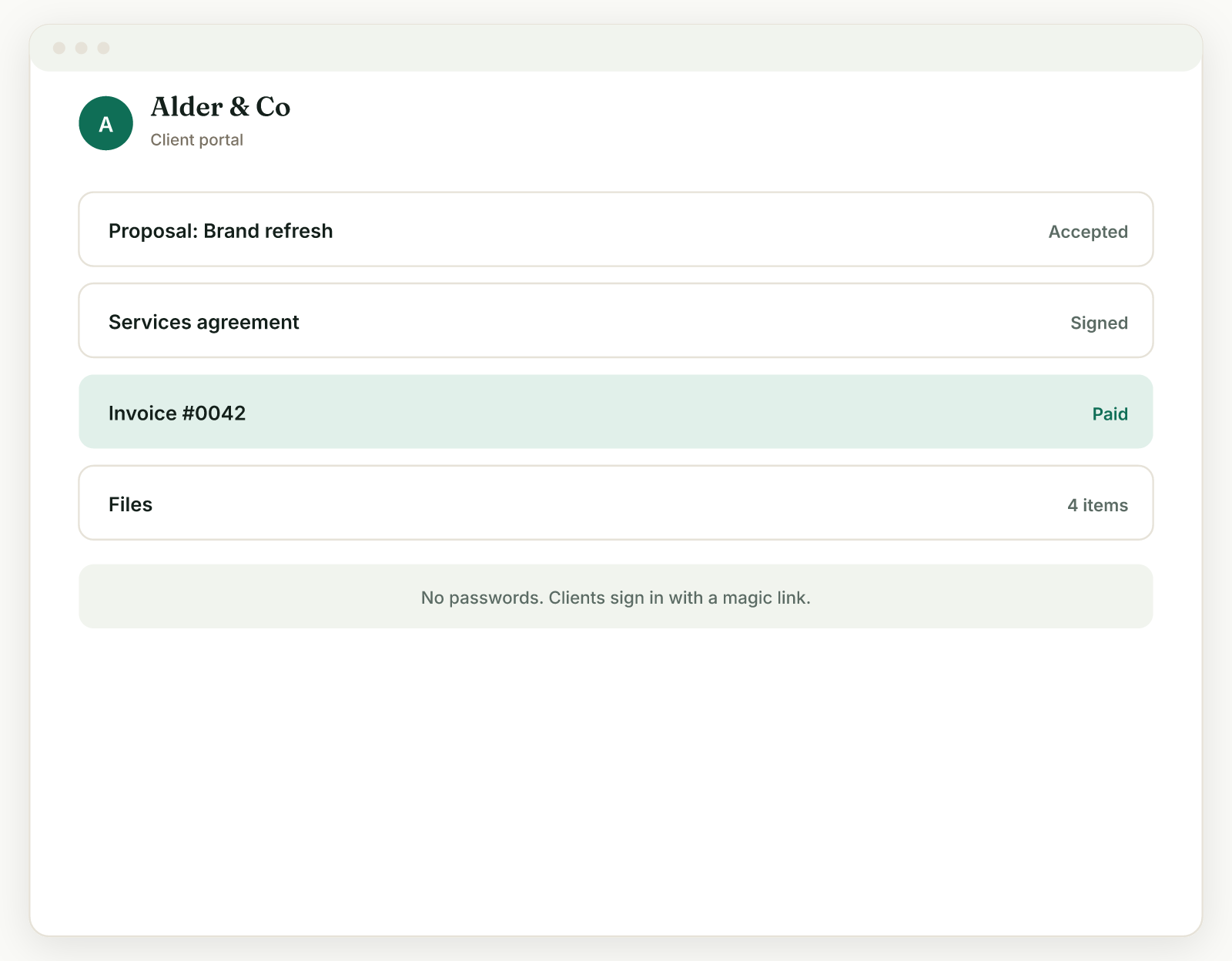
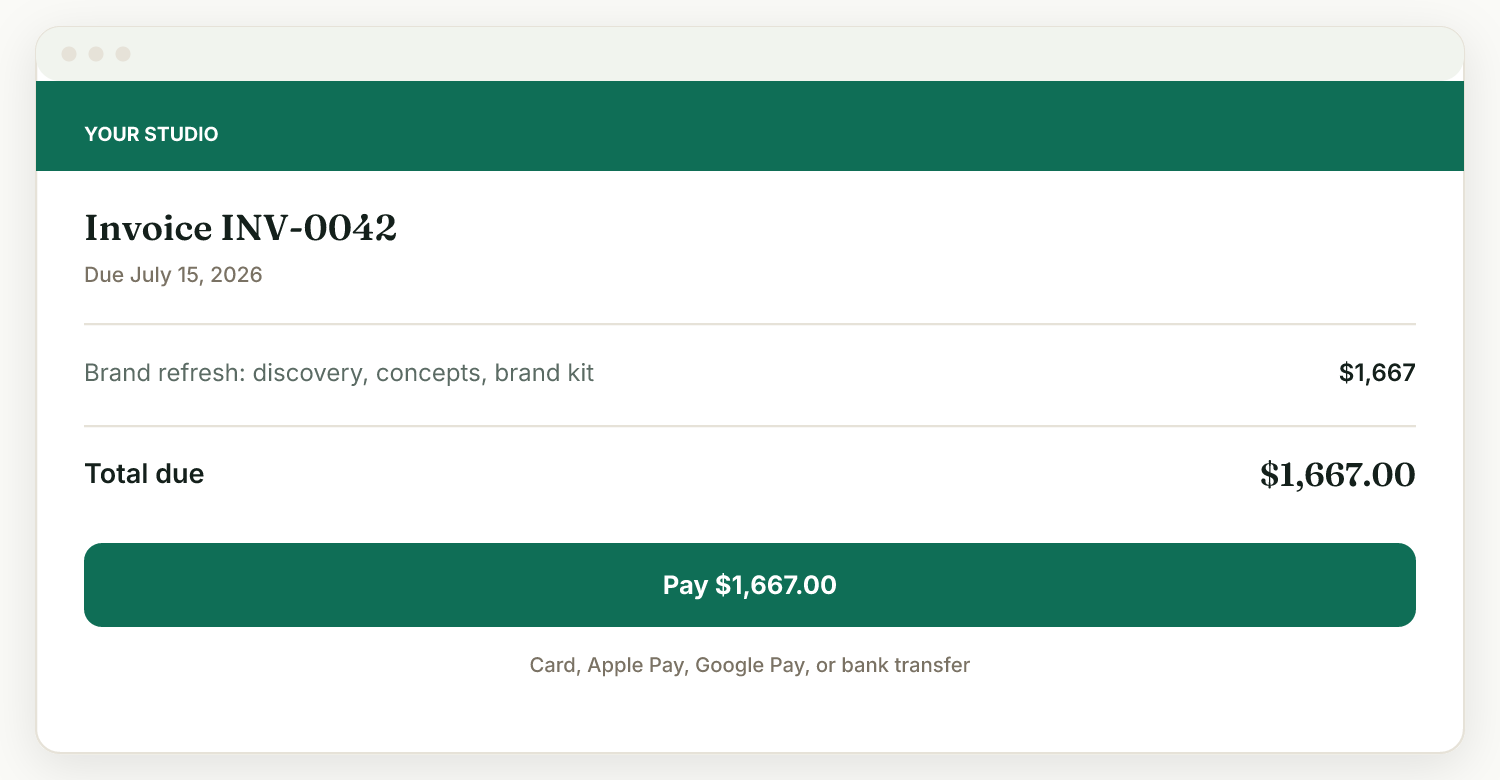
The point of the table is not that HubSpot is overpriced. At list price, one HubSpot Starter seat costs about the same as Moxie or Raoura. The point is what the money buys: on HubSpot, $20 removes a logo from a contact list; on a freelancer platform, $10 to $29 runs your actual client workflow end to end.
Frequently asked questions
Is HubSpot's free CRM really free forever?
Yes. There is no trial period and no credit card requirement, and HubSpot's pricing FAQ says free access has no time limit. The limits are the product: 2 users, 1,000 contacts, 2,000 branded email sends a month, and no online payment collection. You pay with constraints, not dollars.
What is the contact limit on HubSpot Free in 2026?
1,000 contacts, per HubSpot's own pricing page FAQ. Many articles still claim one million; that reflects an older version of the free tier. When you hit 1,000 you must upgrade or delete contacts to add new ones.
Can I send invoices with HubSpot Free?
You can create invoices and manually record payments on any plan, including free. But accepting online payment requires HubSpot payments, which needs a paid plan and a US, UK, or Canada business, or Stripe processing through HubSpot, which adds a 0.75% HubSpot platform fee on top of Stripe's rate.
What is the difference between HubSpot Free and Starter?
Starter costs $20 per seat per month at list price (promoted at $7 per seat for new customers in July 2026) and mainly buys branding removal across email, forms, chat, scheduling, and pages, plus higher automation limits, 1,000 marketing contacts, and email support. Proposals, e-signatures, and a client-facing portal are still not included.
Is HubSpot or a freelancer platform better for a solo freelancer?
If your bottleneck is marketing (building a list, sending newsletters, capturing leads), HubSpot Free is a strong free option. If your bottleneck is operations (getting proposals signed, invoices paid, and clients informed), a freelancer platform in the $10 to $29 per month range does on day one what HubSpot only does across multiple paid hubs. Many freelancers reasonably run a newsletter tool and a client platform side by side.
How much does it cost to upgrade from HubSpot Free to Professional?
Sales Hub Professional costs $90 per seat per month on annual billing ($100 on monthly billing) plus a required one-time $1,500 onboarding fee, about $2,580 for one seat in year one. Marketing Hub Professional is $890 per month plus $3,000 onboarding.
All prices, limits, and claims verified July 2026 against the linked primary sources, principally HubSpot's pricing pages and its Product and Services Catalog at legal.hubspot.com.
Run your client work in one place
Send a proposal, get it signed, invoice, and get paid, with a branded portal your clients will actually use. One flat plan at $17/month, and we never take a cut of your payments.
Try Raoura free for 14 daysNo credit card required. Set up in minutes.
Keep reading
The Best Client Portal Software for Freelancers in 2026: 10 Tools Audited, No Vendor Spin
Every page ranking for this query is a vendor putting itself at #1, and three of them still recommend a product that changed its name ten months ago. We audited 10 client portals against the six things that matter for a business of one: verified pricing, portal tier gates, client caps, white label, login friction, and payment fees.
7 Bonsai Alternatives Now That Bonsai Belongs to Zoom (2026)
Zoom acquired Bonsai in late 2025, Bonsai's blog has been quiet since March 2025, and the product is drifting toward agencies. Here are 7 alternatives for solo freelancers, with verified pricing and the fee math Bonsai does not lead with.
7 Dubsado Alternatives That Do Not Need a $2,000 Setup Specialist (2026)
Dubsado's power comes with a catch: new pricing of $35 to $55 per month, and a setup so involved that certified specialists charge $2,000 to $3,500 to do it for you. Here are 7 alternatives you can set up in an afternoon.